

Key Takeaways
- Sleep cycles through distinct stages, each with a specific biological function.
- The brain consolidates memories and clears metabolic waste primarily during sleep.
- Growth hormone release and tissue repair are concentrated in slow-wave (deep) sleep.
- The immune system produces cytokines during sleep that support infection defense.
- Consistently short sleep disrupts these processes in ways a single recovery night cannot fully reverse.
- Total sleep duration and sleep quality both affect how well nightly restoration occurs.
Sleep stages and body processes
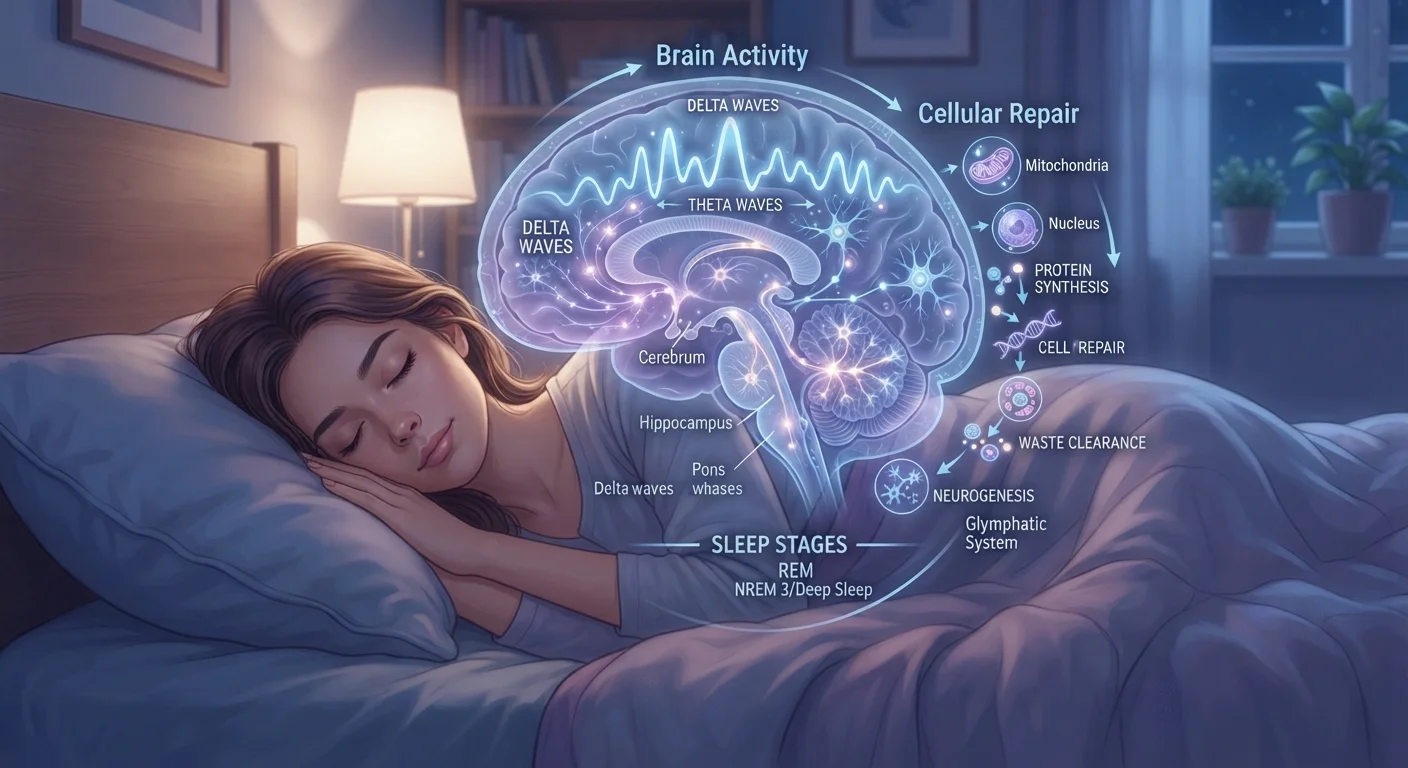
Sleep is not a single uniform state. Each night, the body cycles through distinct stages, including light sleep, deep slow-wave sleep, and REM (rapid eye movement) sleep. Each stage drives different repair and restoration processes in the brain and body. Skipping or cutting these cycles short has measurable biological consequences.
A full sleep cycle lasts roughly 90 minutes, and adults typically complete four to six cycles per night. The proportion of deep sleep is higher early in the night, while REM sleep dominates later cycles.
The architecture of a sleep night
Sleep follows a predictable structure called sleep architecture. Each cycle moves through three stages of non-REM sleep, ranging from light to deep, and then into REM sleep before starting again. Slow-wave sleep (stages N2 and N3) concentrates in the first half of the night. REM periods grow longer as the night progresses, which means cutting sleep short disproportionately reduces REM.
This structure matters because each stage performs different work. Light non-REM sleep acts as a transition zone. Deep slow-wave sleep (N3) is when the most physically restorative activity occurs. REM sleep is when the brain is most cognitively active despite the body being largely still.
Common sleep myths often treat all sleep hours as interchangeable, but the timing within the night affects which stages you accumulate most.
What the brain does overnight
Memory consolidation is one of the most well-documented functions of sleep. During slow-wave sleep, the hippocampus replays recently learned information and transfers it to the cortex for long-term storage. REM sleep then appears to integrate that information with existing knowledge and supports emotional processing.
The brain also runs a waste-clearance process during sleep. The glymphatic system, a network of fluid channels around brain cells, becomes significantly more active during non-REM sleep. Cerebrospinal fluid flushes through brain tissue, clearing metabolic byproducts that accumulate during waking hours. Research published in journals such as Science has shown this system is far less active when awake.
Dreaming and emotional regulation
REM sleep is when most vivid dreaming occurs. The brain's emotional processing centers are highly active during this stage, which researchers link to overnight emotional regulation and the processing of stressful experiences. Consistently reduced REM sleep is associated with greater emotional reactivity the following day.
REM sleep is also when most vivid dreaming occurs. The brain's emotional centers are highly active during REM, which researchers link to overnight emotional regulation and the processing of stressful experiences.
Physical repair and hormone release
The pituitary gland releases the majority of its daily growth hormone output during slow-wave sleep. Growth hormone signals cells to take up amino acids, build proteins, and repair damaged tissue. This is why sleep is not optional recovery for anyone under physical stress, including after exercise.
For a closer look at how this connects to exercise recovery, see our article on muscle recovery after hard workouts.
Cortisol, a stress hormone, follows its own rhythm overnight. Levels stay relatively low during the first half of sleep and rise toward morning, preparing the body to wake. Disrupted sleep can shift this pattern, leaving cortisol elevated at times when it should be suppressed.
Metabolism also adjusts during sleep. Insulin sensitivity and glucose regulation are tied to sleep quality, and research consistently links shortened or fragmented sleep to changes in these markers over time.
Immune function and overnight defense
The immune system uses sleep actively. During deep sleep, the body produces cytokines, proteins that coordinate immune responses. Some cytokines promote sleep, and some support the body's ability to respond to infection or inflammation. Production of certain immune cells also increases overnight.
This connection explains why sleep deprivation is associated with higher susceptibility to illness and slower recovery. Our related article on sleep and immune function examines this relationship in more depth.
The scale of overnight immune activity depends on both sleep duration and sleep continuity. Fragmented sleep, even when total hours seem adequate, reduces the body's ability to complete these cycles fully.
This article is for general informational purposes only and is not medical advice. Speak with a qualified healthcare professional about any concerns related to sleep, health conditions, or symptoms.