

Key Takeaways
- Your electrical panel distributes power from the utility line to individual circuits throughout your home.
- A tripped breaker sits in the middle position; resetting it is usually safe for a homeowner to do.
- Burning smells, buzzing sounds, discolored breakers, or repeated trips on the same circuit all require a licensed electrician.
- Work inside the panel beyond resetting breakers is regulated work that generally requires permits and a licensed professional.
- Labeling every breaker accurately is one of the most practical maintenance tasks a homeowner can do.
Start here
What your electrical panel actually does
Next
How to read your panel
Then
Resetting a tripped breaker
Important
Warning signs that need a licensed electrician
Wrap up
What is and is not a DIY task
What your electrical panel actually does
The electrical panel (also called the breaker box or load center) is the distribution point between the utility power line coming into your home and every individual circuit inside it. Utility power arrives at the panel through thick service wires and passes through the main breaker before splitting into smaller circuits, each protected by its own breaker.
Each circuit breaker connects to a specific set of outlets, lights, or appliances in one area of the home. When current on that circuit stays within the breaker's rating, power flows normally. When current exceeds the rating, the breaker trips, cutting power automatically before wiring can overheat.
Panels are rated by total amperage, most commonly 100 amps or 200 amps for residential use. The panel's capacity determines how many circuits it can support and how much total load the home can draw at once. If you want to understand how electrical findings appear in a professional inspection, reading your home inspection report is a practical next step.
Circuit breaker
A resettable switch that automatically cuts power to one circuit when current exceeds a safe level, protecting wiring from overheating.
Main breaker
The largest breaker in the panel, usually at the top, that controls power to the entire panel. Turning it off cuts power to all circuits but does not de-energize the utility lines feeding into the panel.
Amperage (amps)
A measure of how much electrical current flows through a wire. Each breaker is rated for a maximum amperage; exceeding it causes the breaker to trip.
AFCI / GFCI breaker
Specialized breakers that add protection beyond a standard breaker. GFCI (ground fault circuit interrupter) breakers protect against shock near water; AFCI (arc fault circuit interrupter) breakers protect against electrical arcs that can start fires.
Service capacity
The total amount of electrical power a home's wiring and panel can handle at once, measured in amps. Common residential service capacities are 100 amps and 200 amps.
How to read your panel
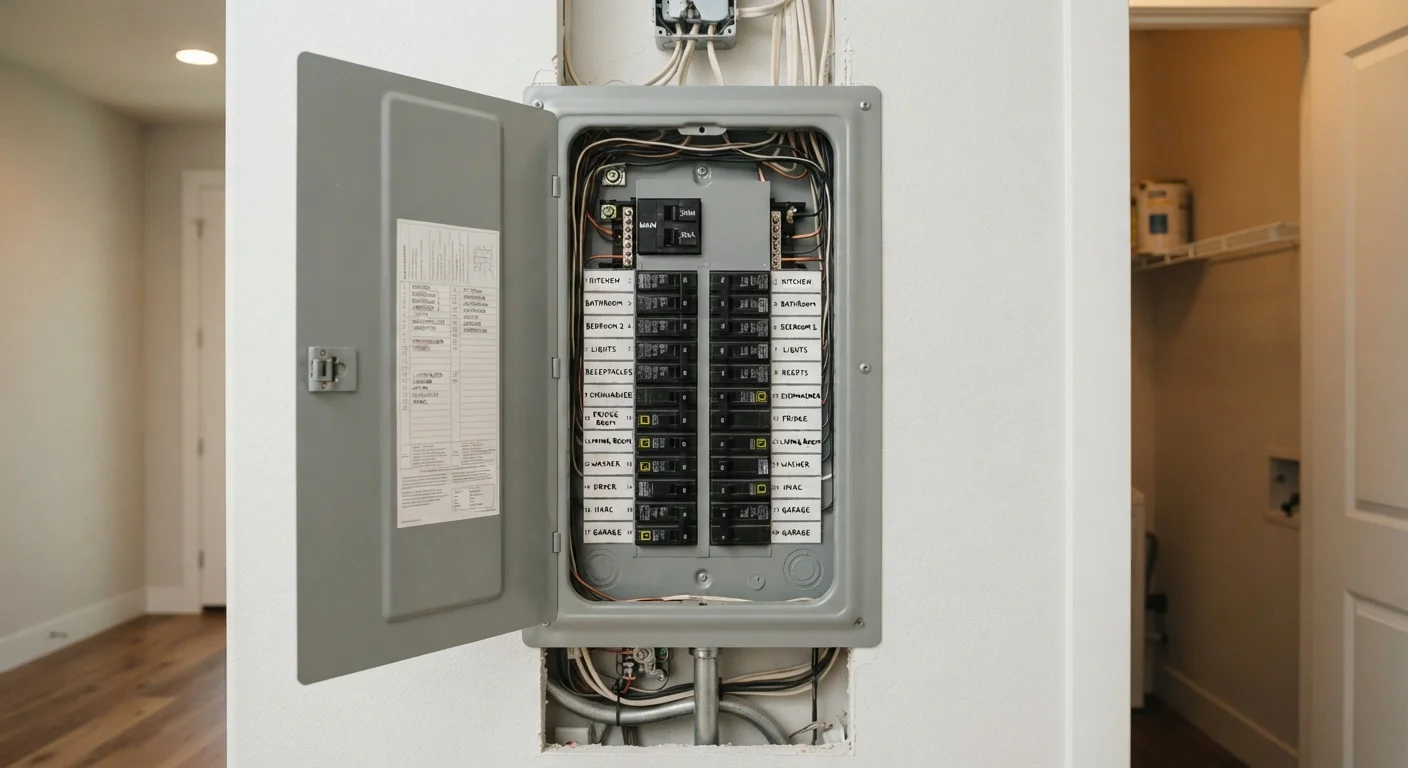
Open the panel door and you will see two columns of breakers flanking a central bus bar. Each breaker should have a label on the directory card inside the door or written directly on the panel. Common labels include "Kitchen outlets," "Master bedroom," "HVAC," and "Water heater."
If your panel is unlabeled or the labels are inaccurate, mapping it is a worthwhile task. Turn on a lamp in one room, then flip breakers off one at a time until the lamp goes out. Write the circuit down, restore the breaker, and move to the next room. This takes time but gives you reliable information when something trips.
Each breaker shows its amperage rating on the handle: 15 or 20 amps for most household circuits, 30 or 50 amps for large appliances like dryers or ranges. Double-pole breakers (two handles joined together) supply 240-volt circuits for those heavy loads.
Resetting a tripped breaker
A tripped breaker sits between ON and OFF rather than firmly at either position. Some models show a small red or orange indicator window when tripped. Before resetting, unplug or turn off the appliances on that circuit to reduce the load. Then:
- Push the breaker firmly to the full OFF position. You should feel a click.
- Wait a few seconds.
- Push the breaker firmly to ON. Another click confirms it has latched.
If the breaker holds, plug appliances back in gradually to avoid immediately overloading the circuit again. If it trips again right away, the circuit has a fault or is consistently overloaded, and a licensed electrician should inspect it. Resetting the same breaker repeatedly without investigating the cause can mask a hazard.
Warning signs that need a licensed electrician
Some observations at the panel are beyond what a homeowner should try to address. Contact a licensed electrician if you notice any of the following:
- A burning smell or the odor of melting plastic near the panel
- Scorch marks, discoloration, or rust on breaker handles or the panel interior
- A buzzing, crackling, or humming sound from inside the panel
- A breaker that will not stay in the ON position even with nothing connected to that circuit
- Warm or hot areas on the panel door or surrounding wall
- Frequent tripping across multiple circuits, which can indicate a problem with the service itself
These signs can point to loose connections, failing breakers, or more serious wiring problems. None of them are situations where waiting is advisable. If you are buying a home and the inspection flagged the panel, understanding how to interpret those findings helps you prioritize next steps.
Never open the panel cover yourself
The panel cover (the metal plate behind the breaker door) shields live bus bars and service wires that stay energized even when the main breaker is off. Removing this cover is work for a licensed electrician only. If you see damage or smell burning at the panel, do not open it: call a licensed electrician and, if there is any risk of fire, your local fire department.
What is and is not a DIY task
Resetting a tripped breaker and labeling your circuits are both appropriate homeowner tasks. So is turning off a specific circuit before doing work on an outlet or light fixture downstream of it.
Work that goes beyond those actions belongs to a licensed electrician. This includes adding or replacing breakers, upgrading panel capacity, adding a subpanel, or troubleshooting repeated faults. The interior of a panel contains live bus bars that remain energized even with the main breaker off, because the utility service wires feed directly into the top of the panel. Contact with those conductors is a lethal hazard.
Most electrical work inside a panel also requires a permit and inspection under US building codes. The rules vary by municipality, but unpermitted work can create complications with home insurance and resale. A licensed electrician will know which permits apply in your area. For a broader look at where the DIY line falls in home systems, understanding when to call a professional covers that decision-making framework across maintenance contexts.