

| Engine air filter replacement interval | Every 15,000 to 30,000 miles (varies by driving conditions) (General industry guidance; check your owner's manual) |
| Cabin air filter replacement interval | Every 15,000 to 25,000 miles or roughly once a year (General industry guidance; check your owner's manual) |
| Fuel filter replacement interval | Every 30,000 miles on older vehicles; many newer vehicles have in-tank filters with no scheduled replacement (Varies widely by make, model, and year) |
| Most common DIY filter | Engine air filter (typically tool-free on most vehicles) |
| Filter most often overlooked | Cabin air filter |
What filters actually do in your vehicle
Every vehicle that burns fuel needs clean air, clean fuel, and (for the people inside) clean interior air. Filters handle all three jobs. When one becomes clogged or degraded, the system it protects starts working harder, sometimes visibly, sometimes in ways you only notice at the repair shop.
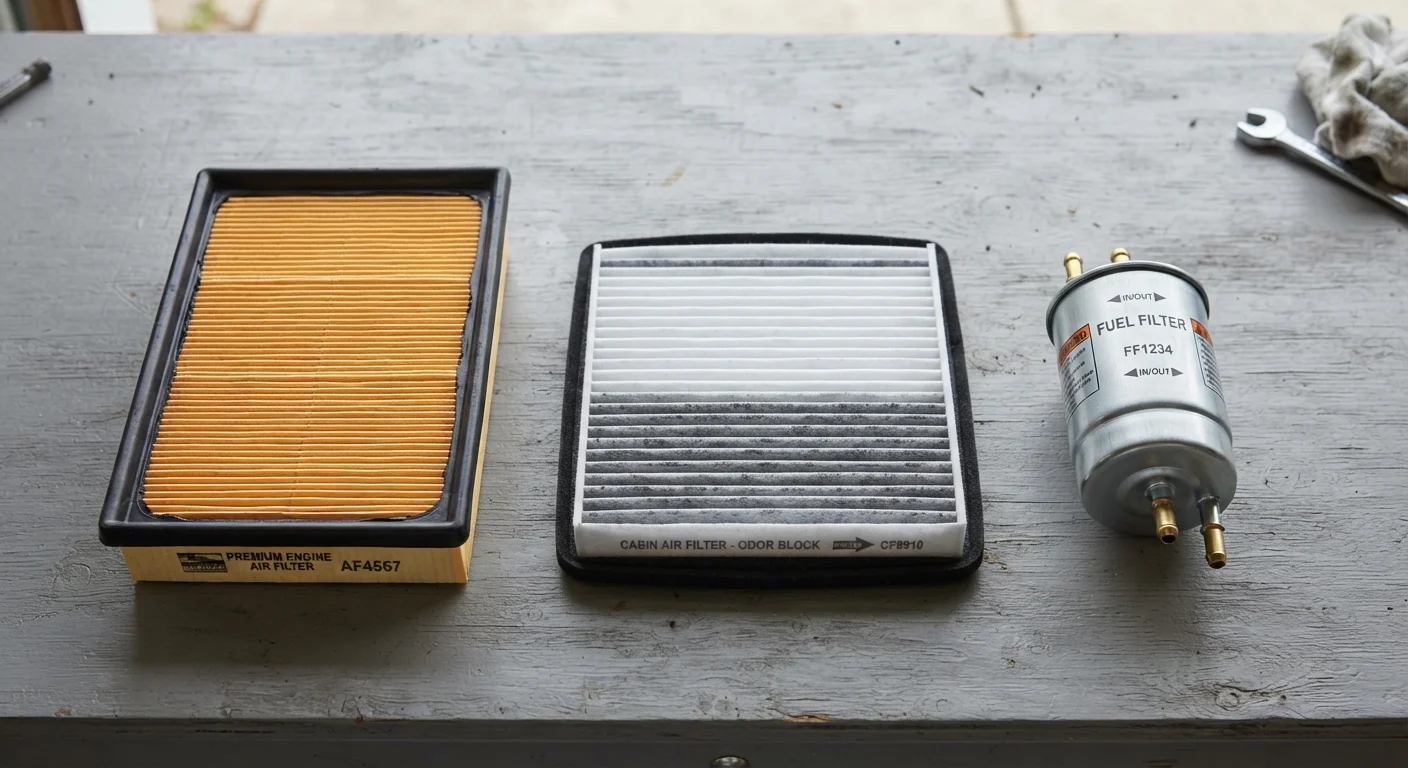
There are three filters most drivers encounter during routine maintenance: the engine air filter, the cabin air filter, and the fuel filter. They sit in different locations, serve different purposes, and follow different replacement schedules. Understanding each one takes the mystery out of service reminders and helps you have an informed conversation with a mechanic.
| Engine air filter replacement interval | Every 15,000 to 30,000 miles (varies by driving conditions) (General industry guidance; check your owner's manual) |
| Cabin air filter replacement interval | Every 15,000 to 25,000 miles or roughly once a year (General industry guidance; check your owner's manual) |
| Fuel filter replacement interval | Every 30,000 miles on older vehicles; many newer vehicles have in-tank filters with no scheduled replacement (Varies widely by make, model, and year) |
| Most common DIY filter | Engine air filter (typically tool-free on most vehicles) |
| Filter most often overlooked | Cabin air filter |
Engine air filter
The engine needs a precise ratio of air and fuel to combust properly. Before that air reaches the intake manifold, the engine air filter catches dust, pollen, insects, and fine debris. On most passenger vehicles, the filter is a pleated paper or synthetic element housed in a plastic airbox near the top of the engine bay.
A clean filter allows air to flow freely. As it loads up with debris, airflow restriction increases. The engine compensates by working harder, which can reduce fuel efficiency. A severely clogged filter may also trigger the check engine light by disrupting readings from the mass airflow sensor (MAF), a sensor that measures incoming air volume to calibrate fuel delivery.
Replacement intervals typically fall between 15,000 and 30,000 miles, though driving on unpaved roads or in dusty conditions calls for more frequent checks. The engine air filter is one of the more accessible components on most vehicles; many drivers replace it without tools by releasing the clips on the airbox. If you are unsure about the procedure for your specific vehicle, a mechanic can inspect and swap it during any routine service visit.
For a broader look at how routine upkeep connects across your vehicle, see Car Fluids Decoded, which covers the fluid systems that work alongside your filters.
Cabin air filter
The cabin air filter cleans air before it passes through the vehicle's HVAC system into the passenger compartment. It catches pollen, dust, soot, and in some designs, odor-causing particles. Most filters are a flat, pleated panel tucked behind the glove box or under the dashboard, though placement varies by vehicle.
A clogged cabin air filter shows up in a few ways: reduced airflow from the vents even at high blower speeds, musty odors when running heat or air conditioning, and increased blower motor noise as the system strains against restricted flow. People with allergies or asthma may notice interior air quality declines before any mechanical symptom appears.
Replacement intervals generally run from 15,000 to 25,000 miles, or roughly once a year for typical driving. The cabin air filter is the most commonly overlooked filter at service time, partly because it has no direct effect on engine performance and symptoms accumulate gradually.
When in doubt, check your owner's manual
Replacement intervals in this article are general guidelines drawn from common industry practice. Your vehicle's manufacturer sets the definitive schedule in the owner's manual. Driving in dusty regions, stop-and-go traffic, or extreme temperatures can shorten filter life compared to the published interval.
Drivers managing vehicles with high mileage should treat cabin filter checks as a regular part of their routine. The high-mileage vehicle maintenance guide covers which inspections become more pressing as miles accumulate.
Fuel filter
Fuel arriving from the tank or fuel pump carries trace contaminants: rust flakes from the tank walls, fine sediment, and microscopic debris. The fuel filter screens these out before fuel reaches the injectors (or carburetor on older vehicles). Blocked injectors are expensive to repair; a functioning fuel filter reduces that risk.
On older vehicles, the fuel filter is typically an in-line canister mounted along the fuel line in the engine bay or beneath the vehicle. Many vehicles built over the past two decades house the filter inside the fuel tank as part of the fuel pump module, with no scheduled replacement interval under normal conditions.
Symptoms of a failing external fuel filter can include hard starting, rough idling, hesitation under acceleration, or stalling. Because these symptoms overlap with several other issues, a mechanic should diagnose the cause before any part is replaced. If your vehicle has a serviceable external filter, the owner's manual will list the replacement interval, commonly around 30,000 miles, though this varies.
Fuel system work that involves disconnecting fuel lines carries a fire risk and requires proper precautions. Unless you have specific experience with fuel system repairs, this job is better left to a qualified mechanic.
For context on related engine components, Spark Plugs and Engine Performance explains another routine replacement that affects how cleanly and efficiently your engine runs.