

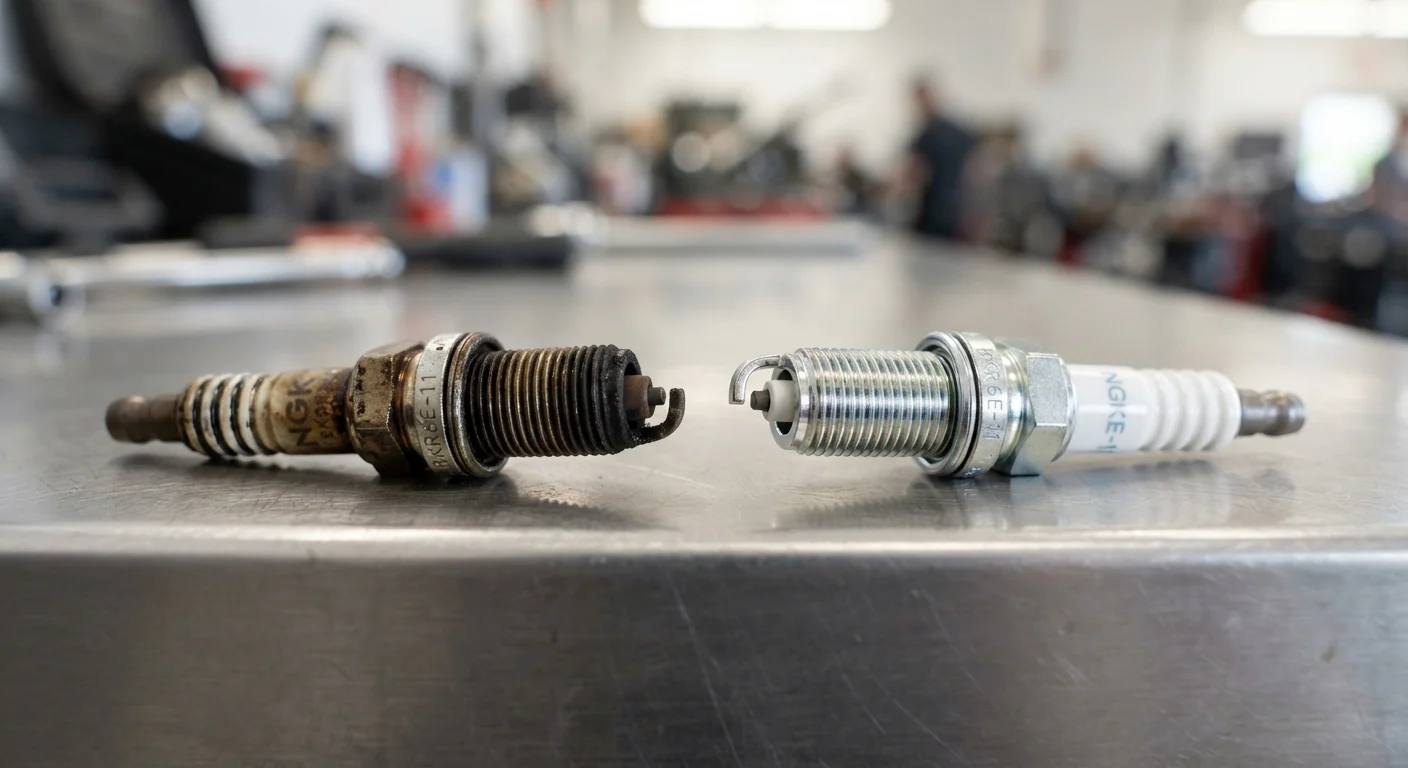
Key Takeaways
- Spark plugs fire millions of times over their service life, and the electrodes gradually erode with use.
- Misfires, rough idling, and reduced fuel economy are common signs of worn spark plugs.
- Most conventional copper plugs are replaced every 30,000 miles; iridium and platinum types can last up to 100,000 miles.
- Replacing spark plugs is time-sensitive: delaying can cause damage to ignition coils and catalytic converters.
- A qualified mechanic should handle spark plug replacement on engines with difficult access or direct-injection systems.
Spark plug
A spark plug is a small electrical component that ignites the air-fuel mixture inside each engine cylinder. It receives high-voltage current from the ignition coil and produces a timed spark across a small gap. That spark starts the combustion that drives the piston and, ultimately, the wheels.
The gap between the center electrode and the ground electrode is measured in thousandths of an inch. The correct gap varies by engine and affects combustion efficiency directly.
What a spark plug actually does
Every gasoline engine depends on a precisely timed explosion inside each cylinder. The spark plug creates that explosion by generating a high-voltage arc across a small gap between two electrodes. That arc ignites the compressed air-fuel mixture, forcing the piston down and turning the crankshaft.
The ignition system controls the timing of each spark to within milliseconds. At highway speeds, a four-cylinder engine fires its spark plugs roughly 50 times per second per cylinder. Over 30,000 miles, that adds up to hundreds of millions of firings per plug. The electrodes erode with every spark, and as the gap widens, the ignition system has to work harder to jump it.
Because spark plugs sit directly inside the combustion chamber, they also act as a window into engine health. A mechanic reading a removed plug can tell whether the engine is running too lean, too rich, or at normal combustion temperature based on deposits and electrode color alone. That diagnostic use is one reason a visual inspection during routine maintenance is worth doing.
Signs that spark plugs are wearing out
Wear rarely announces itself with a loud failure. Instead, symptoms appear gradually and are easy to dismiss as minor quirks.
- Rough idle: the engine shakes or stumbles at a stop because one or more cylinders are misfiring intermittently.
- Slow acceleration: hesitation when pressing the gas pedal, particularly at lower RPMs, suggests incomplete combustion.
- Declining fuel economy: a misfiring cylinder wastes fuel. If your fill-up frequency increases without a change in driving habits, ignition wear is one cause to check.
- A check-engine light with a misfire code (P0300 through P0308 in most vehicles): this is the most direct signal. The engine control module logs misfire events and triggers the light once they exceed a threshold.
Cold mornings tend to make these symptoms more obvious. The conditions during a cold start place extra demand on the ignition system, and a borderline plug that fires adequately at operating temperature may misfire when cold.
Pull a plug at your next oil change
Asking a mechanic to remove and inspect one spark plug during a routine oil change costs little extra time and gives a direct read on electrode condition and combustion health. If the plug shows heavy deposits or a visibly eroded electrode, you have concrete information rather than a guess about service timing.
Replacement intervals and plug types
Owner's manuals specify replacement intervals, and those intervals differ by plug material. Conventional copper-core plugs are typically replaced every 30,000 miles. Platinum plugs are commonly rated for 60,000 miles, and iridium plugs for up to 100,000 miles. These numbers assume normal driving; short-trip driving, towing, or a heavily carbon-prone engine may shorten them.
The owner's manual also specifies the correct plug type for the engine. Installing a plug with the wrong heat range or electrode material can cause pre-ignition or accelerated wear, so matching the specification matters. The right plug is not always the longest-lasting one; it is the one engineered for that combustion chamber's thermal requirements.
Replacing plugs as a set, even if only one is visibly worn, makes sense because all plugs in the engine age at roughly the same rate. Replacing one and leaving others at 80,000 miles means another service interval shortly after.
A healthy ignition system also depends on other components. Battery condition affects the voltage available to the ignition coil. A weak battery can reduce the coil's output, making a borderline plug misfire when a strong battery would fire it reliably. Similarly, a clogged fuel or air filter can skew the air-fuel mixture and accelerate carbon buildup on the electrodes.
When to call a mechanic
On many four-cylinder engines with accessible spark plug wells, replacement is within reach for a careful DIYer. The main risks are cross-threading the plug into the aluminum cylinder head and, on engines with long plugs, breaking a plug that has been heat-seized for years. Both outcomes are more expensive to fix than the original service.
On transversely mounted V6 engines, the rear bank of cylinders is often blocked by the firewall. On turbocharged engines, heat shields and intercooler plumbing add complexity. Direct-injection engines sometimes require removing intake manifolds for access. In these cases, a qualified mechanic with the right tools is the practical choice.
If a check-engine light is on and you are unsure of the cause, a diagnostic scan before any parts purchase is the logical starting point. A misfire code narrows the cause but does not always mean the plug is at fault; a failed ignition coil, a cracked wire, or a fuel injector problem can produce the same code. Replacing plugs without confirming the diagnosis wastes time and money.