

Key Takeaways
- Prolonged sitting tightens the hip flexors, weakens the glutes, and strains the upper back and neck.
- Short movement breaks spread through the day are more effective than one long session after hours of sitting.
- This routine requires no equipment and can be done in a small office or living space.
- Consistency matters more than duration: a few minutes done daily beats an occasional longer session.
- People with existing injuries or chronic conditions should consult a healthcare professional before starting.
What you will need
Why desk work creates specific movement problems
Sitting holds the body in a fixed position for hours, and the same muscle groups bear the load every time. The hip flexors remain shortened. The glutes go largely unused. The thoracic spine rounds forward. The neck protrudes toward the screen. Over time, these patterns affect posture, contribute to musculoskeletal discomfort, and can make everyday movement feel harder.
The good news is that the body responds well to targeted, consistent movement. You do not need a gym or a long workout window. Brief, deliberate breaks that address the areas most affected by sitting are enough to make a meaningful difference. Active daily living and formal exercise serve different functions, and this routine sits in the former category: accessible, repeatable, and woven into your workday.
The routine below covers the main areas affected by desk work: the neck and upper back, chest and shoulders, hip flexors, glutes, lower back, and lower legs. Plan to do it once or twice during your workday, ideally as a 10- to 15-minute break.
What you will need
The routine
Work through each step in order. The sequence moves from the upper body downward, which lets each section of the body warm up before the next. You can do all steps together or split them across two breaks.
Chin tucks and neck rolls (2 minutes)
Sit or stand tall. Draw your chin straight back, as though making a gentle double-chin, and hold for 3 seconds. Release. Repeat 8 to 10 times. This counters the forward-head position that screen time creates.
Follow with slow neck rolls: drop your right ear toward your right shoulder, roll your chin down to your chest, and bring your left ear toward your left shoulder. Go slowly and stop if you feel any sharp sensation. Two passes in each direction is enough.
Thoracic extension over a chair back (1 minute)
Sit at the edge of a firm chair. Place your hands behind your head, elbows wide. Lean back gently over the top edge of the chair back so your mid-spine extends over it. Hold 3 to 5 seconds, return to upright. Do 6 repetitions.
This move targets the thoracic spine (the mid-back), which loses its natural curve after hours of hunching forward over a keyboard.
Standing hip flexor stretch (2 minutes)
Stand behind your chair and hold the back for light support. Step your right foot back into a half-lunge. Lower your right knee toward the floor (or stop short of the floor if preferred). Keep your torso upright and gently press your right hip forward until you feel a stretch in the front of the right hip. Hold 20 to 30 seconds. Switch sides. Repeat twice per side.
Hip flexors shorten when you sit for long periods, which can pull on the lower back. This stretch addresses that pattern directly.
Glute bridges (2 minutes)
Lie on your back with knees bent and feet flat on the floor, hip-width apart. Press through your heels and lift your hips until your body forms a straight line from shoulders to knees. Squeeze the glutes at the top for 2 seconds, then lower slowly. Do 12 to 15 repetitions.
Sitting switches off the glutes, and weak glutes are linked to lower back pain. Glute bridges are one of the most efficient ways to re-activate them without any equipment. See more no-equipment moves if you want to build on this.
Wall chest opener (1 minute)
Stand facing a doorframe or the edge of a wall. Place your right forearm vertically along the frame at shoulder height, elbow bent to 90 degrees. Step your right foot forward and rotate your torso gently to the left until you feel a stretch across your chest and front shoulder. Hold 20 seconds. Switch sides.
This counteracts the rounded-shoulder posture that follows prolonged keyboard and mouse use.
Calf raises and ankle circles (2 minutes)
Stand behind your chair. Rise onto the balls of both feet, hold 2 seconds, lower slowly. Do 15 repetitions. Then lift one foot slightly off the floor and draw slow circles with your ankle, 8 in each direction. Switch feet.
Prolonged sitting reduces circulation in the lower legs. Calf raises and ankle mobility work both address this. Countering the effects of sitting through movement like this can also support healthy circulation over the long term.
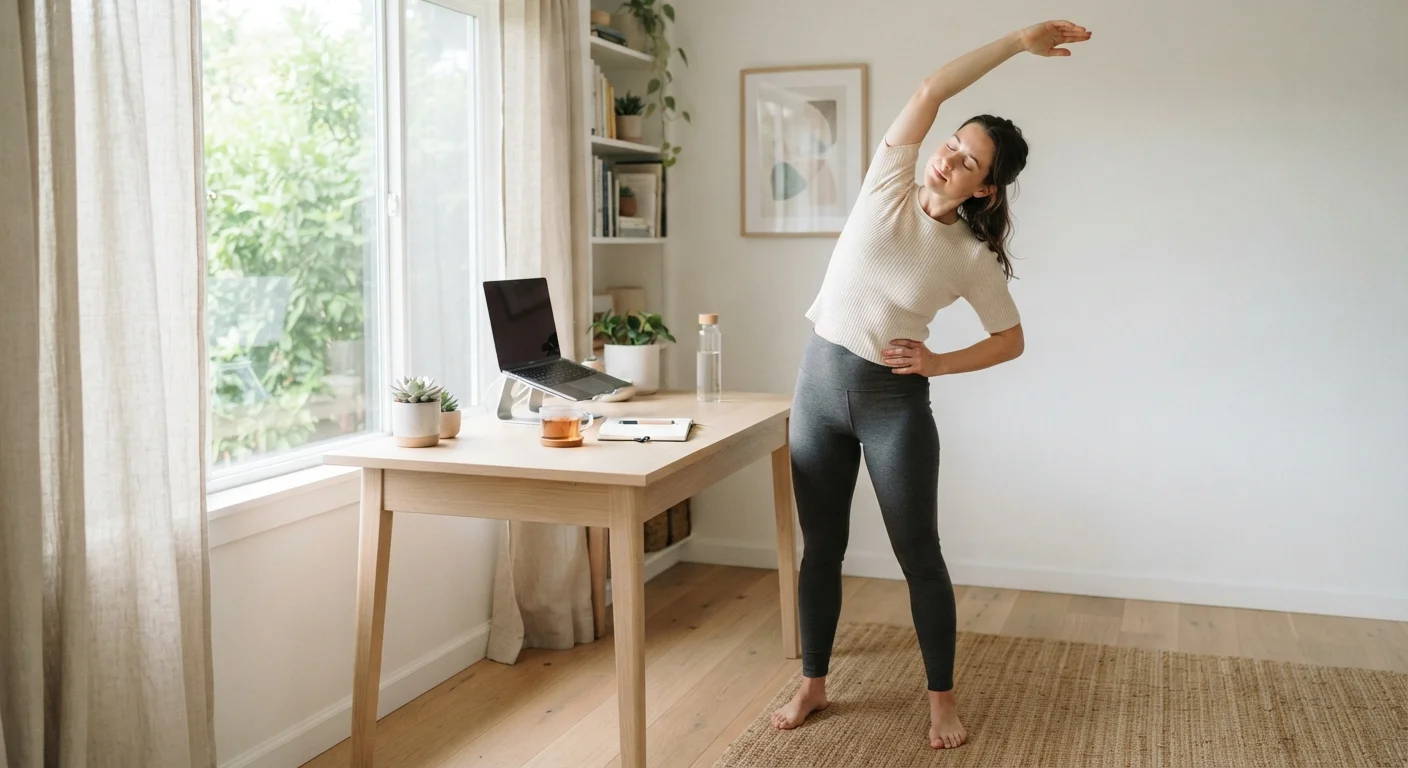
Standing side bend and reach (1 minute)
Stand with feet hip-width apart. Reach your right arm overhead and lean your torso to the left, reaching the right arm further over as you go. Hold 15 seconds, return to center, and repeat on the other side. Two passes per side.
This stretches the lateral trunk muscles and the quadratus lumborum (a deep lower back muscle that tightens with prolonged sitting).
Make breaks a habit, not an afterthought
Setting a recurring alarm every 45 to 60 minutes is more reliable than relying on memory. Even standing and walking to get water counts. Fitting movement into a packed schedule covers practical ways to build this kind of habit without restructuring your entire day.
This article is for general informational purposes only and is not medical advice. If you have an existing injury, chronic condition, or are unsure whether any of these movements are appropriate for you, consult a qualified healthcare professional before starting.