

Key Takeaways
- Most effective bodyweight exercises require only the space of a yoga mat or slightly more.
- Compound moves like squats and push-up variations train multiple muscle groups without any gear.
- Low-impact options such as glute bridges and wall sits protect joints while still building strength.
- Isometric holds and slow tempos increase workout difficulty without increasing space or noise.
- Consistency with a small set of exercises produces meaningful fitness gains over time.
Why small spaces are not a real barrier
A studio apartment, a spare bedroom, or a narrow living room can all support a genuinely effective movement practice. The limiting factor is rarely square footage: it is knowing which exercises work well in a confined area and how to sequence them sensibly.
Most bodyweight exercises need no more floor space than a standard yoga mat (roughly 2 by 6 feet). A few require a little more room to step or lunge, but the list of moves that stay within tight boundaries is long enough to build a full-body routine. For context on how home-based training compares to machine-based gym work, see our bodyweight vs. gym machines overview.
The exercises below are organized so that lower-body, upper-body, and core movements alternate, which helps manage fatigue and keeps you moving without rest periods that stretch too long. If time is the other constraint alongside space, the strategies for fitting movement into a packed schedule article covers realistic ways to make short sessions count.
Bodyweight squats
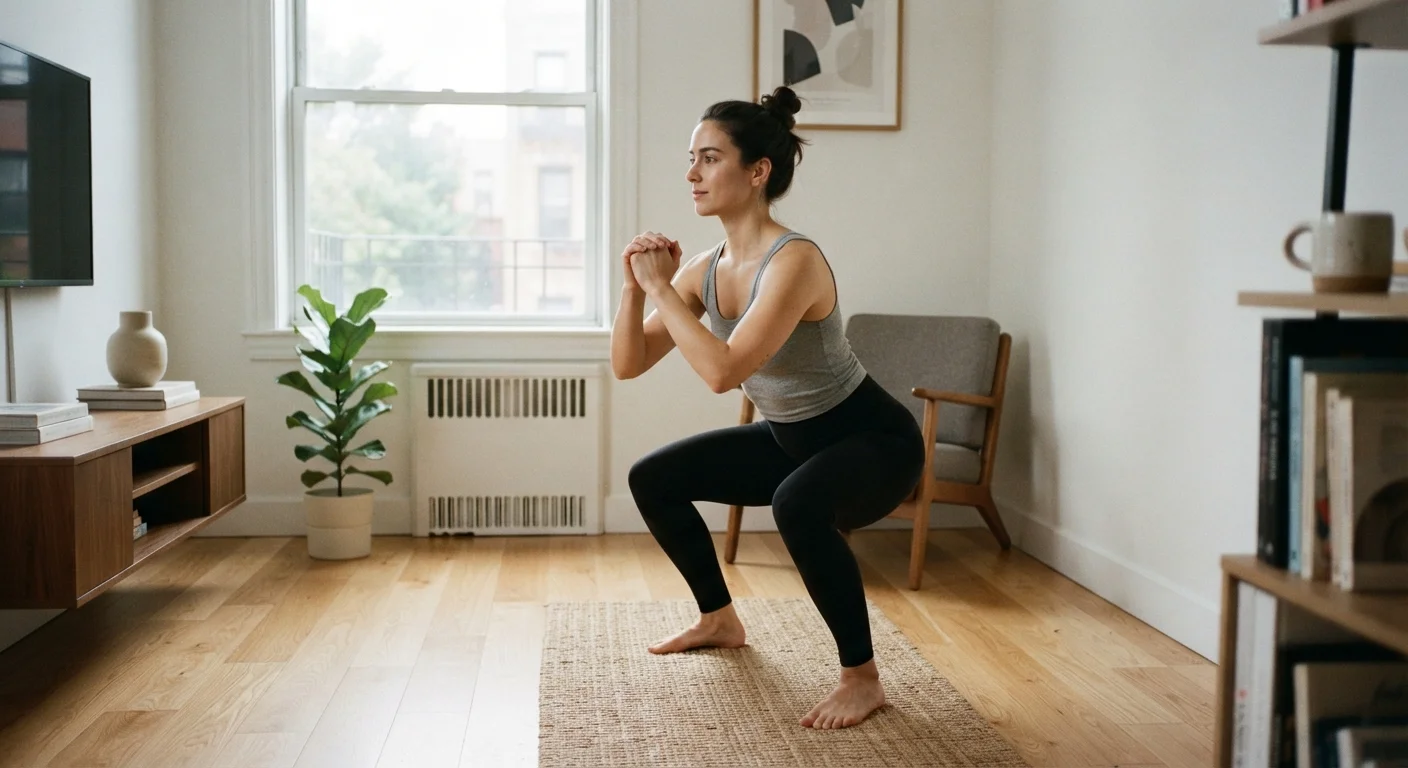
The squat is a fundamental lower-body movement that trains the quadriceps, glutes, and hamstrings. Stand with feet roughly hip-width apart, lower until your thighs are parallel to the floor (or as far as your mobility allows), then press back up through your heels. No furniture is needed, and the footprint is minimal.
Adding a brief pause at the bottom of each rep increases time under tension, which builds strength and endurance without requiring extra space or equipment. Aim for controlled movement throughout rather than using momentum.
A brief pause at the bottom of each squat builds strength without any extra equipment.
Push-up variations
Push-ups train the chest, shoulders, and triceps while also requiring core stability throughout the movement. Standard push-ups demand a floor space about the length of your body. If a full push-up is not yet accessible, an incline variation with hands on a sturdy chair or countertop reduces the load while preserving the movement pattern.
Wide-grip push-ups shift more work to the chest; narrow-grip (hands closer together) increases tricep involvement. Varying grip width across sessions gives you meaningful variety without changing the space requirements at all.
Varying push-up grip width shifts muscle emphasis meaningfully with no extra space needed.
Glute bridges
Lie on your back with knees bent and feet flat on the floor, then press your hips toward the ceiling until your body forms a straight line from shoulders to knees. This move targets the glutes and hamstrings while also activating the lower back stabilizers. It is completely floor-bound and nearly silent, which makes it particularly apartment-friendly.
A single-leg variation (one foot lifted off the floor) increases the challenge substantially. Glute bridges are also one of the better corrective exercises for people who sit for long periods, since prolonged sitting tends to underactivate the posterior chain.
Glute bridges are silent, floor-bound, and counteract the posterior-chain underactivation from sitting.
Reverse lunges
A reverse lunge (stepping back rather than forward) trains each leg independently and improves balance and hip mobility. Stepping backward rather than forward also reduces forward knee shear, which many people find more comfortable. The footprint is roughly one step backward, making it workable in tighter rooms where a full forward stride might feel cramped.
Keep your torso upright and lower your back knee toward the floor without letting it slam down. Alternating legs each rep distributes fatigue evenly and keeps the movement flowing.
Stepping back rather than forward makes lunges joint-friendlier and fits tighter floor space.
Wall sits
A wall sit is an isometric hold: you slide your back down a wall until your thighs are parallel to the floor, then hold that position. It trains the quadriceps, glutes, and calves under sustained tension without any dynamic movement. Because there is no impact and no travel across the floor, it works in spaces too small even for squats.
The challenge scales simply with time. Holding for 30 seconds is a reasonable starting point; building toward 60 to 90 seconds over several weeks produces noticeable improvement in lower-body endurance.
Wall sits produce real lower-body endurance gains with zero floor travel and no impact.
Plank holds and plank variations
A forearm or straight-arm plank trains the entire anterior core, including the transverse abdominis, without any crunching motion. You need only the space your body occupies lying down. A standard plank hold challenges endurance; a plank with alternating shoulder taps adds anti-rotation demand to the same footprint.
For people newer to core training, a plank from the knees reduces load while preserving the muscle engagement pattern. Progressing to a full plank and then adding movement is a straightforward path forward.
Plank shoulder taps add anti-rotation challenge to a core hold with no extra floor space.
Standing hip circles and mobility work
Not every movement session needs to be strength-focused. Standing hip circles, controlled ankle rotations, thoracic (mid-back) rotations, and slow neck rolls address joint mobility and connective tissue health. These moves require almost no space and produce benefits that compound over time, particularly for adults who spend most of their day seated.
Mobility work is often skipped because it does not feel as demanding as strength training. Its effects on range of motion, posture, and injury resilience are well-documented in physical therapy research, even if they are less visible day to day. The connection between daily movement and long-term health is worth understanding alongside any structured exercise habit.
Consistent mobility work produces compounding benefits for joint health and posture over time.
Putting it together as a routine
These exercises do not need to be done all at once. Pairing two or three moves into a short circuit repeated two or three times is a practical format for apartment-sized sessions. A squat-to-push-up-to-glute-bridge sequence, for example, covers lower body, upper body, and posterior chain with minimal repositioning.
Slow down the tempo of any move to increase demand without adding more repetitions or noise, which matters in buildings with shared floors. A four-count descent on a squat or push-up produces significantly more muscular work than a fast, bouncy rep.
Make tempo your intensity tool
In a small apartment, you often cannot add load or jump height without disturbing neighbors or risking furniture. Slowing the lowering phase of any exercise to a count of three or four seconds is a proven way to increase muscular demand without adding noise or space requirements. Apply this to squats, push-ups, lunges, and glute bridges for a noticeably harder session.
For a structured sequence targeting the specific stiffness patterns that desk work creates, the full-body routine for desk workers is a useful companion. If you want a broader picture of what home workouts can and cannot realistically deliver, home workout routines: pros, cons, and realistic expectations lays that out honestly.
This article is for general informational purposes only and is not a substitute for professional medical or fitness advice. Consult a qualified healthcare provider before starting a new exercise program, particularly if you have any existing health conditions or injuries.