

Key Takeaways
- Both bodyweight training and gym machines can build meaningful strength when programmed consistently.
- Bodyweight training requires no cost or commute and scales with skill, but loading options are limited.
- Gym machines offer precise, incremental resistance increases, which supports progressive overload over time.
- Neither approach is universally superior; the better fit depends on your goals, access, and preferences.
- Combining both methods is a practical option for many adults, not a compromise.
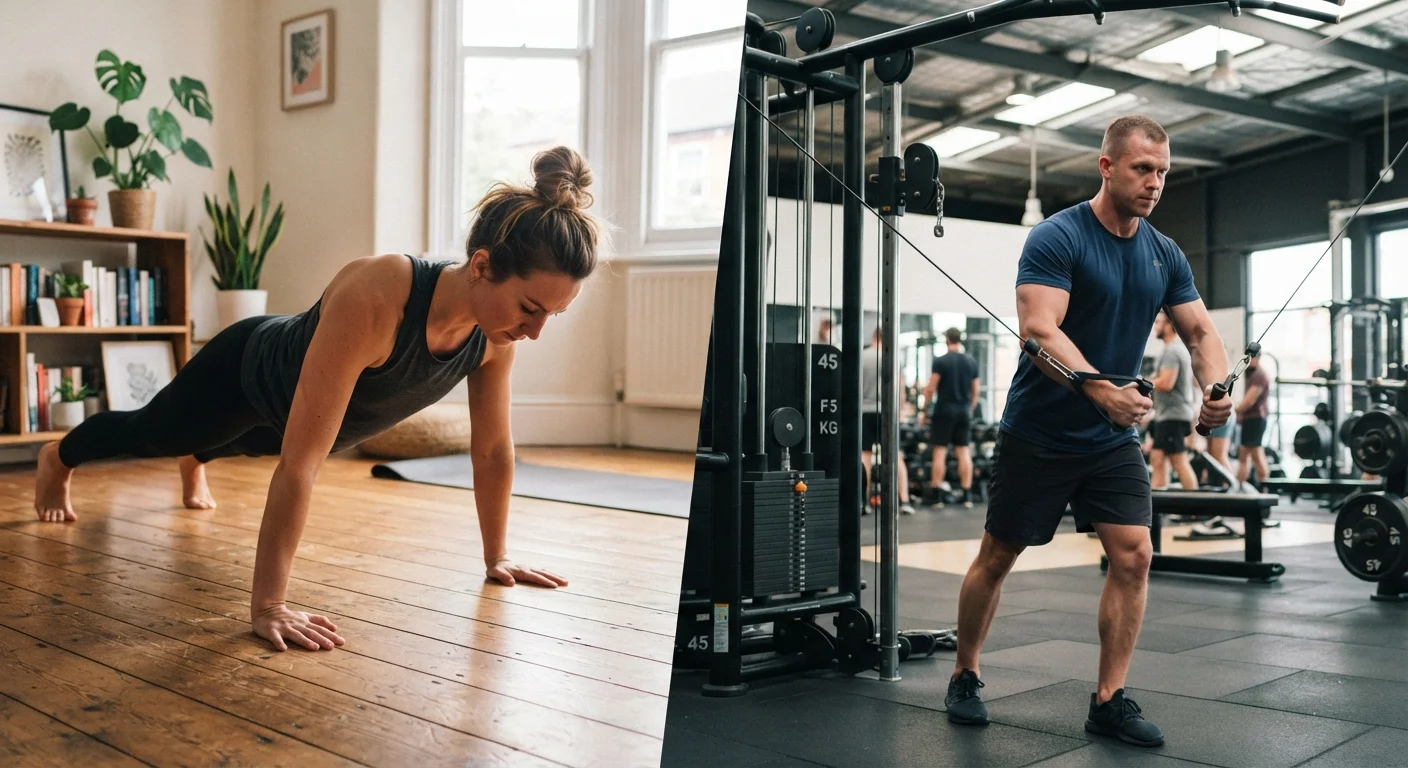
Option A
Bodyweight training
Resistance exercise using only your own body mass, no equipment required.
Best for: Anyone who wants a flexible, cost-free way to build strength and endurance at home or while traveling.
Option B
Gym machines
Fixed-path resistance equipment found in commercial and home gyms.
Best for: People who want structured, measurable resistance progression with reduced technique demands on certain movements.
If you want to start exercising with no upfront cost or equipment
Bodyweight training
Push-ups, squats, lunges, and planks cover the major movement patterns and require only floor space.
If progressive overload and measurable resistance increases are your priority
Gym machines
Machines let you add small, consistent increments of load over weeks and months, which is a reliable driver of strength adaptation.
If you are returning to exercise after a long break
Bodyweight training
Low impact, low cost, and adjustable difficulty make bodyweight work a lower-barrier re-entry point.
If you have a specific injury history or need movement guidance
Gym machines
Many machines restrict range of motion to a guided path, which can reduce injury risk for certain movements. Consult a qualified professional to confirm what suits your situation.
What each approach actually involves
Bodyweight training uses your own mass as resistance. Movements like push-ups, pull-ups, squats, lunges, dips, and planks work multiple muscle groups at once and require no tools beyond your body and a stable surface. Difficulty scales through leverage changes, tempo, and movement complexity rather than added weight.
Gym machines guide you through a fixed or semi-fixed movement path using a weight stack or cable system. The design reduces the balance and coordination demand of free weights while allowing precise load adjustments, often in increments as small as 2.5 pounds. Core concepts for beginners covers the foundational ideas behind resistance training that apply to both formats.
Strength and muscle development
Both methods stimulate muscle growth through the same underlying mechanism: applying sufficient mechanical tension to muscle fibers over time. The American College of Sports Medicine notes that progressive overload, gradually increasing the challenge placed on a muscle, is the central driver of adaptation regardless of equipment.
Bodyweight training achieves this through movement progressions. A standard push-up becomes a decline push-up, then an archer push-up, then a single-arm variation. Each step increases demand without adding external load. This works well through beginner and intermediate levels, but advanced trainees often find it harder to keep adding stimulus for lower-body muscle groups in particular, since squatting your own bodyweight eventually plateaus without added resistance.
Gym machines address that ceiling directly. Adding five pounds to a leg press or a lat pulldown is straightforward. For adults focused on building muscle mass or following structured strength programming, that precision is a genuine advantage.
Practical access and consistency
Consistency matters more than method. A training approach that fits your schedule and circumstances will produce better results than an optimal program you rarely follow.
Bodyweight training removes friction. No commute, no membership fee, no waiting for equipment. This matters for people with irregular schedules, travel demands, or tight budgets. Home workout routines offers a realistic look at what to expect from training at home.
Gym machines offer structure and variety that some people find motivating. The environment itself, designated for exercise, can help with focus. The trade-off is that access depends on proximity, cost, and hours. If any of those factors become barriers frequently, consistency suffers.
Active daily living research suggests that regular movement of any kind is more predictive of health outcomes than the specific format of structured exercise sessions.
Who fits each approach
This is general information, not medical advice
The content here is for educational purposes and does not constitute personal medical or exercise advice. Individual health conditions, injury history, and fitness levels vary. Consult a qualified healthcare or exercise professional before starting a new training program, particularly if you have a chronic condition or have been inactive for an extended period.
Gym machines suit people who want external load progression, appreciate guided movement paths, or have specific muscle groups they want to train with greater isolation. They are also a reasonable option for adults managing certain joint concerns, though anyone with an injury or medical condition should consult a healthcare professional before starting or changing a training program.
Many adults use both. A few sessions per week in a gym combined with bodyweight work at home is a practical and flexible arrangement, not a fallback. Recovery between sessions matters regardless of which format you use.