

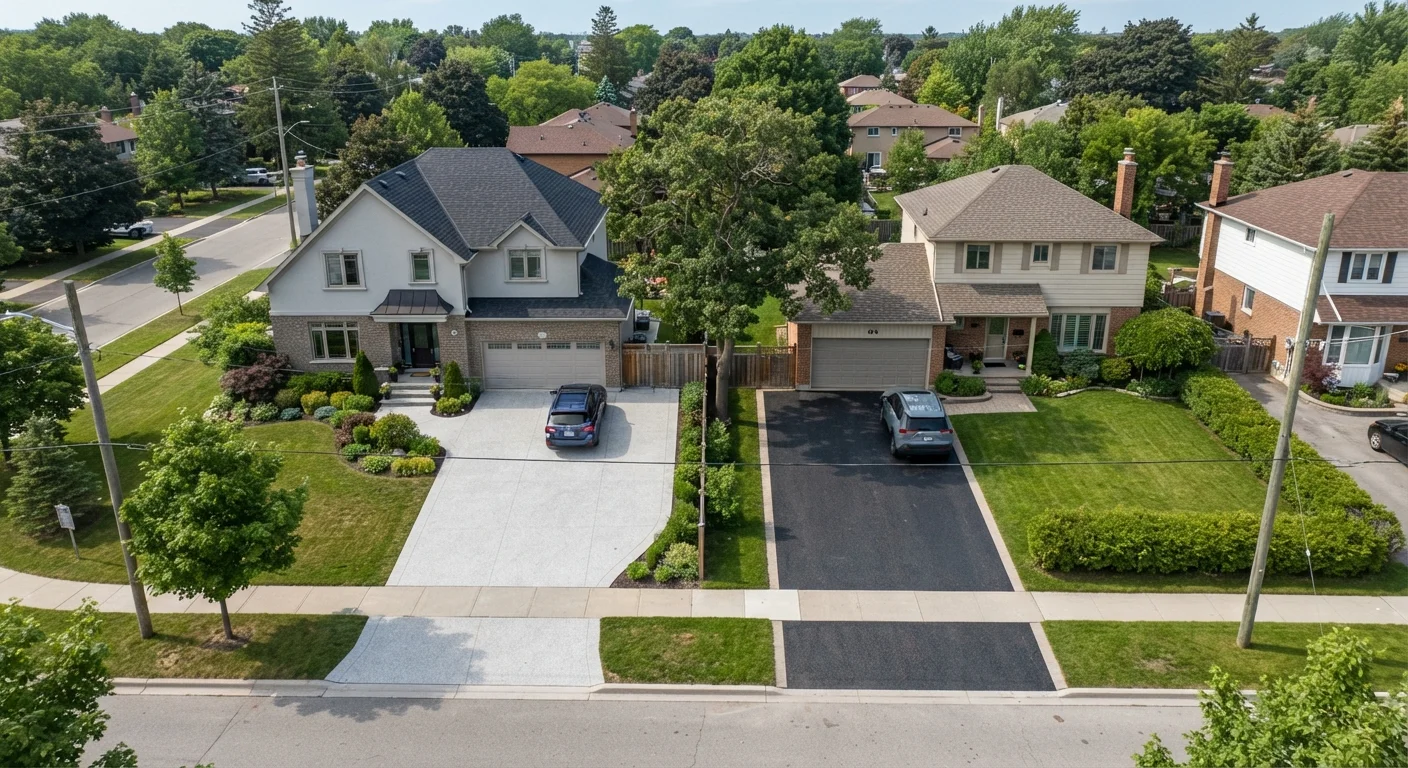
Our Verdict
Concrete and asphalt both hold up well when maintained consistently, but they demand different routines. Asphalt asks for more frequent attention in the form of sealing and crack filling, while concrete is lower maintenance day to day but more expensive to repair when problems arise.
| Best for | Recommended |
|---|---|
| Homeowners in cold climates who want less frequent upkeep | Asphalt |
| Homeowners in hot climates who want a longer-lasting surface | Concrete |
| Those comfortable with periodic sealing as a DIY task | Asphalt |
| Those who prefer minimal routine maintenance and a lighter surface color | Concrete |
How each material ages
Concrete and asphalt are both durable, but they deteriorate in different ways. Concrete is rigid, so it cracks at specific points, typically along control joints (the planned grooves cut into the slab to guide where cracking occurs). Asphalt is flexible, so it tends to develop surface cracks and soft spots gradually, especially under repeated load or heat.
A well-installed concrete driveway can last 30 to 50 years. Asphalt typically lasts 20 to 30 years with regular maintenance. However, a neglected asphalt surface can degrade significantly faster, while a concrete driveway that develops deep cracks and is left unaddressed can require full-section replacement.
Routine maintenance compared
| Criterion | Concrete | Asphalt | |
|---|---|---|---|
| Typical lifespan | 30 to 50 years | 20 to 30 years | |
| Sealing required | Optional but beneficial | Every 2 to 5 years | |
| Crack repair (DIY) | Epoxy or polyurethane filler | Asphalt patching compound | |
| Stain visibility | High (light surface) | Low (dark surface) | |
| Cold climate performance | Avoid deicing salts | Flexible, handles freeze-thaw well | |
| Hot climate performance | Holds up well | Can soften under heat | |
| Repair cost when damage is severe | Higher (section replacement) | Moderate (resurfacing or base repair) |
Asphalt
Asphalt needs to be sealed every two to five years, depending on traffic and climate. Sealcoating (applying a thin protective layer over the surface) slows oxidation, prevents water penetration, and keeps the surface flexible. Without it, the top layer dries out and becomes brittle. Crack filling with asphalt patching compound is a straightforward DIY task on cracks up to half an inch wide. Potholes, once they form, should be filled promptly to prevent water from reaching the base layer.
Concrete
Concrete does not require sealing to remain functional, but applying a penetrating concrete sealer every few years reduces moisture intrusion and stain absorption. Cracks in concrete are filled with polyurethane or epoxy crack filler, both available at hardware stores. The repair is visible against the light-gray background, which bothers some homeowners. Spalled concrete (where the surface layer flakes off) usually results from freeze-thaw damage or deicing salt use and is more difficult to address cosmetically without resurfacing the affected section.
Climate and its effects
The local climate matters more than most homeowners expect when choosing between these two materials.
In regions with cold winters, freeze-thaw cycles push water into cracks, expand them, and heave slabs. Concrete handles this reasonably well at its control joints, but deicing salts accelerate surface deterioration. If you live where roads are salted regularly, avoid applying rock salt directly to a concrete driveway. Sand or kitty litter provide traction without the corrosive effect.
Asphalt softens in prolonged high heat, which can cause surface deformation under heavy vehicles or sharp objects like kickstands. In consistently hot climates, the binder in asphalt breaks down faster, making regular sealing more important rather than optional.
Stains, spills, and surface care
Oil and fuel stains show clearly on concrete because of its light color. Absorbent concrete also holds stains deeper in the material. Treating a fresh oil spill with a degreaser and a stiff brush within 24 hours gives the best result; older stains may require a poultice (a paste of absorbent material and solvent left to draw the stain out). Even with treatment, some discoloration typically remains.
On asphalt, oil stains are much less visible but can soften the surface if left to penetrate. Cleaning the area and applying an asphalt patching product over any softened spot is the standard fix. The dark color of asphalt hides most staining, though it also makes cracks and surface wear harder to spot early.
Just as staying ahead of small problems matters with high-mileage vehicle maintenance, catching driveway deterioration early avoids larger repairs later.
Catch cracks before winter
Inspect your driveway each fall and fill any cracks before freezing temperatures arrive. Water trapped in an unsealed crack expands as it freezes, widening the crack significantly by spring. A tube of crack filler costs a few dollars and takes less than an hour to apply.
When to call a professional
DIY repairs work well for surface cracks, small potholes, and routine sealing. Professional help is warranted when cracks are wider than an inch, when sections of concrete have shifted or heaved significantly, or when the base layer under asphalt has failed (indicated by a spongy feel underfoot or large connected cracks called alligator cracking).
Base failure on an asphalt driveway cannot be fixed by resurfacing alone; the damaged base material must be removed and replaced before a new surface layer goes down. On concrete, a full section replacement is the standard fix for severely cracked or settled slabs. Both repairs involve equipment and expertise beyond typical DIY scope.