

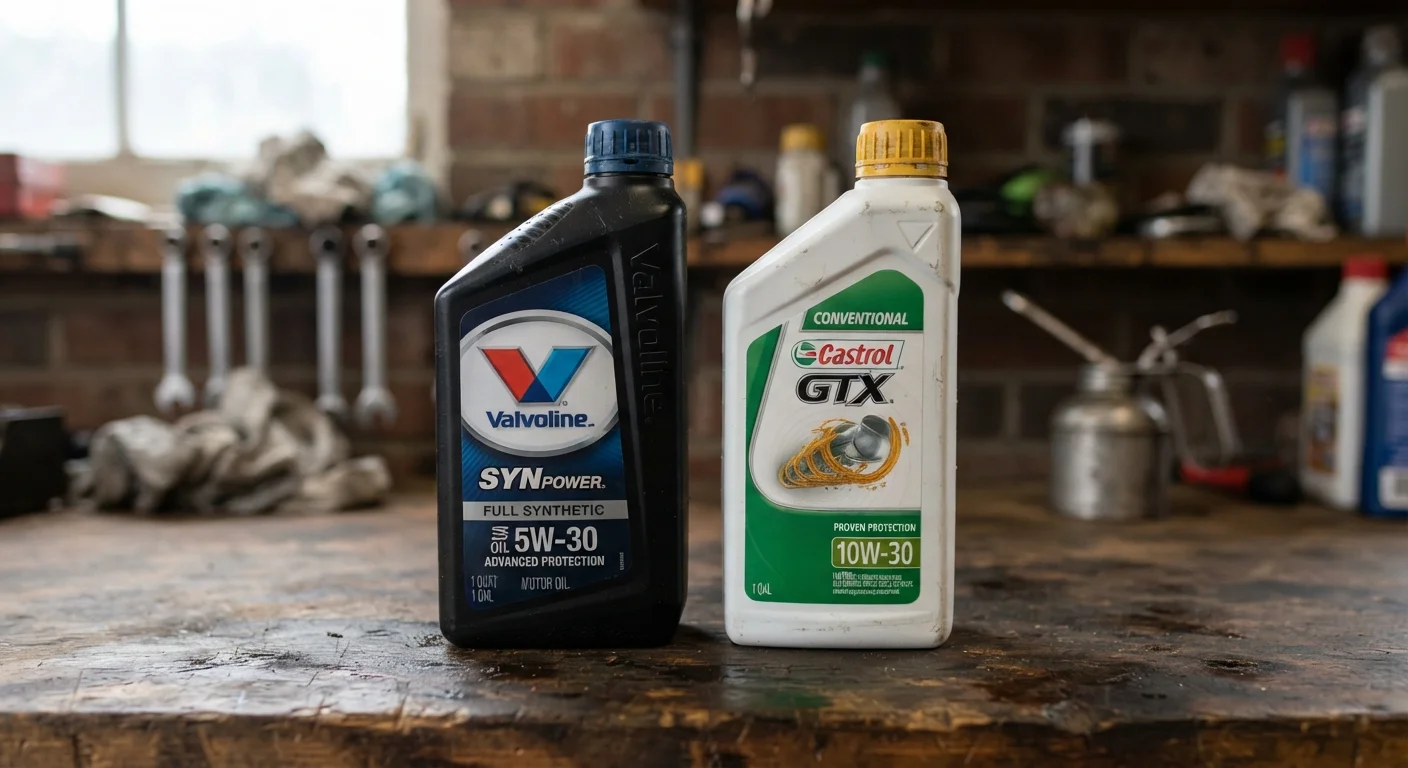
Key Takeaways
- Your owner's manual specifies which oil type your engine requires, and that recommendation takes priority.
- Synthetic oil holds its viscosity better in heat and cold, making it more stable across temperature extremes.
- Conventional oil costs less per quart but typically requires more frequent changes.
- Switching from conventional to synthetic in a high-mileage engine warrants a conversation with a qualified mechanic.
- Viscosity grade (such as 5W-30) matters as much as oil type; always use the grade your manufacturer specifies.
Option A
Synthetic motor oil
Engineered for consistent performance across a wider range of conditions.
Best for: Drivers with newer vehicles, turbocharged engines, or those in climates with extreme temperatures.
Option B
Conventional motor oil
A petroleum-based lubricant refined from crude oil.
Best for: Older, simpler engines with low mileage that are driven under normal, predictable conditions.
If you drive a modern vehicle with a turbocharged or high-performance engine
Synthetic motor oil
Turbocharged engines run hotter and demand an oil that resists breakdown under sustained heat. Most manufacturers of these engines specify full synthetic.
If you drive an older, naturally aspirated vehicle under typical city or highway conditions
Conventional motor oil
A well-maintained engine without special performance demands can run reliably on conventional oil, provided you follow the change interval in your owner's manual.
If you live in a region with very cold winters or very hot summers
Synthetic motor oil
Synthetic oil flows more readily at low temperatures and maintains a stable film at high temperatures, giving the engine better protection at startup and under load.
What each oil actually is
Conventional motor oil starts as crude oil that is refined and blended with additive packages to meet viscosity and performance standards. The base molecules vary in size and shape, which means the oil can behave less predictably when temperatures swing.
Synthetic motor oil is either fully synthesized from chemical compounds or built from a highly refined petroleum base (called a group III or group IV base stock). The molecules are more uniform, which gives the oil tighter control over viscosity across a broader temperature range. Full synthetics and synthetic blends both exist; a blend mixes synthetic base stock with conventional base stock at a lower price point than full synthetic.
Both types use the same additive chemistry for detergents, anti-wear agents, and oxidation inhibitors. The difference is the base oil they start with.
How they compare across the factors that matter
| Criterion | Synthetic | Conventional |
|---|---|---|
| Base stock | Engineered or heavily refined molecules | Refined crude oil |
| Cold-weather flow | Flows readily at low temperatures | Thickens more in cold |
| Heat resistance | Higher oxidation resistance | Degrades faster under sustained heat |
| Typical change interval | 7,500 to 15,000 miles | 3,000 to 5,000 miles |
| Cost per quart | Higher | Lower |
| Turbocharged engine suitability | Generally required or recommended | Usually not suitable |
Viscosity stability is where the gap between the two oils is most practical. When an engine sits overnight in freezing temperatures, a thicker oil takes longer to reach all moving parts at startup. Synthetic oils are formulated to flow more freely in the cold, which reduces wear during those first few seconds after ignition.
At the other end, high heat degrades conventional oil faster through oxidation. Synthetic oil resists that breakdown longer, which is why most turbocharged engine manufacturers specify it. Turbos spin at extremely high speeds and run hotter than naturally aspirated engines.
Change intervals and cost over time
Your owner's manual is the final word
No general guideline overrides what your vehicle manufacturer specifies. The manual lists both the required oil type and the viscosity grade. If your manual says 0W-20 full synthetic, using a 5W-30 conventional oil because it is cheaper is not an equivalent substitution. Viscosity grade and oil type are separate specifications, and both matter.
Conventional oil is typically changed every 3,000 to 5,000 miles depending on driving conditions, though some formulations last longer. Synthetic oil is generally rated for 7,500 to 15,000 miles, with some full synthetics approved for extended intervals when paired with the right filter.
The higher per-quart price of synthetic can offset somewhat when you account for fewer changes per year. That said, extended intervals only apply when driving conditions match the manufacturer's assumptions. Frequent short trips, towing, or stop-and-go traffic all degrade oil faster regardless of type.
For a detailed look at what modern change intervals actually call for, see our guide to oil change intervals.
When to be cautious about switching
Switching a very high-mileage engine from conventional to full synthetic is not automatically a good idea. Older engines with worn seals sometimes rely on conventional oil's slight tendency to cause minor seal swelling. A qualified mechanic can assess whether your engine is a good candidate before you make the change.
For newer vehicles, the owner's manual will state outright if synthetic is required. Using conventional oil in an engine that specifies synthetic can void warranty coverage and may cause inadequate lubrication in demanding conditions.
Motor oil is one of several fluids worth understanding. Our car fluids guide covers what each fluid does and how to spot when something is off.