

Key Takeaways
- Seat belts reduce the risk of death in a crash by about 45% for front-seat occupants, according to NHTSA data.
- Airbags are designed to work with seat belts, not replace them; an unbelted occupant can be seriously injured by an airbag alone.
- Most fatal crashes happen within 25 miles of home, so short trips carry real risk.
- A properly worn seat belt across the shoulder and hips is safer than tucking the strap behind your back or under your arm.
- Being 'trapped' by a seat belt after a crash is far less common than being ejected without one.
Why these myths persist
Seat belts have been mandatory in US vehicles since 1968, yet misconceptions about when and how to wear them still circulate. Some myths feel like common sense. Others get passed down from older relatives who drove before modern restraint systems existed. A few are simple misreadings of how crash physics work. Whatever their source, they lead real drivers to make choices that increase their risk of serious injury or death.
The National Highway Traffic Safety Administration (NHTSA) estimates that seat belts saved roughly 14,955 lives in a single recent year, and that about half of the people who died in crashes were unbelted. Those numbers make the stakes of these myths concrete.
Myth
Short trips don't require a seat belt. Most serious crashes happen on highways at high speed.
Fact
NHTSA data consistently shows that most fatal crashes occur within 25 miles of home, often at lower speeds on familiar local roads.
Familiarity with a road does not reduce crash risk. Driver inattention, intersection conflicts, and pedestrian activity are common close to home. Crash forces at 30 mph are enough to cause fatal head injuries without restraint. Buckling up takes about two seconds regardless of trip length.
Myth
Airbags protect you in a crash, so a seat belt is redundant.
Fact
Airbags are designed as a supplement to seat belts, not a replacement. An unbelted occupant can be seriously injured or killed by the airbag deployment itself.
Front airbags deploy at speeds between roughly 100 and 220 mph. That force is calibrated to stop a belted occupant who is already held in position. An unbelted occupant slides forward before the bag fully inflates, meeting a still-expanding bag at the wrong moment. Side curtain airbags provide no torso restraint at all. The systems work together by design.
Myth
You might get trapped in a burning or submerged car if you're wearing a seat belt.
Fact
The odds of a crash involving fire or water submersion are very low. Being unbelted dramatically increases the chance of losing consciousness in a crash, making escape far harder.
Federal data puts fire- or submersion-involved crashes at well under 1% of all crashes. In a serious crash, an unbelted occupant is far more likely to be ejected (which is nearly always fatal) or to be knocked unconscious by impact with the interior. Either outcome makes escape impossible. Seat belt cutters and window-breaking tools are available for drivers who want a contingency plan, but skipping the belt to prepare for a rare scenario removes protection from the far more common one.
Myth
A heavier body provides enough mass to absorb crash forces without a belt.
Fact
Body mass does not substitute for mechanical restraint. In a crash, an unbelted occupant of any size is subject to the same physics: the body continues moving at pre-crash speed when the vehicle stops.
At 35 mph, an unbelted person effectively becomes a projectile weighing many times their resting weight due to deceleration forces. Greater body mass in that situation means greater force, not more protection. Seat belts work by distributing those forces across the strongest parts of the skeleton over a longer time period, which is a mechanical function that body size cannot replicate.
Myth
Seat belts cause injuries, so wearing one isn't always safer.
Fact
Seat belts can cause bruising or soft-tissue injuries in a serious crash, but those injuries are far less severe than the alternative. The belt is doing its job by absorbing energy that would otherwise reach the head, chest, and spine.
Seat belt syndrome (bruising along the belt line) is a documented medical finding after crashes. It is also a marker that the occupant survived an impact that might otherwise have been fatal. Comparing a bruised collarbone to ejection or a steering-column head impact is not a close call. Injuries from wearing a belt are real but predictably less severe than injuries from not wearing one in the same crash.
Myth
The back seat is safe enough without a belt because you're farther from the dashboard.
Fact
Unbelted rear-seat passengers are at significant risk of being thrown forward into the front seats, the roof, or out of the vehicle entirely.
Rear-seat occupants without belts also become hazards for front-seat occupants. In a frontal crash, an unbelted adult in the back can hit the front seat or the person in it with substantial force. NHTSA research has found that rear-seat belt use rates are lower than front-seat rates, even though the risk of serious injury for unbelted rear occupants is well established.
Wearing your belt correctly matters as much as wearing it at all
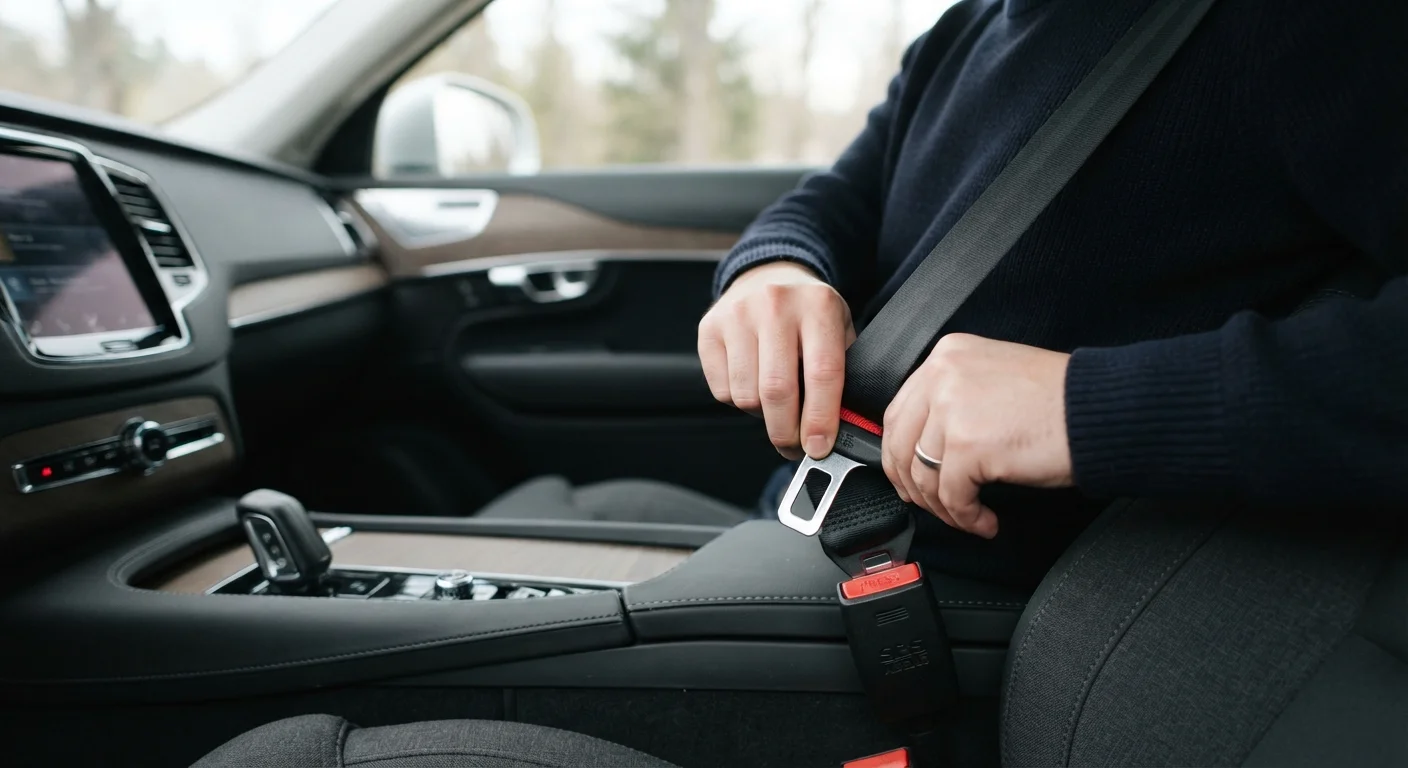
Knowing the facts about seat belts is only part of the picture. How you wear the belt affects how well it protects you. The shoulder strap belongs across the chest and collarbone, not behind the back or tucked under the arm. The lap portion belongs low across the hips, not across the soft tissue of the abdomen. Routing the belt incorrectly shifts crash forces onto organs and soft tissue that cannot absorb them the way the pelvis and chest can.
Pregnant drivers sometimes tuck the lap belt across the abdomen to avoid pressure on the belly. Medical guidance from ACOG (the American College of Obstetricians and Gynecologists) states the opposite: the lap belt should sit below the belly, across the hip bones, with the shoulder strap between the breasts and to the side of the abdomen. Wearing the belt correctly is more protective for both the driver and the baby than avoiding it or repositioning it incorrectly.
For families with children, proper restraint extends beyond the adult seat belt. See our overview of child passenger safety for guidance on car seats, booster seats, and when a standard belt is appropriate by age and size.
Never modify how a belt fits by rerouting it
Clip-on belt adjusters that route the shoulder strap behind the back or position it away from the chest compromise the belt's ability to function in a crash. If a belt fits uncomfortably, the vehicle owner's manual may describe a built-in height adjustment on the B-pillar anchor. A mechanic or dealer can advise on compatible solutions that do not alter the restraint path.