

Key Takeaways
- Children should stay rear-facing until they reach the maximum height or weight limit of their seat, not just until age 2.
- A forward-facing harness seat offers more protection than a booster seat, so delaying the switch is generally safer.
- Booster seats should be used until the vehicle's seat belt fits the child correctly, typically at 4 feet 9 inches tall.
- Incorrect installation and loose harness straps are the two most common car seat errors.
- State laws set minimum requirements; following manufacturer guidelines and safety organization recommendations often exceeds those minimums.
Start here
Why the seat type matters at each stage
Next
Rear-facing seats: infants and young toddlers
Then
Forward-facing seats with a harness
Then
Booster seats and the transition to seat belts
Finally
Checking your installation
Why the seat type matters at each stage
A child's body changes dramatically between birth and the early teens, and so does the kind of crash protection it needs. Infants have large heads relative to their bodies and underdeveloped neck muscles. Young toddlers have similar vulnerabilities. Older children have outgrown harness seats but are still too small for adult seat belts to fit correctly. Each seat type is engineered for a specific size and weight range; using the wrong type, or moving to the next stage too early, reduces protection in a crash.
State laws set the legal floor for each stage, but they vary considerably. The safest approach is to follow manufacturer height and weight limits for each seat, which often exceed legal minimums. The American Academy of Pediatrics publishes guidance that is worth reviewing alongside your state's requirements.
For context on how vehicle safety systems work together, see active and passive safety to understand where a car seat fits within the broader picture of crash protection.
Rear-facing seats: infants and young toddlers
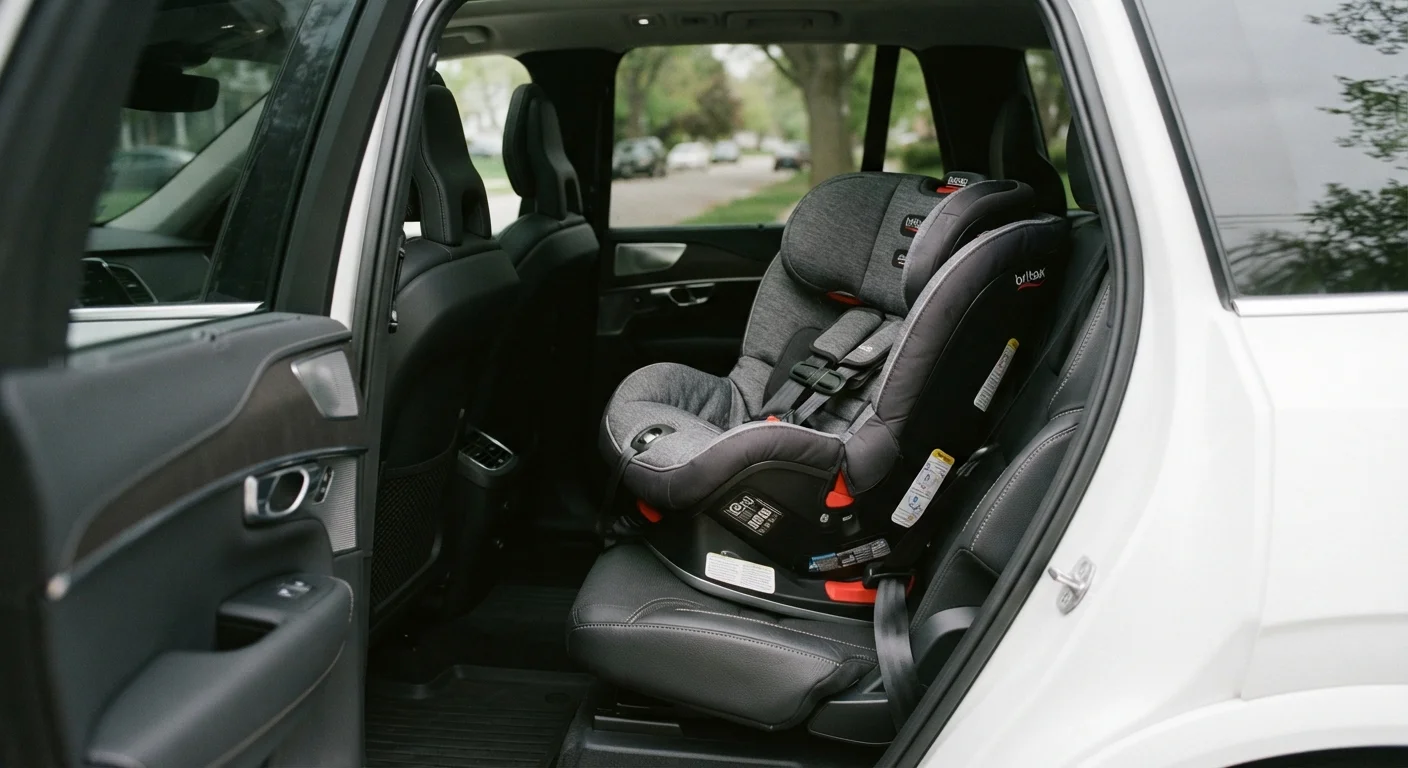
Rear-facing seats distribute crash forces across the child's entire back, shoulders, and head rather than concentrating them on the neck. This makes them the safest option for the youngest passengers.
Infant-only seats are designed for newborns up to roughly 22 to 35 pounds, depending on the model. Convertible seats can be used rear-facing for larger children, often up to 40 to 50 pounds, and then converted to forward-facing later. Many families find a convertible seat more economical because it covers both stages.
The seat back should recline at the angle specified in the manual, typically 30 to 45 degrees. If the angle is too upright, a young infant's head can fall forward and restrict the airway. Most seats have an angle indicator built in.
Rear-facing seat
A car seat that faces the back of the vehicle. It spreads crash forces across the child's back, head, and neck, which are the most vulnerable areas for young children.
Forward-facing seat
A car seat that faces the front of the vehicle, secured with a five-point harness. Used once a child has outgrown the rear-facing limits of their seat.
Booster seat
A seat that lifts a child so the vehicle's own seat belt fits correctly across the body. It does not have its own harness.
LATCH system
Lower Anchors and Tethers for Children. A set of metal anchors built into most vehicles made after 2002 that allows car seats to be attached without using the seat belt.
Harness slot
The openings on a car seat through which the harness straps pass. Using the correct slot height for a child's size keeps the harness working as intended.
Forward-facing seats with a harness
Once a child has reached the rear-facing height or weight limit of their seat, a forward-facing seat with a five-point harness is the next step. The harness spreads force across the strongest parts of the body: the shoulders, hips, and chest.
The harness straps should sit at or just above the child's shoulders, not below them. After clipping the chest clip at armpit level, you should be able to fit no more than two fingers under the strap at the collarbone. Any looser and the harness will not perform correctly in a crash.
The top tether strap, which connects the top of the seat to an anchor behind or above it, reduces head movement during a crash. It should always be attached, even when using the LATCH system for the lower anchors. Many parents skip this step, which is a significant oversight.
Booster seats and the transition to seat belts
A booster seat has no harness of its own. Its job is to position the child so the vehicle's seat belt fits correctly, with the lap portion across the upper thighs and the shoulder belt across the chest, not the neck or face.
High-back boosters provide head and neck support and are the better choice in vehicles without headrests or with low seat backs. Backless boosters work well in vehicles with adequate headrests but are not appropriate for every vehicle.
Children should remain in a booster until the seat belt fits without one. The height threshold is generally around 4 feet 9 inches, but fit matters more than any specific number. A child who tucks the shoulder belt behind their back or under their arm because it cuts across the neck is not yet ready to skip the booster.
For road trips, double-check that the seat is secured correctly before departure. The pre-trip vehicle safety walkthrough covers other checks worth doing at the same time.
Keep records of your seat's details
Write the manufacture date and expiration date on a piece of tape inside the seat's storage compartment. Also note the model number so you can check for recalls quickly. The NHTSA maintains a free recall lookup tool at nhtsa.gov.
Checking your installation
A correctly installed seat should not move more than one inch side to side or front to back when you grip it at the belt path and push firmly. If it moves more than that, the installation needs adjustment.
The LATCH system and seat belt are both acceptable attachment methods, but you generally should not use both simultaneously unless the manufacturer's manual specifically says you can. Check the vehicle owner's manual as well; some vehicles have LATCH weight limits lower than the child seat's weight limit, at which point the seat belt becomes the correct choice.
Many communities offer free car seat inspection events staffed by certified Child Passenger Safety Technicians (CPSTs). The National Highway Traffic Safety Administration (NHTSA) maintains a locator tool on its website to help you find a nearby inspection station. Having a CPST check your installation is one of the most practical steps you can take.
Common mistakes to avoid
The two errors seen most often at inspection events are a loose harness and a loose seat. Both can be corrected without replacing anything.
- Moving to the next seat stage before the child has reached the height or weight limit of the current seat.
- Placing the chest clip too low, near the stomach rather than at armpit level.
- Using a thick winter coat under the harness. In cold weather, buckle the harness over thin layers and place a blanket or coat over the child on top of the harness.
- Installing a rear-facing seat in the front passenger seat when the airbag is active. A deploying airbag can cause serious injury to a rear-facing child.
- Using an expired or post-crash seat without knowing its history.
For a broader look at how vehicle safety ratings are tested and what they mean for the car your child rides in, see car safety ratings explained.