

Key Takeaways
- NHTSA and IIHS are the two main sources of crash test data in the US, and they use different rating scales.
- A five-star overall NHTSA score is an average; individual category scores can vary significantly.
- IIHS tests include small overlap frontal crashes and roof strength, which NHTSA does not test the same way.
- IIHS Top Safety Pick and Top Safety Pick+ awards require strong scores in headlight performance, not just crash tests.
- Ratings apply to specific model-year configurations; changes in trim or production year can affect results.
Car safety ratings
Car safety ratings are scores assigned to vehicles after controlled crash tests and safety evaluations conducted by independent organizations. They measure how well a vehicle protects its occupants in common collision scenarios. In the United States, two organizations publish the ratings drivers encounter most often: the National Highway Traffic Safety Administration (NHTSA) and the Insurance Institute for Highway Safety (IIHS).
NHTSA uses a five-star scale across multiple crash categories, while IIHS uses a descriptive rating system (Good, Acceptable, Marginal, Poor) and also evaluates advanced driver-assistance systems separately.
The two organizations behind most US safety ratings
When you look up a vehicle's safety record, you will almost always land on results from NHTSA or IIHS. They run separate programs and their scores are not interchangeable.
NHTSA is a federal agency within the Department of Transportation. Its New Car Assessment Program (NCAP) assigns one to five stars in three categories: frontal crash, side crash, and rollover resistance. An overall star rating appears on the window sticker of new cars sold in the United States. Because NHTSA is a government body, its tests influence federal safety policy.
IIHS is a nonprofit organization funded by auto insurers. It publishes ratings of Good, Acceptable, Marginal, or Poor across several test types, and its Top Safety Pick and Top Safety Pick+ awards are widely referenced by consumers. IIHS also evaluates front crash prevention systems and headlight performance as part of its award criteria.
Using both sources together gives a more complete picture than either one alone. Active and passive safety systems work differently, and the two rating programs reflect that distinction in how they test vehicles.
What each test actually measures
Crash tests are not random collisions. Each one is a controlled scenario designed to replicate common real-world accidents.
NHTSA test types
- Frontal crash: A full-width barrier impact at 35 mph, measuring forces on the driver and front passenger.
- Side crash (pole): A moving deformable barrier strikes the side of the vehicle, simulating a T-bone collision.
- Rollover resistance: A dynamic handling maneuver that measures the vehicle's tendency to tip, not an actual rollover crash.
IIHS test types
- Moderate overlap frontal: The front 40 percent of the driver's side hits a barrier at 40 mph.
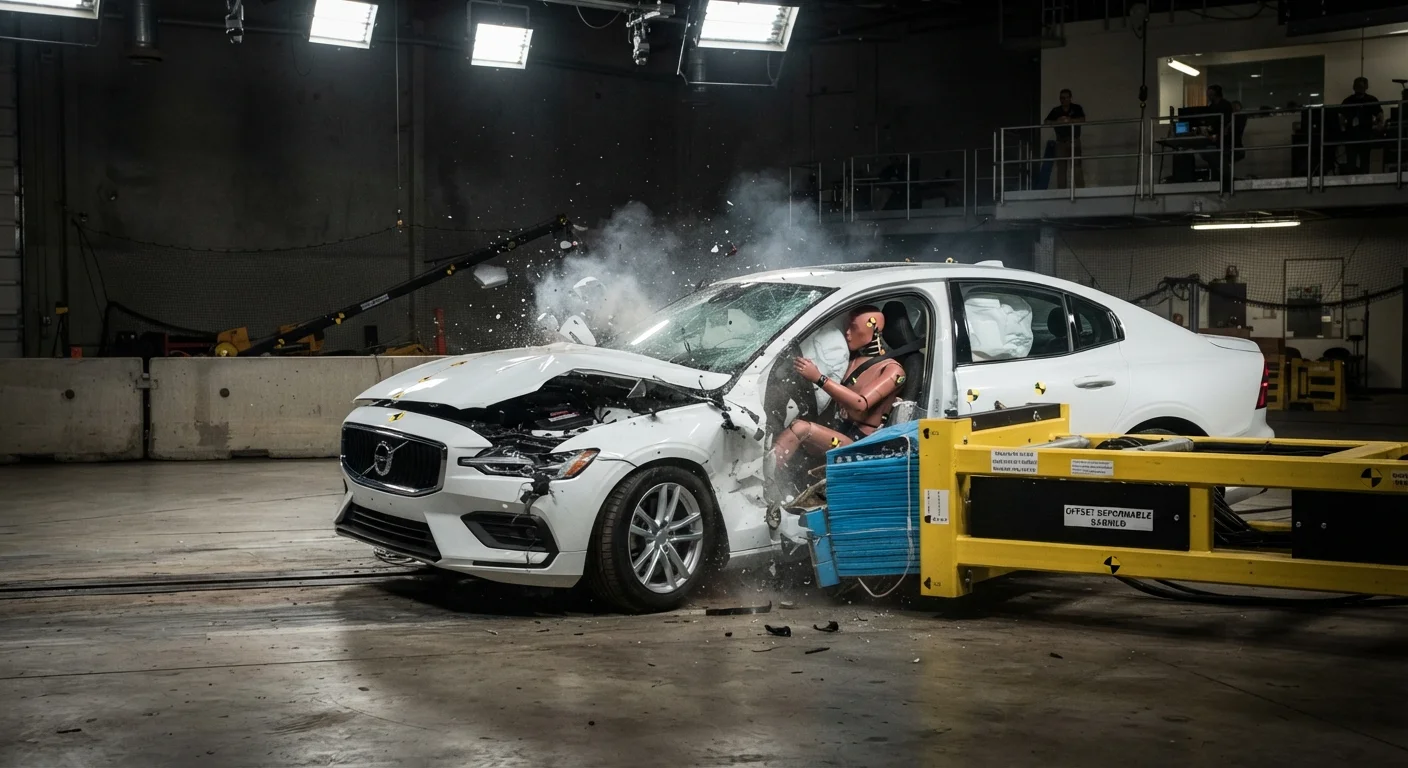
- Small overlap frontal: Only 25 percent of the front corner hits a rigid barrier, replicating a common real-world crash pattern. Many vehicles that score well on other tests perform worse here.
- Side barrier and pole tests: Similar in concept to NHTSA's side tests but with different barrier specifications.
- Roof strength: A hydraulic ram presses down on the roof to measure crush resistance during a rollover.
- Head restraints and seats: Measures whiplash protection in rear impacts.
25%
Front corner overlap in IIHS small overlap test
The IIHS small overlap frontal test was introduced in 2012 after analysis showed a significant share of serious frontal crashes involve only the corner of the vehicle.
35 mph
Speed used in NHTSA frontal barrier test
NHTSA's New Car Assessment Program specifies 35 mph for its full-width frontal crash test, a speed chosen to represent severe but survivable real-world collisions.
40 mph
Speed used in IIHS moderate overlap frontal test
IIHS conducts its moderate overlap frontal test at 40 mph, slightly higher than the NHTSA frontal test, against a deformable barrier designed to simulate another vehicle.
IIHS added a passenger-side small overlap test in the early 2020s after finding that some vehicles protected the driver well but left the front passenger more exposed. A vehicle rated before that addition may not reflect current passenger-side performance.
How to read a score without getting misled
A single headline number can hide important detail. Here is how to avoid misreading what you see.
NHTSA's overall star rating is an average. A vehicle can earn five overall stars while receiving only four stars in rollover resistance. If rollover risk matters to you because you drive an SUV in winter conditions, the individual category score is what to examine.
IIHS ratings apply to a tested vehicle configuration. A pickup truck tested as a crew cab may have a different rating than the same model in an extended cab. The IIHS website lists the tested body style and model year clearly, so verify that the result matches the exact vehicle you are researching.
Headlights are part of the IIHS award, but they are rated separately from crash performance. A vehicle can earn Good scores in every crash category and still fall short of Top Safety Pick+ if its headlights rate Marginal or Poor. Conversely, trim levels with optional upgraded headlights sometimes qualify while the base trim does not.
For families buying a vehicle that will carry children, car seat compatibility and rear-seat crash protection are worth examining alongside the overall rating.
What ratings do not cover
Safety ratings measure structural performance in specific crash scenarios. They do not assess every variable that affects crash outcomes.
Driver-assistance technologies such as automatic emergency braking, lane departure warning, and blind-spot monitoring are evaluated separately by IIHS under its Vehicle Safety Assist program, and by NHTSA under its Five-Star rating supplemental notes. A high crash-test score does not confirm that a vehicle has any of those systems standard, or that they perform reliably.
Ratings also do not account for compatibility between vehicles of different sizes. A small car may score well in tests conducted against standardized barriers but perform differently in a real collision with a heavier vehicle. This is a known limitation of current testing protocols.
Finally, ratings say nothing about tire condition, maintenance history, or driver behavior, all of which affect real-world crash outcomes. Understanding your tire specifications is one practical step that complements what safety ratings tell you.
This article is for general informational purposes. Always consult official NHTSA and IIHS databases for the most current ratings on a specific vehicle before making any decision.