

Key Takeaways
- Active safety systems intervene before or during a potential crash to help the driver avoid it.
- Passive safety systems absorb and redirect crash energy to reduce injury after impact.
- Both categories work together; a vehicle with strong active systems still needs solid passive protection.
- NHTSA and IIHS ratings test passive safety performance; active systems are evaluated separately.
- No system, active or passive, removes the need for attentive driving.
Option A
Active safety
Systems designed to prevent a crash from happening in the first place.
Best for: Drivers who want to understand how a vehicle helps avoid collisions during everyday driving.
Option B
Passive safety
Systems designed to protect occupants once a crash is unavoidable.
Best for: Anyone evaluating how well a vehicle manages injury risk when a collision occurs.
When comparing vehicles for overall occupant protection
Passive safety
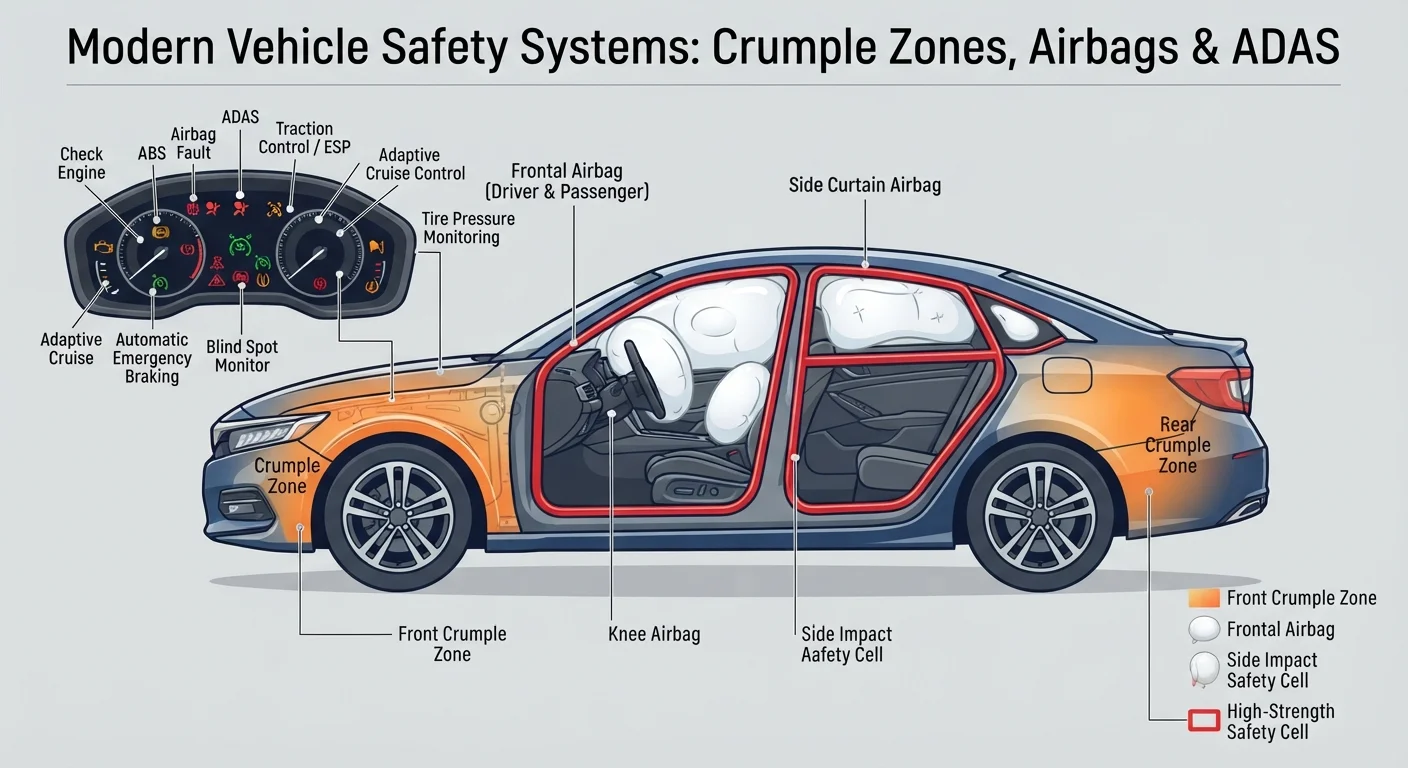
Crumple zones, airbags, and seat belt pretensioners are the primary factors in crash-injury outcomes and are directly measured by crash test ratings.
When evaluating how a vehicle handles highway driving or lane changes
Active safety
Systems like automatic emergency braking and lane-keep assist act before a collision, which is where the most useful comparison between vehicles lies.
When buying a vehicle for a new or inexperienced driver
Active safety
Newer drivers benefit most from systems that provide real-time warnings and automatic interventions while driving habits are still forming.
What active safety systems actually do
Active safety covers any technology or mechanical system that works while the vehicle is in motion to help prevent a crash. Anti-lock brakes (ABS) stop the wheels from locking during hard braking so the driver keeps steering control. Electronic stability control (ESC) detects when the vehicle begins to skid and selectively applies brakes to individual wheels to correct the slide. Traction control limits wheel spin on slick surfaces.
More recent additions fall under the umbrella of advanced driver assistance systems (ADAS). Automatic emergency braking (AEB) applies the brakes when sensors detect an imminent forward collision. Lane departure warning and lane-keep assist alert the driver or gently steer the vehicle back if it drifts across lane markings. Blind-spot monitoring flags vehicles in adjacent lanes. For a detailed look at what these features do and their limitations, see our guide to ADAS.
The common thread across all active systems is timing: they operate before impact, either assisting the driver or acting automatically to avoid the collision.
What passive safety systems actually do
Passive safety systems do nothing until a crash occurs, then work automatically to limit the physical forces on occupants. The vehicle body itself is passive safety: engineers design the front and rear sections as crumple zones that deform progressively, absorbing kinetic energy before it reaches the passenger cabin. The cabin structure, by contrast, is built to hold its shape.
Seat belts with pretensioners tighten instantly on impact, pulling occupants into the seat before they lurch forward. Load limiters then allow the belt to release a small amount of force to reduce chest injury. Airbags inflate in milliseconds and cushion the head and torso against the steering wheel, dashboard, and door panels. Side curtain airbags protect against head strikes in side impacts and rollover events.
Headrests count too
A properly positioned headrest limits how far the head snaps back during a rear-end collision, reducing whiplash injury. The top of the headrest should be roughly level with the top of the occupant's head. Many drivers leave headrests in the lowest position, which reduces their effectiveness significantly.
Headrests, though simple, count as passive safety: a properly positioned headrest limits how far the head snaps back during a rear-end collision, reducing whiplash injury. Correct headrest height matters. The top of the headrest should be roughly level with the top of the occupant's head.
Safety ratings from NHTSA and IIHS measure passive system performance through controlled crash tests. Understanding what those scores mean helps put the numbers in context.
How the two categories interact
Active and passive safety are not alternatives; they work in sequence. A vehicle with good active systems may avoid crashes that passive systems would otherwise have to manage. But active systems do not prevent every crash. A pedestrian stepping unexpectedly into traffic, a tire blowout at speed, or a driver who disables warnings all create situations where passive systems become the last line of protection.
There is also an interaction at the engineering level. Modern AEB systems can pre-tension seat belts and close windows slightly before impact if sensors predict a collision is inevitable. Some airbag systems adjust inflation force based on occupant size and seat position data. The boundary between active and passive is blurring as vehicles become more connected internally.
When comparing vehicles, look at both categories separately. A car can score well in IIHS crash tests while offering limited active assistance features, or carry a full ADAS suite but have an older body structure. Defensive driving habits remain relevant regardless of how capable either set of systems is, because driver behavior is still the first input in most crash scenarios. You can also read about how blind spots form and how mirrors help to see where active monitoring systems add value that mirrors alone cannot cover.