

Key Takeaways
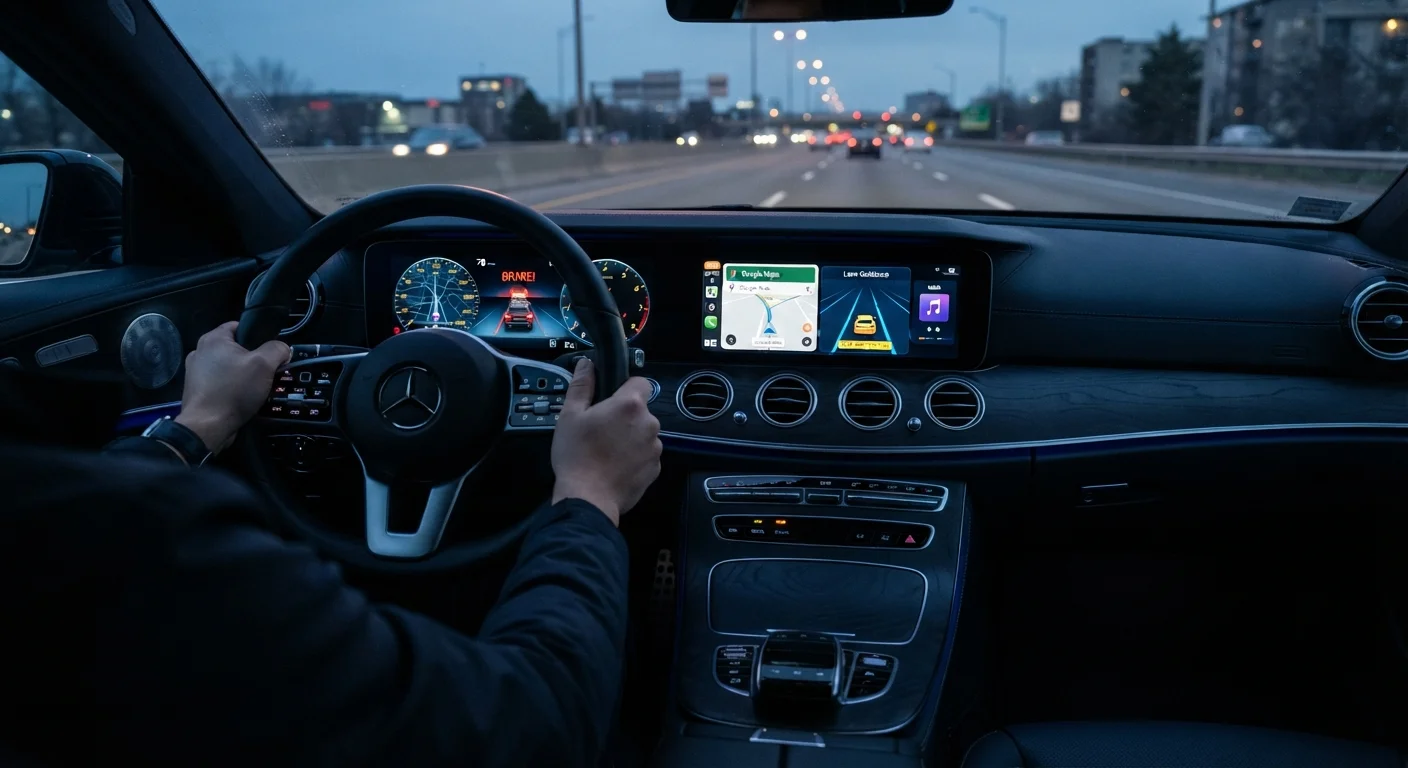
- ADAS features use cameras, radar, and sensors to monitor the road and alert or assist the driver.
- No current ADAS system makes a vehicle self-driving; the driver remains responsible at all times.
- Features like automatic emergency braking and lane departure warning work best when sensors are clean and calibrated.
- Over-relying on ADAS can erode the situational awareness that prevents crashes in the first place.
- A damaged or replaced windshield often requires ADAS recalibration by a qualified technician.
Start here
What ADAS actually is
Next
The most common ADAS features explained
Then
What ADAS cannot do
Finally
ADAS and your driving habits
What ADAS actually is
Advanced Driver Assistance Systems, commonly shortened to ADAS, is the collective term for electronic systems that monitor the driving environment and either warn the driver or take limited automatic action to reduce crash risk. The technology is built into the vehicle and draws on cameras, radar, ultrasonic sensors, and sometimes lidar to build a real-time picture of what is happening around the car.
ADAS is an example of active safety technology, which tries to prevent a crash before it happens. This is different from passive safety features like airbags, which manage the consequences of a crash that has already occurred. For a fuller look at how these two approaches work together, see active vs. passive safety.
ADAS
Advanced Driver Assistance Systems: a group of electronic features that use sensors to monitor the road and warn or assist the driver to reduce crash risk.
Sensor fusion
The process of combining data from multiple sensor types (camera, radar, ultrasonic) so the vehicle gets a more complete picture of its surroundings than any single sensor could provide.
Automatic emergency braking
A system that detects an imminent collision and applies the brakes without driver input if the driver has not already reacted.
Calibration
The process of precisely aligning ADAS sensors and cameras so they measure the road environment accurately. Recalibration is often needed after windshield replacement or collision repair.
Active safety
Features designed to prevent a crash from happening, as opposed to passive safety features like airbags that protect occupants after a crash has begun.
The most common ADAS features explained
Automatic emergency braking (AEB) detects an imminent collision with a vehicle or pedestrian ahead and applies the brakes if the driver has not reacted in time. It cannot always stop the vehicle completely, but it can reduce impact speed significantly.
Lane departure warning (LDW) monitors lane markings and alerts the driver when the vehicle drifts across a line without a turn signal active. Some vehicles add lane-keeping assist, which applies a small steering correction rather than just alerting.
Adaptive cruise control (ACC) maintains a set speed like traditional cruise control, but also measures the gap to the vehicle ahead and slows down to maintain a safe following distance. The driver still controls steering.
Blind-spot monitoring uses rear-facing radar to detect vehicles in zones the mirrors do not cover well. A warning light in or near the mirror illuminates when another vehicle is alongside.
Rear cross-traffic alert detects vehicles moving across the path of the car while reversing, which is useful in parking lots where pillars and other vehicles block the driver's view.
Forward collision warning (FCW) alerts the driver to a rapidly closing gap ahead without automatically braking. It gives the driver the chance to act first.
What ADAS cannot do
No vehicle with ADAS today is self-driving. Systems labeled "autopilot" or "driver assist" still require the driver to remain alert, keep hands near or on the wheel, and be ready to take control at any moment. This distinction matters because studies from highway safety researchers have found that some drivers misunderstand the scope of these features and reduce their attention as a result.
ADAS also has sensor limitations. Cameras lose reliability in direct glare or heavy precipitation. Radar can have difficulty distinguishing a stopped vehicle from a bridge overpass or road debris. Ultrasonic sensors work only at low speeds and short distances. No single sensor solves every scenario, and sensor fusion (combining multiple inputs) improves but does not eliminate blind spots in the system's perception.
Distracted driving remains a problem regardless of what technology is fitted to the car. A driver who is not watching the road cannot catch errors the system misses. Driver distraction takes many forms beyond phone use, and ADAS does not address most of them.
ADAS does not replace driver attention
No current production vehicle is self-driving. Features like adaptive cruise control and lane-keeping assist are driver support tools, and the driver is responsible for safe operation at all times. Treating these systems as substitutes for attention increases crash risk rather than reducing it.
Keeping ADAS working properly
The sensors ADAS relies on require physical care. Cameras mounted behind the windshield need a clean glass surface; a bug-splattered or icy windshield can degrade or disable them. Radar units are often hidden behind the front grille or bumper badges, so a minor parking-lot impact that looks cosmetic may knock a radar out of alignment.
Windshield replacement is a common trigger for ADAS problems. Forward-facing cameras are calibrated to specific mounting angles. After a windshield swap, the camera must be re-aimed using manufacturer-specified targets and equipment. A shop that skips this step can leave AEB or LDW reading the road geometry incorrectly. Always ask whether ADAS recalibration is included in windshield repair quotes.
Tire size changes can also affect systems that use wheel speed sensors as part of their calculations. If you change wheel or tire sizes from the factory specification, ask a qualified technician whether any system recalibration is needed. More on keeping your vehicle road-ready is covered in the car maintenance hub.
ADAS and your driving habits
ADAS works best when the driver continues to scan ahead, check mirrors, and read traffic the way defensive driving principles describe. The systems are designed as a backup layer, not a replacement for situational awareness.
New drivers in particular benefit from understanding that ADAS features respond to conditions that have already developed. A driver who spots a hazard early and eases off the throttle will handle it more smoothly than a driver who waits for AEB to intervene at the last moment. Building that habit of reading ahead is covered in reading the road ahead.
When you get behind the wheel of an unfamiliar vehicle, take a few minutes with the owner's manual to understand which ADAS features are fitted and how each one signals to the driver. The sounds, lights, and vibrations vary across manufacturers, and misreading a warning in traffic costs the response time the system is trying to give you.