

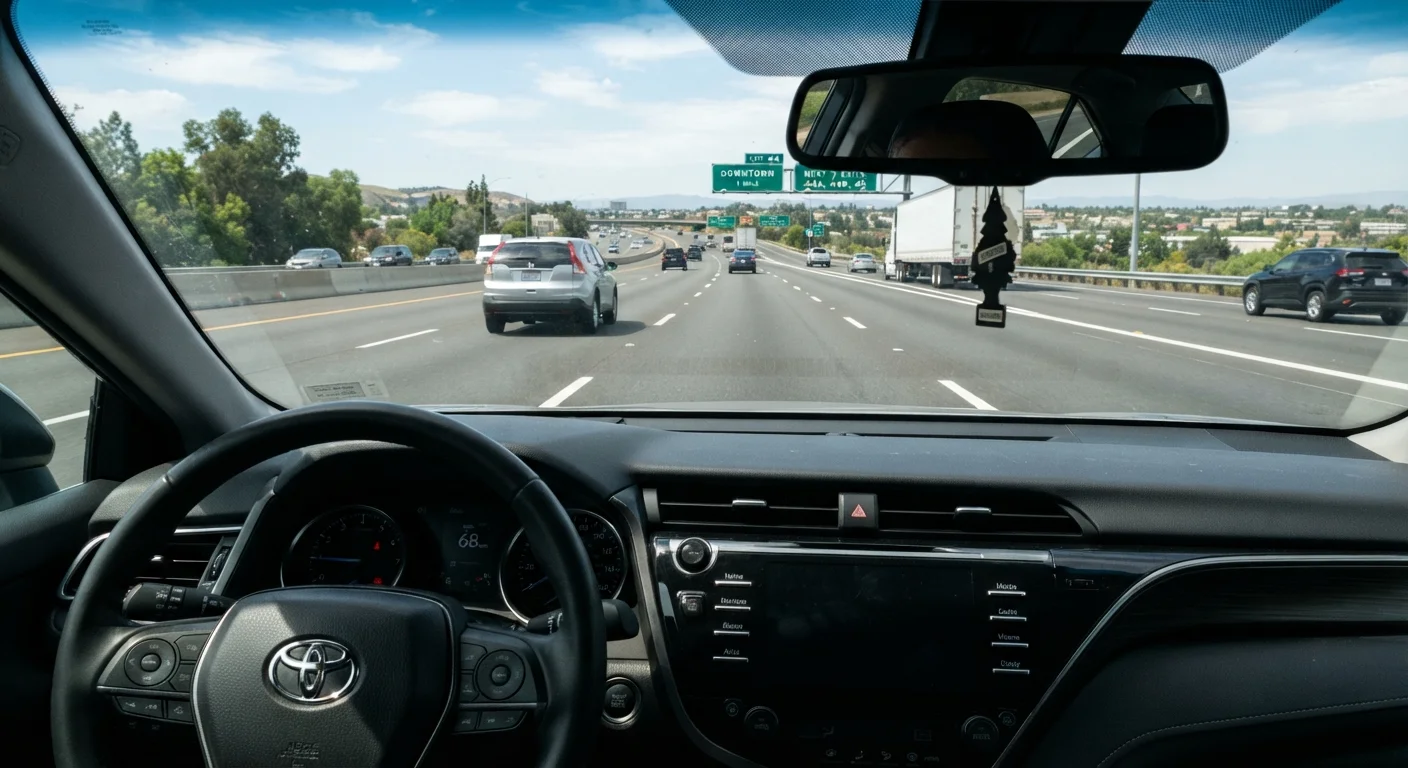
Key Takeaways
- New drivers tend to fixate close to the hood; experienced drivers look 12 to 15 seconds ahead.
- Scanning the road in three distance zones gives you time to respond before situations become emergencies.
- Brake lights, turn signals, and wheel movement all telegraph what a nearby driver is about to do.
- Low visibility, heavy traffic, and unfamiliar roads all require slower speeds and wider following gaps.
- Situational awareness is a trained habit, not an instinct. It improves with consistent practice.
Start here
Why new drivers miss what experienced ones see
Next
The three zones of road awareness
Then
How to scan without losing your lane
Apply it
Reading other drivers before they act
Go deeper
Conditions that demand more attention
Why new drivers miss what experienced ones see
A new driver's attention tends to collapse inward, toward the hood, the lane lines, and the car directly ahead. This is normal. Controlling the vehicle takes so much mental effort early on that scanning further out feels impossible. The problem is that crashes rarely announce themselves from ten feet away.
Experienced drivers have automated the physical controls enough to free up attention for the broader picture. Their eyes naturally settle on a point 12 to 15 seconds of travel time ahead, and they process near and mid-range information in passing, not as the main focus. That gap between new and experienced drivers is not talent. It is a habit built through repetition, and it can be built deliberately.
Situational awareness
Knowing the positions, speeds, and likely next moves of all road users around you at any given moment.
Following distance
The gap between your vehicle and the one in front of you, measured in seconds of travel time rather than car lengths.
Visual lead time
How far ahead you are looking, expressed as seconds of travel time. A longer lead time gives you more opportunity to respond to developing hazards.
Peripheral vision
The area of your visual field outside your direct line of sight. It detects movement and near-zone information without requiring you to shift your eyes.
The three zones of road awareness
Think of your visual field as three overlapping zones rather than one flat view through the windshield.
- Far zone (12 to 15 seconds ahead): This is where you should spend most of your focus. Scan for traffic patterns changing, signals ahead, merging lanes, or any situation that is developing. At 60 mph, 15 seconds of travel time covers roughly a quarter mile.
- Mid zone (4 to 12 seconds ahead): Monitor vehicle speeds and gaps, pedestrians near crosswalks, and vehicles about to merge or turn. This is where you confirm what the far zone showed you.
- Near zone (0 to 4 seconds): Your peripheral vision handles most of this, including lane position and immediate obstacles. Staring here means you are already reacting rather than anticipating.
A wider following distance makes all three zones more useful, because it opens up your view of the far zone past the vehicle ahead.
How to scan without losing your lane
New drivers worry that looking far ahead means losing track of their immediate position. The technique is to move your eyes, not just your gaze. Your head follows your eyes, and your hands follow your head, so drivers who stare at one fixed point tend to drift. Frequent, deliberate eye movement keeps the car tracking straight while expanding your awareness.
A practical method: every few seconds, shift focus from the far zone to the mid zone, glance at your mirrors, then return to the far zone. This cycle keeps all three zones updated without fixating on any one of them. Blind spots require a head-check rather than mirror use, so include a shoulder glance before any lane change.
Practice scanning on familiar roads first
When you are still building the habit, practice the three-zone scanning pattern on a route you already know well. Familiar roads reduce the cognitive load of navigation, leaving more mental room to focus on your eye movement pattern. Once the habit feels automatic there, apply it in new environments.
Reading other drivers before they act
Other drivers communicate constantly, often without meaning to. Brake lights appearing earlier than usual suggest the driver ahead sees something you cannot yet. A vehicle sitting at the edge of a lane boundary may be preparing to merge. Wheels angled toward your lane at an intersection tell you the driver intends to turn, even if no signal is on.
Watch for hesitation. A car that slows without braking, drifts without signaling, or accelerates then brakes in short bursts may have a distracted or uncertain driver. Give these vehicles more space. Following too closely removes the reaction time you need when those early signals appear.
Pedestrians and cyclists follow similar patterns. A pedestrian glancing at their phone while walking toward a crosswalk may step out without checking. A cyclist moving from the bike lane toward the center of the road is likely preparing for a left turn.
Conditions that demand more attention
Some environments compress the time you have to react, and the scanning habits above need to adjust accordingly.
Heavy urban traffic means more potential conflict points per mile. Shorten your scanning intervals and expect more unpredictable movement from other road users.
Rain and reduced visibility cut the useful range of your far zone. Slow down so that your stopping distance stays inside the distance you can actually see. Headlights help others see you as much as they help you see the road.
Unfamiliar roads require more cognitive effort because you cannot rely on memory of the route. If you are navigating a new city, set your route before you start moving rather than adjusting it while driving.
Advanced driver assistance systems can support your awareness, but they do not replace it. See our overview of ADAS features for a plain-language breakdown of what those systems actually do.