

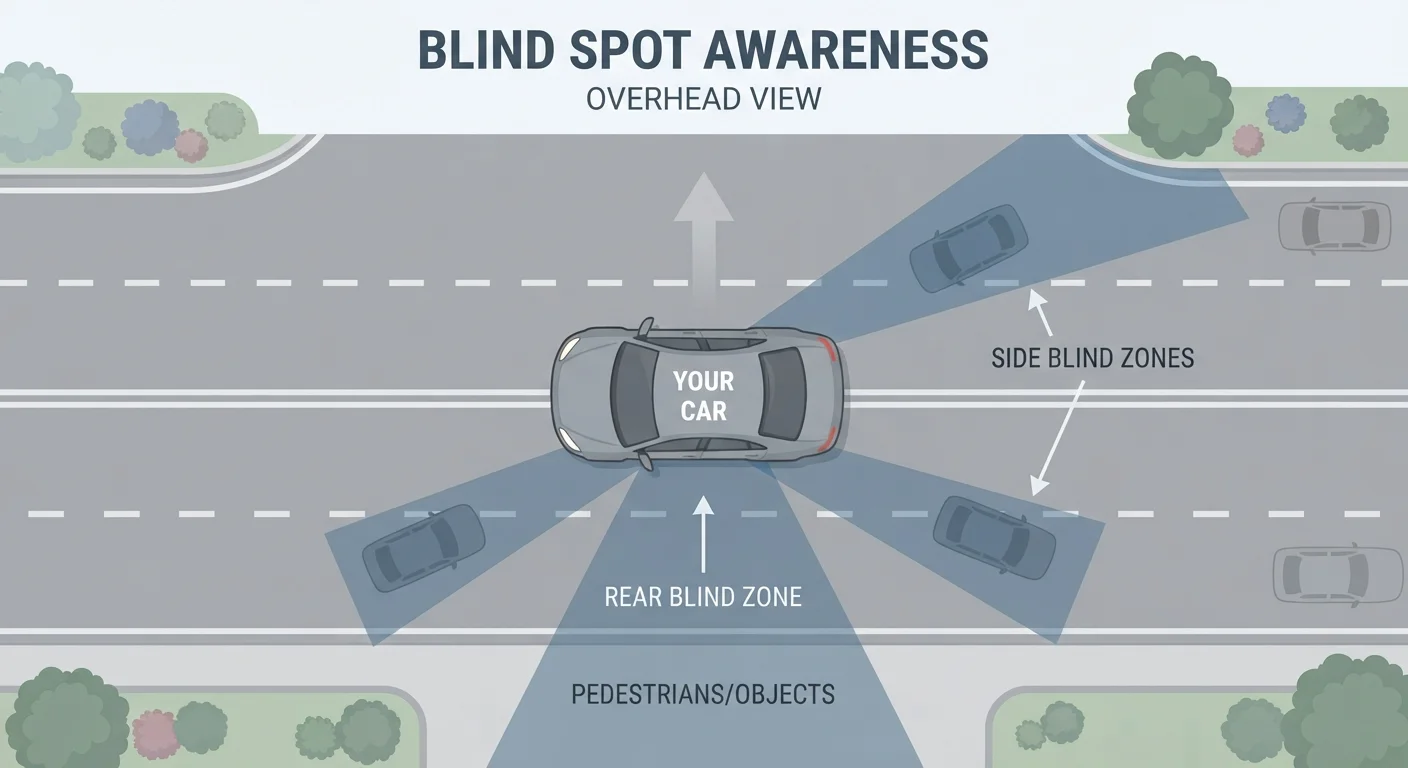
Key Takeaways
- Every vehicle has blind spots; larger vehicles such as SUVs and trucks have bigger ones.
- Mirrors set too close to the driver's head position create more overlap and less coverage.
- A physical head check before lane changes covers what mirrors cannot.
- Pedestrians and cyclists are disproportionately at risk from driver blind spots at low speeds.
- Blind spot monitoring systems assist but do not replace active scanning habits.
Blind spot
A blind spot is any area around a vehicle that the driver cannot see directly through the windshield or by glancing at properly adjusted mirrors. These zones exist because the vehicle's own body blocks the sightline, and because mirrors cover only a limited arc of the surrounding space. Every vehicle has them, and their size varies by vehicle type and mirror setup.
Blind spots are sometimes called 'no-zones' in the context of large trucks and buses, where the zones are significantly larger than those of a passenger car.
Why blind spots form around every vehicle
A car's body is not transparent. The roof pillars, door frames, headrests, and cargo areas all block portions of the driver's sightline, creating zones where another vehicle, cyclist, or pedestrian can sit without the driver knowing it. Mirrors cover a wide arc, but they cannot cover everything, and the angle at which most drivers set their side mirrors means a meaningful gap exists between what the mirror shows and what direct peripheral vision picks up.
The geometry is straightforward. Imagine standing at the driver's seat and drawing lines outward from every point your eyes can reach, either directly or via a mirror. The spaces those lines never cross are your blind spots. On a typical sedan, the rear-quarter zones on each side are the largest problem areas. On an SUV or pickup truck, those zones grow because the vehicle is wider, taller, and the rear glass is smaller relative to the body.
Forward blind spots also exist. The A-pillars (the structural columns beside the windshield) can hide a cyclist in a turn or a pedestrian stepping off a curb. This matters most at low speeds in urban environments, which is also where pedestrian and cyclist conflicts are most likely to happen.
How mirror positioning changes the geometry
Most drivers angle their side mirrors inward until they can see the rear corner of their own car. This feels reassuring because it gives a reference point, but it wastes coverage. You already know where your own car is. What you need the mirror to show is the lane beside you.
A more effective method, sometimes called the BGE (Blindzone-Glare-Elimination) technique, involves sitting in the normal driving position and angling each side mirror outward until your own car's flank just disappears from view. The result is a wider coverage arc that nearly overlaps with your direct peripheral vision. The gap between what the mirror covers and what your eye naturally catches becomes much smaller.
The rearview mirror covers the center zone directly behind the car. Setting it to show the full rear window, not clipped by the headliner above, maximizes that coverage. Together, three properly adjusted mirrors create an overlapping band of visibility, and the remaining uncovered zones are genuinely small, though not zero.
Adjust mirrors before you move the car
Set all three mirrors while stationary before pulling out, not while moving in traffic. Sit in your normal driving posture first, then adjust each mirror from that exact position. Moving the seat or headrest after setting mirrors shifts the angles and reduces their coverage.
The head check and why it still matters
Even with mirrors set optimally, a brief shoulder check before changing lanes or merging remains the most reliable way to confirm the adjacent zone is clear. The check takes less than a second: turn your head to glance through the rear side window in the direction of the intended move. What you see (or do not see) confirms what the mirrors suggest.
The habit breaks down when drivers feel rushed, when traffic is heavy and the pace feels urgent, or when familiarity with a regular commute creates overconfidence. Building situational awareness from the start of a driving career makes the head check automatic rather than effortful.
Speed also changes the math. At highway speeds, a vehicle in your blind spot covers ground quickly. A car that was barely visible in the mirror a moment ago can be directly beside you when you begin to move. Stopping distance grows faster than speed does, and the same principle applies to how fast adjacent traffic enters your danger zone.
Blind spots on large vehicles and what that means for car drivers
Passenger car drivers share the road with vehicles whose blind zones are far larger. A loaded semi-truck has no-zones that extend roughly 20 feet in front of the cab, 30 feet behind the trailer, and one to two lanes wide along each side. A driver sitting in any of those zones for an extended time is invisible to the truck driver regardless of how carefully that driver is watching.
The practical rule when passing a truck is to move through the side no-zone at a steady pace rather than traveling alongside it. Driving near semi-trucks involves a different set of blind zone risks than those around passenger vehicles, and understanding them separately reduces exposure.
Buses, RVs, and vans with no rear windows present similar issues. When following any vehicle where you cannot see through it to the traffic ahead, maintaining a longer following gap gives you both more visibility and more time to react.
Technology assistance and its limits
Blind spot monitoring systems have become standard on many vehicles. Most use radar sensors in the rear bumper to detect vehicles in adjacent lanes and display a warning light in or near the side mirror. Some add audible or tactile alerts if the driver signals toward an occupied lane.
These systems work well in clear conditions on highway-type roads where the relative speeds are predictable. They are less reliable at detecting cyclists traveling at lower speeds, pedestrians, or vehicles approaching unusually fast from behind. Active safety systems like blind spot monitoring assist driver attention; they do not replace it.
Rear cameras, which are required on new vehicles sold in the US, address the direct-rear blind spot when reversing but cover nothing to the sides or front. Cross-traffic alert systems add some side coverage in parking lots, though again with range and detection limitations. Each technology fills a specific gap, and none covers the full geometry of the zones described above.