

Key Takeaways
- Pedestrians and cyclists are far more vulnerable than drivers in any collision, so caution is not optional.
- The door zone extends about four feet from a parked car and is a frequent cause of cyclist injuries.
- Drivers must yield to pedestrians in marked and unmarked crosswalks in most U.S. states.
- Scanning intersections before turning right is one of the most effective habits a driver can build.
- Speed reduction in residential areas, school zones, and bike lanes cuts stopping distance and reaction time.
Why vulnerability changes the equation
A typical passenger car weighs roughly 3,500 pounds. A cyclist weighs perhaps 180 pounds on a 25-pound bike. A pedestrian has no protection at all. When a driver makes an error, the person outside the vehicle absorbs nearly all of the consequences. That asymmetry shapes every practice in this article.
Defensive driving asks you to anticipate hazards before they become emergencies. With pedestrians and cyclists, the hazard is often invisible until it is directly in your path, which means scanning habits and speed management matter more than any single rule.
Crosswalks and intersections
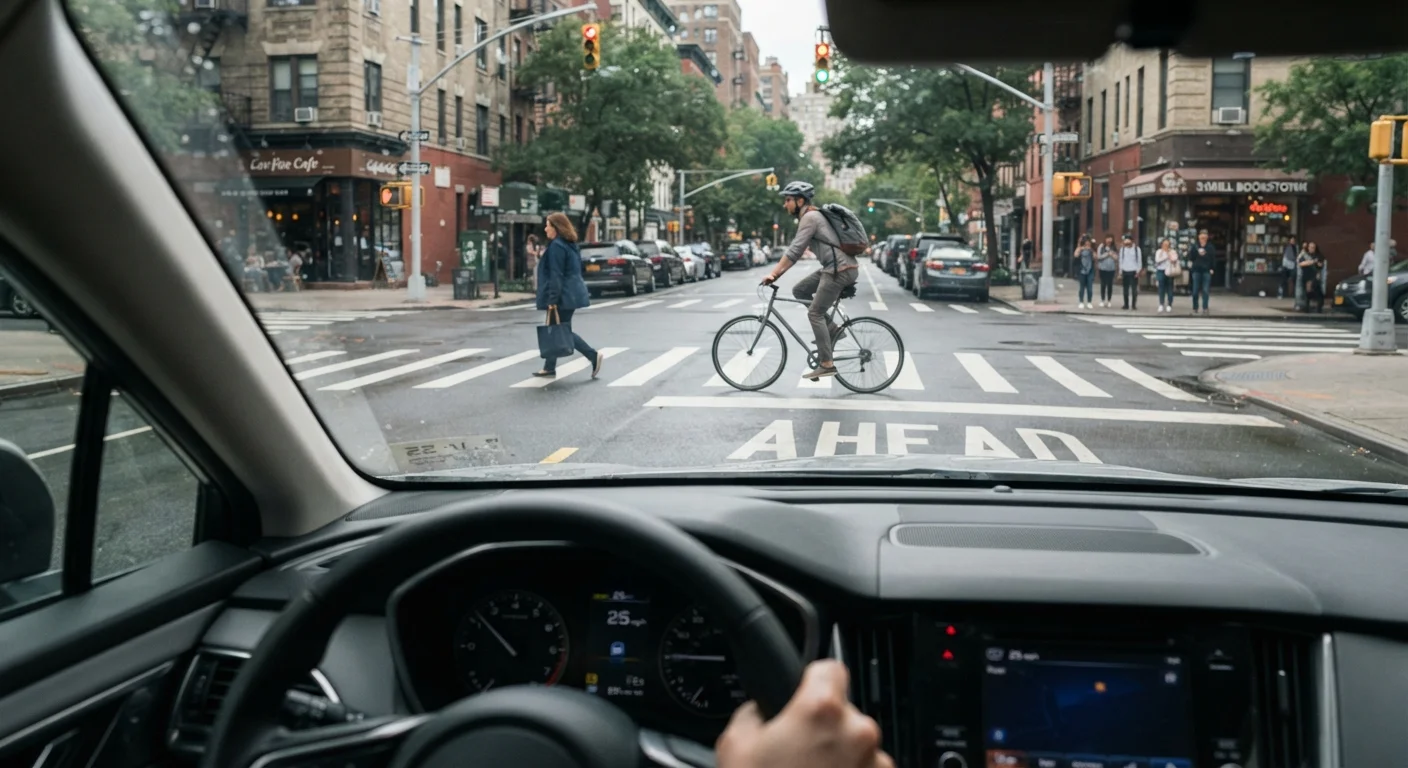
Most U.S. states require drivers to yield to pedestrians in both marked crosswalks and unmarked ones at intersections. An unmarked crosswalk exists at any four-way corner where two roads meet, even without painted lines. Treating only painted crosswalks as yield zones leaves pedestrians unprotected in legal crossing areas.
The right-turn-on-red is one of the most common points where pedestrian conflicts happen. A driver checks for oncoming traffic, sees a gap, and pulls forward without scanning the crosswalk on the right. Right-of-way rules make clear that a pedestrian crossing with the walk signal has priority over a vehicle turning on red. Check the crosswalk before your mirrors.
At intersections without signals, slow to a speed that allows a full stop before the crosswalk line. If one lane has already stopped for a pedestrian, do not pass that vehicle. The pedestrian may be stepping into your lane without seeing you.
Scan crosswalks before completing any turn
Turns focus a driver's attention on the steering path and gap in traffic, making it easy to miss a pedestrian already in the crosswalk. Looking at the crosswalk first, before committing to the turn, catches conflicts early enough to stop.
Maintain at least three feet of clearance when passing a cyclist
A cyclist can swerve to avoid road debris or lose balance unexpectedly. Three feet provides a margin for both the rider's movement and your vehicle's wind effect at speed.
Use the Dutch Reach when exiting a parked vehicle
Opening a door with your far hand forces your body to rotate toward the side mirror, making it natural to spot an approaching cyclist before the door swings open.
Treat a stopped vehicle at a crosswalk as a warning sign
A car already stopped for a pedestrian blocks your view of whoever is crossing. Pulling alongside or passing that stopped car puts you in the pedestrian's path without either party seeing the other in time.
Reduce speed proactively near schools, parks, and residential areas
Pedestrian density and unpredictability are higher where people gather. Lower speed increases reaction time and reduces injury severity if a collision does occur.
The door zone and passing cyclists
The door zone is the strip of road about three to four feet out from a parked car's driver-side door. A driver or passenger opening a door into traffic can knock a cyclist off their bike with no warning. When you park and exit, check your mirror and use what safety advocates call the Dutch Reach: open your door with your far hand, which naturally turns your body toward the mirror and any approaching riders.
When passing a cyclist on the road, most states now require a minimum three-foot buffer. On a narrow road or at highway speeds, that buffer should be wider. Do not accelerate past a cyclist and immediately merge back into the bike lane or shoulder. Give the rider time and space to react to your vehicle's wind disturbance before you move back over.
City driving brings denser cyclist traffic, bike lanes, and sharrows (shared lane markings). Rural roads often have no shoulder, meaning cyclists ride on the travel lane. Both environments require you to treat cyclists as you would a slow-moving vehicle: visible, predictable, and legally present on the road.
Speed, distraction, and stopping distance
At 20 mph, a driver who reacts in 1.5 seconds travels about 44 feet before braking begins. At 30 mph, that pre-brake distance stretches to 66 feet, and total stopping distance roughly doubles. A pedestrian stepping off a curb 40 feet away is survivable at 20 mph and potentially fatal at 30 mph. Speed is not just a legal matter; it is a physics matter.
Distracted driving extends effective reaction time beyond those 1.5 seconds. A glance at a phone for two seconds at 25 mph moves a vehicle about 73 feet without the driver registering what is ahead. Pedestrians and cyclists are small targets in a wide visual field; distraction removes the margin that allows a driver to detect and respond to them.
School zones and high-pedestrian corridors post reduced speed limits for this reason. Those limits apply whether children are visible or not. Stopping early builds in the buffer that prevents a bad outcome when a child darts into the street.
Backing up and parking lot hazards
Parking lots account for a significant share of pedestrian strikes. Visibility is limited, pedestrians move unpredictably, and speeds feel low enough that drivers relax their attention. Back out slowly, check your mirrors and camera before moving, and yield to anyone already in the travel lane behind you. Pedestrians crossing the lane behind a reversing car are at head height relative to a rear bumper and frequently outside a backup camera's field of view.
Cyclists can approach at 15 mph or faster in a parking lot entrance, much quicker than a walking pace. Treat every parking lot drive as you would a low-speed road with unmarked crossings at every row.