

| Typical school zone speed limit | 15 to 25 mph (Varies by state) |
| Fine multiplier in most states | 2x the standard fine (Varies by state; some states impose higher multipliers) |
| Work zone speeding fatalities (U.S.) | Hundreds per year (Federal Highway Administration data) |
| Flagger legal authority | Same as a traffic control device (MUTCD federal standard) |
| Speed reduction in work zones | Often 10 to 15 mph below posted limit (State DOT guidelines vary) |
School zone speed limits: when and how they apply
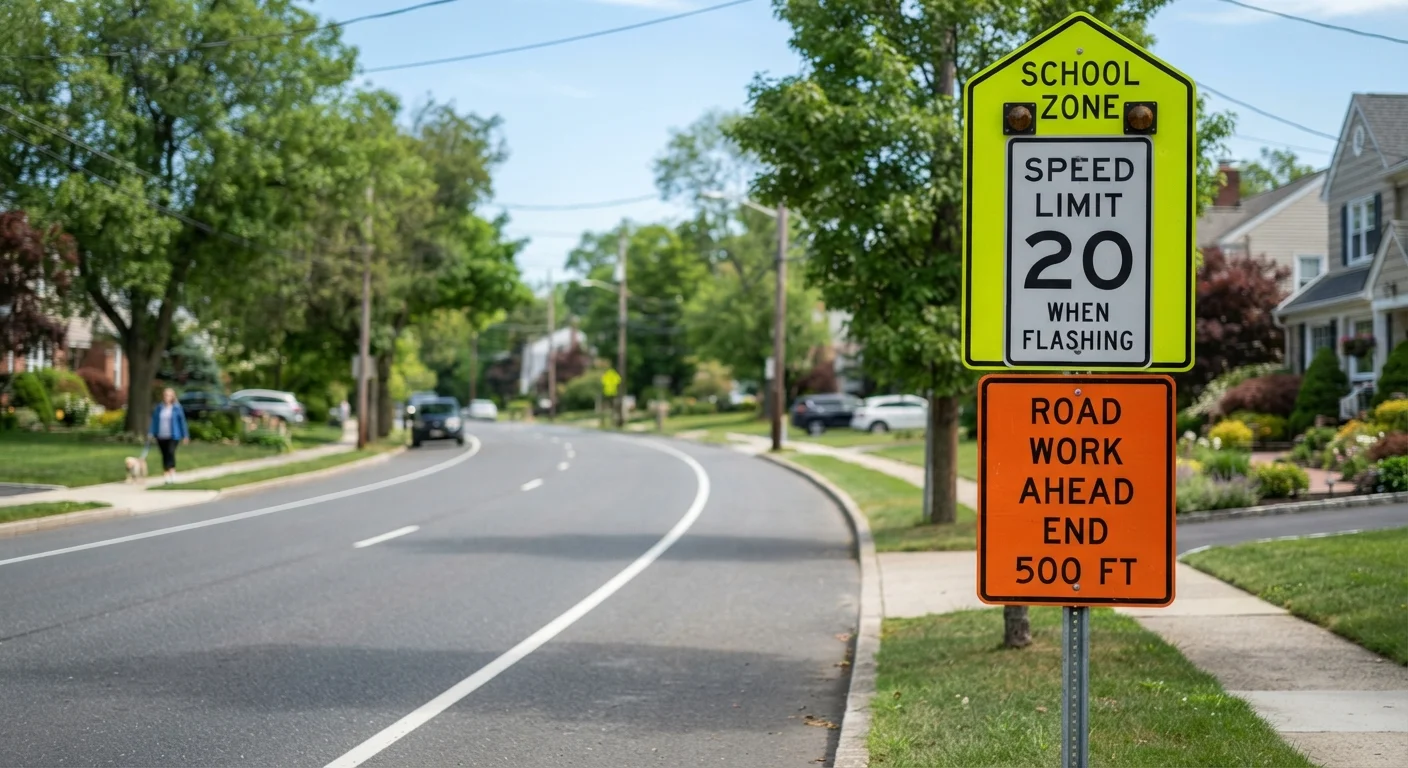
A school zone speed limit is not always active. Most states tie enforcement to one of two triggers: a flashing yellow beacon on the sign, or posted time windows such as "7:00 AM to 3:30 PM on school days." When neither condition is present, the standard road speed limit applies.
When a beacon is flashing, drivers must drop to the posted school zone speed, commonly 15 to 25 mph depending on the state and municipality, regardless of whether children are visibly present. Waiting to spot a child before slowing is not a legal defense.
Crosswalk rules tighten in school zones. A driver must stop and remain stopped until any pedestrian has fully crossed the travel lane, not just reached the center line. This applies at both marked crosswalks and intersections where a crosswalk is implied. For a broader look at how pedestrian right-of-way works, see pedestrian and cyclist safety for drivers.
Penalties in school zones are steep. Most states double the standard fine for speed violations, and some add license points at a higher rate. A few states apply increased fines regardless of whether a child was present at the time of the violation. Because these rules vary, checking your state's motor vehicle statutes is the reliable way to know the exact penalty schedule where you drive.
Work zone rules: signs, flaggers, and fines
| Typical school zone speed limit | 15 to 25 mph (Varies by state) |
| Fine multiplier in most states | 2x the standard fine (Varies by state; some states impose higher multipliers) |
| Work zone speeding fatalities (U.S.) | Hundreds per year (Federal Highway Administration data) |
| Flagger legal authority | Same as a traffic control device (MUTCD federal standard) |
| Speed reduction in work zones | Often 10 to 15 mph below posted limit (State DOT guidelines vary) |
Work zones use a sequence of signs to give drivers advance notice. The first sign typically reads "Road Work Ahead" and appears well before any lane shift or speed reduction. A reduced speed sign follows, and that limit is legally enforceable from the point the sign is posted, not from where the workers are standing.
Flaggers have the same legal authority as a stop sign or traffic signal under federal Manual on Uniform Traffic Control Devices (MUTCD) standards. When a flagger displays a stop paddle or raises a hand, a driver must stop. Proceeding past a flagger who has signaled stop is a moving violation in every state, and in many states it carries the same doubled-fine rule that applies to speeding.
Lane shifts and narrow shoulders are common in active work zones. When lanes are compressed, side mirrors can extend past painted edge lines, and the margin for error shrinks. The posted work zone speed accounts for that reduced clearance; driving at the prior road speed is both illegal and genuinely hazardous to road workers.
Many states enforce work zone fines even when no workers are physically present, because equipment and lane closures remain. Signs reading "fines double" are a legal notice, not a caution. Some states also suspend a driver's license for multiple work zone speeding convictions within a set period.
Because work zone rules, fine amounts, and license consequences differ by state, verify the specific rules for any state where you regularly drive. U.S. traffic laws that vary by state covers other areas where crossing a state line changes what is legally required of you. For a full picture of how traffic control devices interact with right-of-way, right-of-way rules every driver should understand walks through the relevant scenarios.