

Key Takeaways
- Right-of-way is a legal priority, not a guarantee of safety; yielding to an aggressive driver is always the wiser choice.
- At four-way stops, the first vehicle to arrive goes first; ties go to the driver on the right.
- Pedestrians in marked or unmarked crosswalks generally have the right-of-way over turning vehicles.
- Merging drivers must yield to traffic already on the highway; vehicles already in a lane do not have to move over.
- Emergency vehicles with lights and sirens active always have the right-of-way in every state.
- Right-of-way rules vary by state, so knowing local law matters when you cross state lines.
Right-of-way
Right-of-way is the legal priority one driver, cyclist, or pedestrian has to proceed before others in a shared traffic situation. No one owns the road permanently; right-of-way shifts depending on location, signs, signals, and the position of other road users. Yielding means giving up your turn so the party with priority can move safely.
Right-of-way laws are established at the state level, so specific rules can differ across jurisdictions. Always check the motor vehicle code for the state where you are driving.
What right-of-way actually means
Right-of-way tells you whose turn it is to move. It does not give anyone an absolute guarantee of a clear path, and it does not protect you from the consequences of a crash just because you had legal priority. The practical purpose of these rules is to make traffic flow predictable and to reduce conflicts at points where vehicles, cyclists, and pedestrians converge.
One principle applies everywhere: if yielding to someone who is behaving dangerously prevents a collision, yield. Courts and insurance adjusters sort out fault later. The road is not the place to assert legal technicalities.
Because these rules are set by individual states, some details vary. The core framework below reflects widely shared U.S. practice, but check your state's motor vehicle code for anything specific to where you drive. If you travel across state lines regularly, the traffic laws that vary by state article covers the most common differences.
Intersections: the most common source of confusion
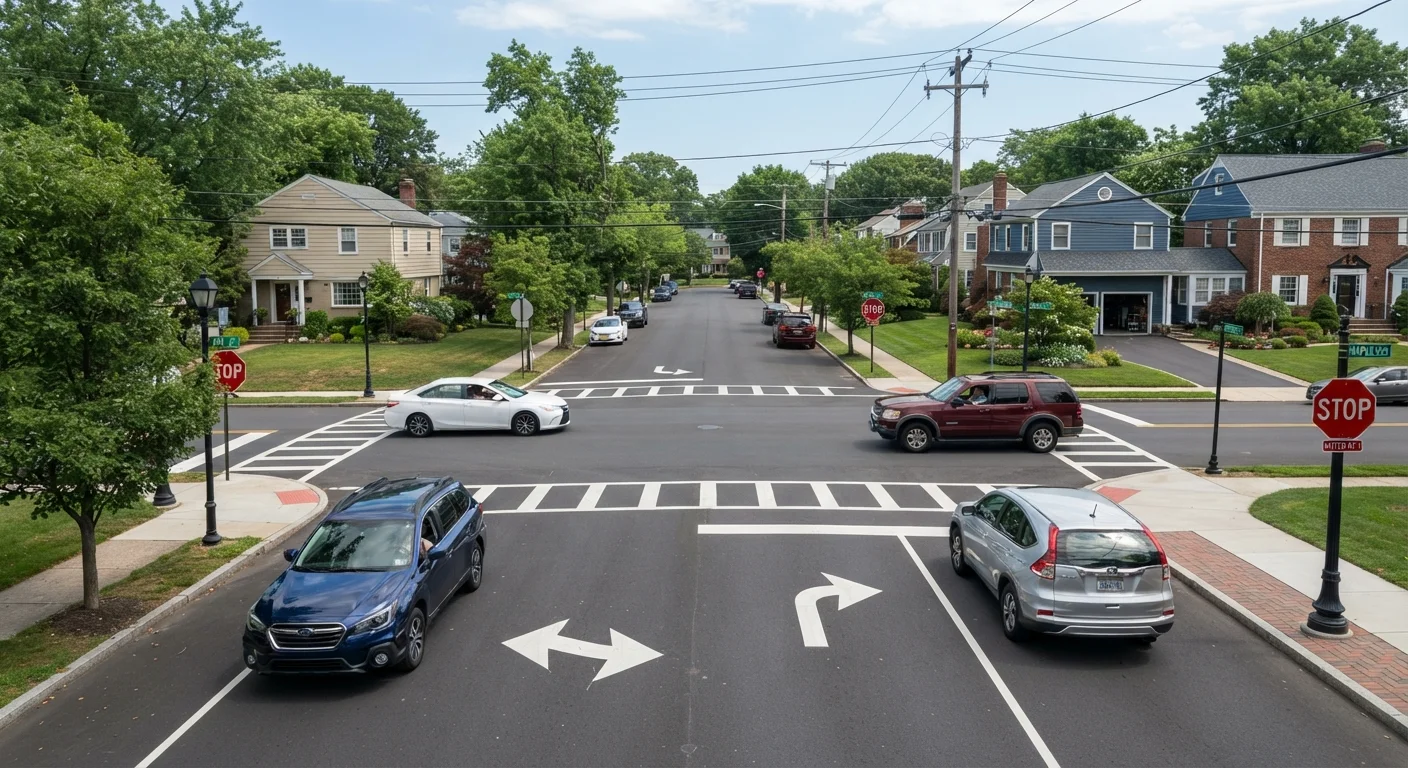
Intersections account for a large share of traffic conflicts, and right-of-way rules there follow a clear hierarchy.
Traffic signals and signs
A green light gives you the right to proceed, but it does not clear the intersection of cross-traffic that may have run a red. Always scan before entering. A red light means you must stop and yield to all crossing traffic and pedestrians. A flashing red works like a stop sign: stop completely, then proceed when clear.
Four-way stops
The vehicle that stops first goes first. If two vehicles arrive simultaneously, the one on the left yields to the one on the right. If three vehicles arrive at once, the same rule applies sequentially. If you are unsure who arrived first, make eye contact, use a hand gesture to wave someone through, and proceed only when the path is clear.
Uncontrolled intersections
At an intersection with no signs or signals, yield to any vehicle already in the intersection. If you arrive at the same time as another vehicle, yield to the vehicle on your right. These intersections appear more often on rural roads and in older neighborhoods.
When in doubt, yield
No right-of-way rule is worth a collision. If another driver appears to be proceeding regardless of who has priority, let them go. Defensive driving means adjusting to what other drivers actually do, not what they should do.
Left turns
A driver turning left must yield to oncoming traffic going straight and to pedestrians crossing the street being entered. This applies whether you are at a green light, a green arrow that has ended, or an uncontrolled intersection. Left-turn crashes are among the most preventable collisions on the road.
Pedestrians and cyclists
At marked crosswalks, drivers must stop for pedestrians who have stepped into the crosswalk. In most states, that obligation extends to unmarked crosswalks at intersections, which are the implied crossing zones at the corners of any intersection, even where no paint exists. A pedestrian crossing mid-block outside any crosswalk generally does not have legal priority, though stopping to avoid a collision is always the right call.
Cyclists on the road have the same rights and responsibilities as other vehicles in most states. That means a cyclist traveling straight through an intersection has the right-of-way over a driver turning across their path. When passing cyclists, give adequate lateral space; many states require a minimum distance of three feet.
Sharing the road with large vehicles adds another layer. Trucks have wide turning radii and large blind zones, so yielding even when you technically have priority can prevent a serious crash. The article on sharing the road with large trucks explains what car drivers often miss in those situations.
Merging, roundabouts, and emergency vehicles
On highway on-ramps, the merging driver yields to traffic already in the travel lane. The through-lane driver has no legal obligation to move over, though doing so when safe keeps traffic moving. For a deeper look at timing and speed on ramps, see freeway on-ramp and off-ramp technique.
At roundabouts, vehicles already circulating inside the roundabout have the right-of-way. Entering drivers yield and merge when a gap opens. Do not stop inside a roundabout to let someone in from an entrance.
Emergency vehicles with active lights and sirens have the right-of-way in every state. Pull to the right edge of the road and stop until the vehicle passes. On a divided highway, move right and stop in your lane; do not cross the median. After the vehicle passes, check for additional emergency vehicles before pulling back into traffic.
~40%
Of all U.S. traffic crashes occur at intersections
According to the Federal Highway Administration, intersection-related crashes account for a significant share of overall collision fatalities and injuries.
1 in 3
Fatal crashes involve an improper turn or failure to yield
National Highway Traffic Safety Administration data consistently identifies failure to yield and improper turns as leading driver-related factors in fatal crashes.