

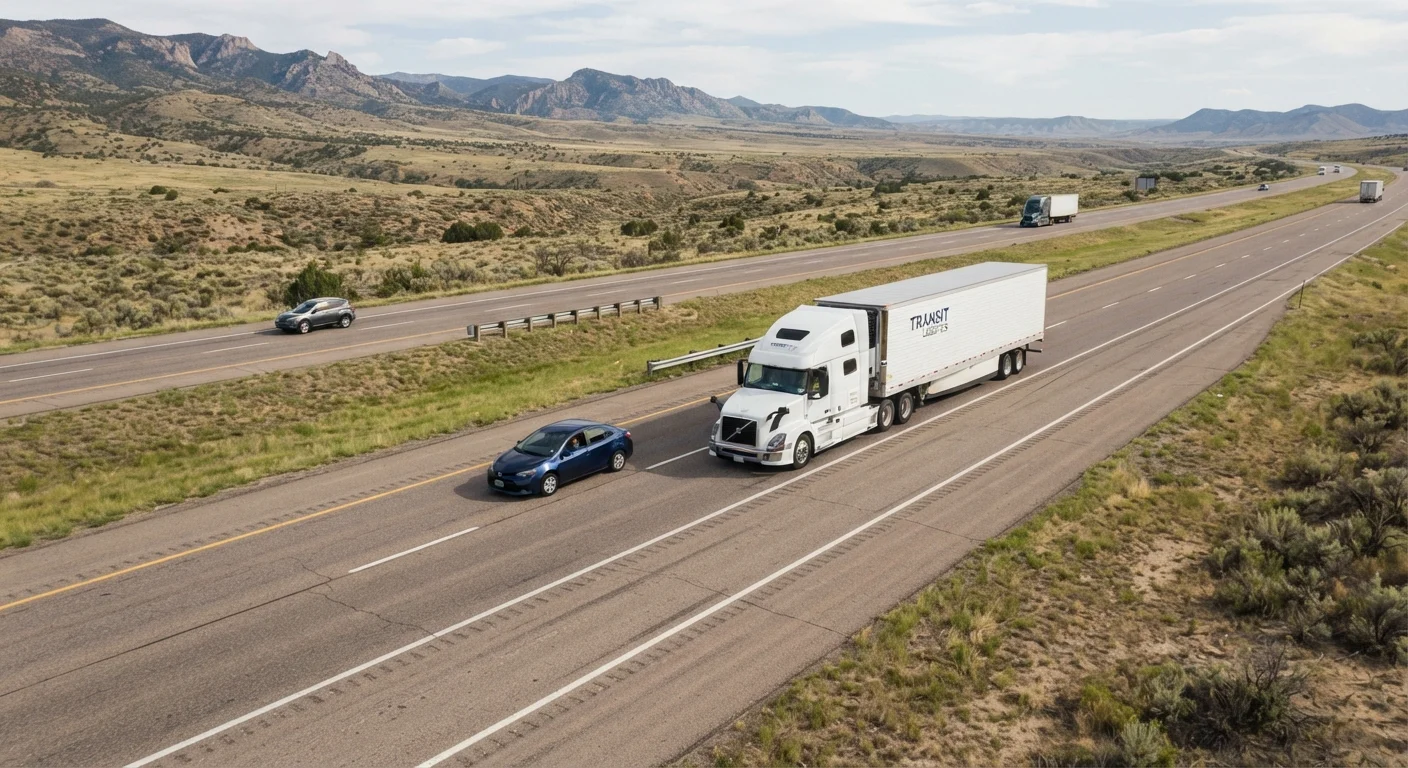
Key Takeaways
- Large trucks have four major blind zones where car drivers can disappear from the trucker's view entirely.
- A fully loaded semi needs up to 525 feet to stop from highway speed, roughly double a passenger car's distance.
- Wide right turns by trucks can trap cars that pull alongside at intersections.
- Passing quickly and predictably is safer than lingering beside a large truck.
- Wind turbulence from passing trucks can affect your steering, especially in crosswinds.
Why trucks behave differently than other vehicles
A fully loaded semi-truck can weigh up to 80,000 pounds. A typical passenger car weighs around 4,000 pounds. That 20-to-1 weight ratio changes almost every rule of road physics you rely on without thinking. Stopping distance, turning radius, wind displacement, and visibility are all dramatically different, and most car drivers only discover this during a close call.
Understanding how trucks move, and where they cannot see, lets you make smarter decisions around them. This is not about fear; it is about adjusting your habits to match conditions that are genuinely different from driving near other cars. See the car safety hub for related guidance on defensive driving principles.
The four blind zones you need to know
Truck mirrors cover a wide angle, but they cannot eliminate dead zones. The Federal Motor Carrier Safety Administration identifies four areas around a commercial truck where car drivers are invisible to the driver:
- Directly in front of the cab (approximately 20 feet)
- Directly behind the trailer (approximately 30 feet)
- Along the left side, roughly one lane wide for most of the trailer's length
- Along the right side, extending up to two lanes wide across the trailer's full length
The right-side blind zone is the largest. A car positioned beside the rear axle on the right has no mirror coverage and cannot be seen. A useful reference point: if you cannot see the truck driver's face in their side mirror, they cannot see you.
For a broader look at how blind spots form around your own vehicle too, see blind spots and the geometry behind them.
Pass trucks quickly and completely rather than lingering alongside them
The longer you stay beside a truck, the longer you occupy its blind zone. Extended side-by-side travel also exposes you to sustained wind turbulence and limits your escape options if the truck drifts or a tire blows.
Give extra following distance when behind a truck on grades or in traffic
Trucks can roll backward slightly on hills when starting from a stop, and they take longer to accelerate from low speeds. Staying farther back gives you time to react to unexpected rollback or slow acceleration.
Watch for blinker signals well before an intersection and position accordingly
Truck turn signals can be easy to miss when you are behind a large trailer, especially in bright daylight. Missing a right-turn signal and pulling up beside the truck is how drivers get caught in wide-turn traps.
Avoid stopping or parking in the space immediately behind a trailer
Drivers backing a trailer cannot see objects directly behind them, and the rear blind zone at low speeds is large. This applies in loading areas, truck stops, and tight urban streets.
Braking, merging, and following distance
At highway speeds, a loaded truck traveling at 65 mph needs about 525 feet to stop. That is longer than 1.5 football fields. If you cut in front of a truck and brake hard, the truck driver may have no way to avoid a collision regardless of reaction time.
When merging in front of a truck, wait until you can see the full front of the truck in your rearview mirror before moving over. That visual check confirms you have left enough space. Merging too early is one of the most common errors car drivers make near trucks.
Tailgating a truck blocks your sightline to the road ahead and puts you inside the rear blind zone simultaneously. Following too closely near any vehicle is dangerous, but the consequences escalate with trucks because you have no visibility and they have far less ability to stop quickly. A four-second following gap is a reasonable minimum; increase it in wet or heavy-load conditions.
For more on judging safe gaps, following distance and reaction time covers the mechanics in detail.
525 ft
Stopping distance for a loaded semi at 65 mph
According to the Federal Motor Carrier Safety Administration, this is roughly double the distance needed by a passenger vehicle under the same conditions.
~4,900
Large truck fatal crashes in the US annually
The National Highway Traffic Safety Administration reports that large trucks are involved in roughly 4,900 fatal crashes per year in the United States.
Intersections, wide turns, and wind
Trucks need significant space to complete a right turn. Drivers often swing left before turning right to create enough clearance for the trailer's rear wheels. If a car pulls into that gap on the right, it can get trapped as the trailer swings back over. Signs reading "Caution: Wide Right Turn" on truck rear doors are a direct warning about this.
At intersections, do not position your car to the right of a truck that is signaling right, even if there appears to be space. Wait behind the truck and let the turn complete.
Wind turbulence is a less obvious hazard. When a large truck passes you at speed, or when you pass one, the displaced air creates a pressure wave. On exposed sections of highway or in crosswinds, this can push your car noticeably sideways. Keep both hands on the wheel when passing or being passed by a truck, and avoid abrupt steering corrections.
Right-of-way rules at intersections also apply to truck-specific situations, particularly when trucks need extra space to maneuver.