

Key Takeaways
- The 3-second rule gives drivers a simple way to measure a safe following gap at any speed.
- Reaction time alone typically consumes around 1.5 seconds before braking even begins.
- Wet, icy, or gravel-covered roads extend stopping distance and require a larger gap.
- Tailgating is a leading factor in rear-end collisions, which are among the most common crash types in the US.
- Larger vehicles ahead require extra space because their bulk blocks your view of hazards further up the road.
- Adjusting your gap is a continuous habit, not a one-time setting you apply and forget.
Following distance
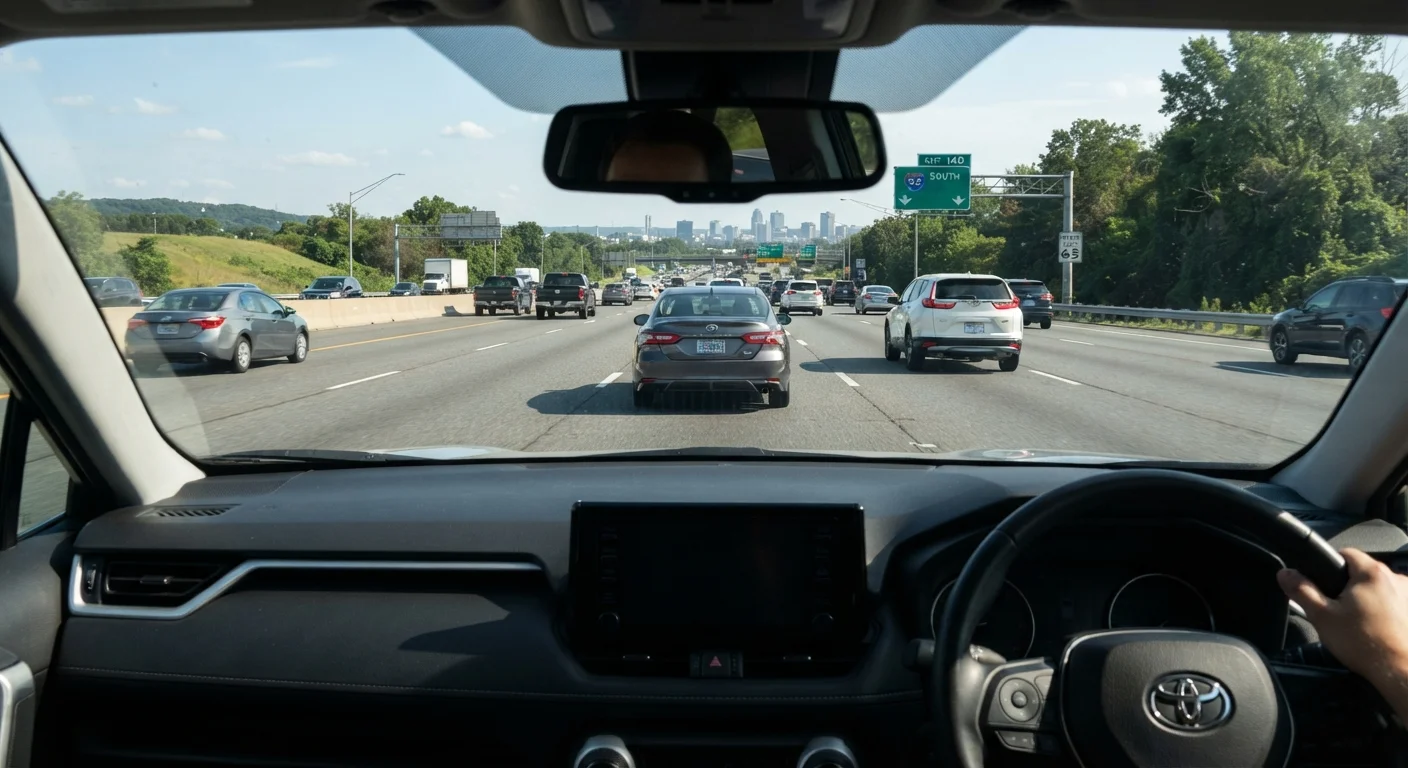
Following distance is the gap between the front of your vehicle and the rear of the vehicle ahead of you. Drivers use it as a buffer that gives them time to perceive a hazard, decide how to respond, and bring the car to a stop before a collision. The gap that looks like 'empty road' is, in practice, time.
Stopping distance is the sum of reaction distance (the ground covered while your brain processes the hazard and your foot moves to the brake) and braking distance (the ground covered while the brakes slow the vehicle to a stop). Both components grow with speed, so the required gap increases non-linearly as you go faster.
Why the gap ahead is really time
Most drivers think about space in feet or car lengths. The more useful frame is seconds. At 60 mph your car covers 88 feet every second, so a two-car-length gap (roughly 30 feet) gives you about one-third of a second to react. That is nowhere near enough. Human reaction time, from the moment you see a hazard to the moment your foot contacts the brake, averages around 1.5 seconds under normal conditions. Add braking distance on top of that and the math becomes uncomfortable quickly.
The physical gap you maintain is time stored up. When the car ahead stops short, that stored time is what prevents a collision. This is why stopping distance grows faster than speed does: at 30 mph you need roughly 75 feet to stop; at 60 mph the figure is closer to 240 feet, not 150.
How to measure your gap in real traffic
The 3-second rule is the method most driving instructors teach, and it holds up in practice. When the rear of the vehicle ahead passes a fixed roadside marker, count three full seconds. If your front bumper reaches that same marker before you finish counting, close the throttle and let the gap open.
Three seconds is a minimum for dry pavement at normal speeds. Conditions that extend your stopping distance require more time:
- Rain: use at least 5 to 6 seconds.
- Snow or ice: use 8 to 10 seconds or more.
- Gravel or loose surfaces: add at least 2 additional seconds.
- Heavy loads or towing: your own stopping distance increases, so add 2 to 3 seconds regardless of weather.
At night, tired, or in heavy traffic where the road ahead is obscured by another vehicle's bulk, a larger gap also improves your forward sightlines. That secondary benefit connects directly to reading the road ahead: the further ahead you can see, the earlier you can react.
Pick a fixed marker, not a moving one
When counting seconds, use a stationary roadside object: a sign post, a painted line, a shadow edge. Using another vehicle as your reference point introduces error because that vehicle is also moving. A fixed point gives you an honest measure of your gap in real time.
Common situations where drivers underestimate the gap needed
Highway speeds compress perceived distance. A 4-second gap at 70 mph is more than 400 feet of pavement, which looks enormous and often prompts other drivers to merge into it. Rebuilding that gap after a merge is the correct response; competing for it is not.
Following large trucks creates a specific hazard. Their height blocks your view of brake lights further up the road, meaning you may not see a hazard until the truck itself reacts. Driving near semi-trucks warrants at least 4 seconds of gap on dry roads, more in any other condition.
Urban stop-and-go traffic tempts drivers to close gaps to prevent merging. The result is that any vehicle ahead that stops faster than expected leaves no margin at all. The geometry of blind spots around adjacent vehicles also worsens when you are close, because your field of view narrows.
Following distance as a habit, not a rule
Checking your gap periodically is more effective than setting it once and assuming it holds. Speed varies, traffic density changes, and road surface conditions shift within a single trip. A driver who actively manages the gap is also a more attentive driver overall, which connects following distance to the broader habits described in defensive driving.
Rear-end collisions are one of the most frequently reported crash types on US roads, and following too closely is a documented contributing factor in a significant share of them. The gap ahead is the simplest variable in your control, adjustable at any moment, that directly affects your ability to avoid being part of that statistic.
~1.5 sec
Average driver reaction time before braking
This figure is widely cited in traffic safety research as the perception-reaction time under normal, alert driving conditions.
~240 ft
Total stopping distance at 60 mph on dry pavement
This estimate combines reaction distance and braking distance for a typical passenger vehicle under normal conditions; actual results vary by vehicle and tire condition.
2x
Approximate increase in stopping distance on wet roads
Wet pavement significantly reduces tire-to-road friction; the exact multiplier varies with tire tread depth, vehicle weight, and pavement type.