

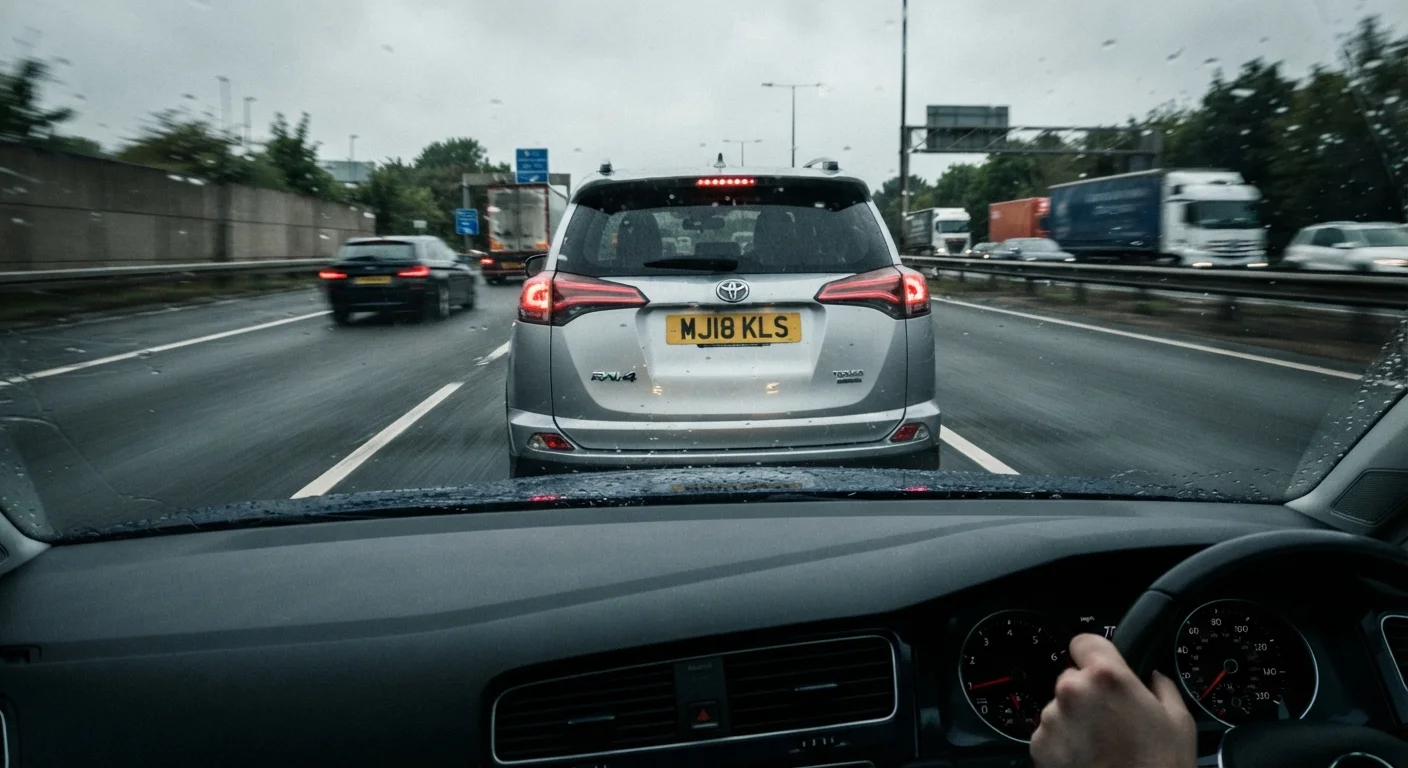
Key Takeaways
- Most drivers underestimate how much stopping distance increases as speed rises.
- Tailgating is a factor in a large share of rear-end crashes, which are among the most common collision types.
- Stress, habit, and overconfidence each lead drivers to close the gap more than they realize.
- A consistent three-second following gap is the practical baseline most traffic safety guidance recommends.
- Conditions like rain, darkness, and heavy loads all require more space, not the same amount.
Why tailgating causes more crashes than drivers expect
Rear-end collisions are one of the most frequent crash types on US roads, and following too closely is a leading contributing factor. The problem is not that drivers are unaware of the rule about keeping a safe gap. The problem is that most people think they are already doing it when they are not.
Stopping distance grows faster than speed does. At 60 mph, a typical passenger car needs roughly 240 feet to stop from the moment a driver perceives a hazard and applies the brakes. At 70 mph, that figure climbs by more than 80 additional feet. The math is covered in detail in our article on the physics of stopping distance. The short version: the gap most drivers leave looks adequate until the car ahead brakes hard.
Leaving a gap that looks safe at current speed but ignores the lead vehicle's potential to brake suddenly.
Why it happens: Drivers judge distance visually and tend to underestimate it. A one-car-length gap at 60 mph feels like room to spare but is far less than a single second of following time.
Reducing the gap in response to another vehicle filling the space ahead.
Why it happens: Drivers feel the gap is "theirs" and instinctively reclaim it when another vehicle moves in. This reaction is almost automatic.
Keeping the same following distance in rain, snow, or darkness as in clear, dry conditions.
Why it happens: Drivers often adjust speed for bad conditions but forget that braking distance scales with both speed and road surface. The mental adjustment stops at the speedometer.
Following large trucks at the same distance used for passenger cars.
Why it happens: Drivers treat all vehicles on the road as equivalent targets. Trucks have much longer stopping distances and larger blind zones at the rear.
Using tailgating as pressure to make a slower driver move over.
Why it happens: Frustration with lane discipline or a driver who seems to be blocking traffic triggers an urge to communicate displeasure through proximity.
Conditions that make the same gap more dangerous
A three-second gap on a dry highway in clear daylight is a reasonable baseline. Change any one variable and that same gap shrinks in practical terms.
Rain reduces tire grip and extends stopping distances. Wet roads can increase braking distance by 50 percent or more depending on speed, tire condition, and pavement type. If your tires are worn, the numbers get worse. Our guide to hydroplaning causes and responses explains how quickly grip can disappear on wet surfaces.
Night driving adds a reaction-time problem on top of the physics. Reduced visibility means a driver may not register a brake light or a stopped vehicle ahead as quickly as in daylight. For a fuller picture of how darkness changes risk, see our piece on night driving challenges.
Driving near large trucks requires extra space in both directions. A semi-truck's stopping distance is considerably longer than a passenger car's, and following one closely puts you inside the truck driver's rear blind zone. Our article on sharing the road with large trucks covers what passenger-car drivers commonly miss.
Worn tires make every gap smaller
Stopping distance figures assume tires with adequate tread depth. Worn tires lose grip earlier under braking, meaning the gap that would stop you safely in dry conditions may not be enough. Check tread depth regularly. If any tire is near or below the wear indicator, the vehicle's stopping performance is already compromised.
Building the habit of accurate gap judgment
The three-second rule is practical because it scales with speed automatically. Pick a fixed point on the road, such as a sign or a road marking. When the vehicle ahead passes it, count three seconds. If you reach that point before you finish counting, you are too close.
Many drivers find their gap shrinks without them noticing, especially in heavy traffic. A vehicle in an adjacent lane merges into the space, the driver accelerates to close it back up, and the cycle repeats. The fix is to treat the gap as something you maintain actively, not something you set once and forget.
Tailgating also raises the risk of road-rage escalation. The driver ahead may interpret a close following distance as aggression and respond unpredictably. Our article on understanding and managing road rage explains how quickly these situations can worsen and what steps reduce that risk.
For drivers still building situational awareness, especially newer drivers, our guide on following distance and reaction time walks through how to judge the gap accurately across different real-world conditions. The habit of scanning farther ahead also matters: reading the road ahead describes how experienced drivers use early visual cues to give themselves more time.