

Key Takeaways
- Match freeway traffic speed before you reach the merge point, not after.
- Your mirrors and a quick shoulder check should be done before the ramp curves end.
- On off-ramps, slow down after you exit the freeway, not while still in the travel lane.
- A short acceleration lane does not change your target speed; adjust your entry timing instead.
- Hesitating on an on-ramp is often more dangerous than committing to a confident merge.
What you will need
Why on-ramps and off-ramps cause so many problems
Most freeway crashes do not happen in the middle lane at cruising speed. They happen at the transitions: where slower surface-street traffic meets vehicles moving at 60 or 70 mph. The physics are unforgiving. A speed differential of 20 mph between a merging car and a freeway vehicle leaves almost no room for error.
The two most common mistakes are braking on an on-ramp (which makes matching freeway speed impossible) and decelerating in the travel lane before reaching the off-ramp exit. Both create sudden speed mismatches that other drivers cannot always predict. Stopping distance grows disproportionately with speed, so even a brief gap in speed can require the driver behind you to react faster than is safely possible.
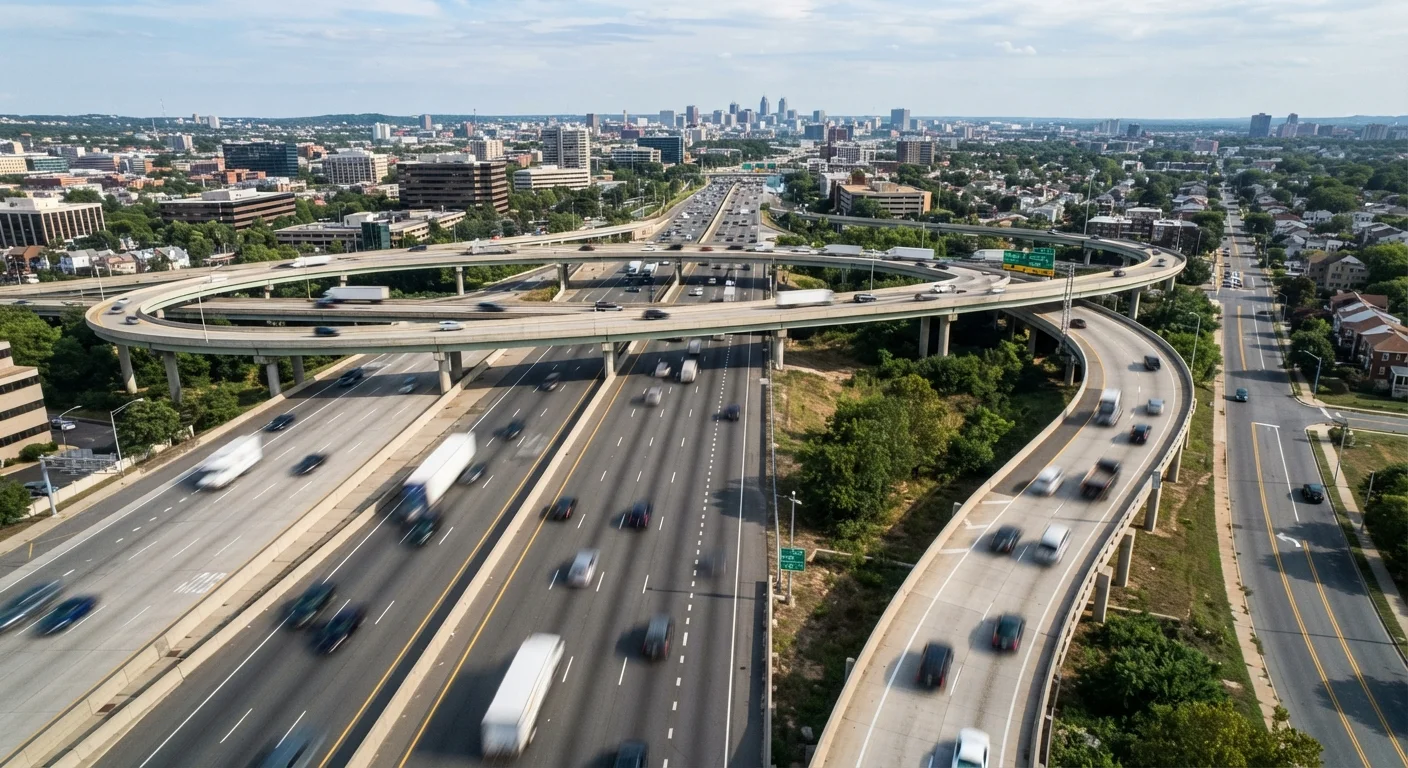
Understanding what the ramp is actually for changes how you use it. An acceleration lane is not a place to decide whether to merge. It is the distance the road gives you to reach the speed you need before the lane ends.
Practice scanning earlier, not harder
New drivers often fixate on the vehicle directly beside them. Experienced drivers scan the entire right lane for gaps 10 to 15 seconds ahead of the merge point. Building this habit makes merging feel far less rushed. A structured approach to scanning the road ahead can help you develop it systematically.
How to merge onto a freeway
Check traffic before you commit to the ramp
Before you turn onto the on-ramp, glance at freeway traffic if it is visible. Note the speed and density of vehicles in the right lane. This preview lets you plan your acceleration rate and start identifying a gap before you need one.
Accelerate steadily through the entire acceleration lane
Use the full length of the acceleration lane to reach freeway speed. If posted freeway speed is 65 mph, your goal is to be at or near 65 mph by the time you reach the merge point, not 45 mph with a plan to speed up after. Steady acceleration is smoother for you and more predictable for freeway drivers.
Signal and identify your gap while still in the acceleration lane
Turn on your signal early, then scan your mirrors and check your blind spot. You are looking for a gap in the right lane large enough to enter without requiring the freeway driver to brake. Aim to match the speed of the vehicle just ahead of your intended entry point.
Merge smoothly and cancel your signal
Move into the gap with a steady steering input. Do not jerk the wheel. Once you are fully in the travel lane, cancel your signal and match the flow of surrounding traffic. Check your mirrors again to confirm you have cleared the lane line and that the vehicle behind you has adequate space.
After completing the merge, maintain your speed and stay aware of how much space surrounds your vehicle. The gap ahead of you matters as much as the gap beside you during those first few seconds after entering the freeway. Move toward the center lanes when traffic allows, which gives you more options if conditions change.
If another driver is already in the lane you need, do not force the merge. Adjust your speed to slot in behind them rather than alongside them. Closing that gap under pressure is how rear-end situations start.
How to exit a freeway safely
Exiting a freeway requires the opposite discipline: you stay at freeway speed until you are in the deceleration lane, then slow down. Touching the brakes while still in the travel lane forces the driver behind you to react to an unexpected speed drop at highway speed.
Read the exit signs early. Most freeways post the first sign about a mile before the exit, then again at half a mile and at the exit itself. Use those markers to move right gradually, not in one abrupt lane change. Signal at least three to four seconds before you move.
Once you are fully in the deceleration lane or on the ramp itself, brake smoothly to match the posted ramp speed. Many off-ramp curves have an advisory speed lower than the freeway limit, and those figures are based on the geometry of the curve, not a conservative suggestion. Reading signs and road markings well ahead of your position is what makes this feel unhurried rather than reactive.
At the end of the ramp, come to a full stop or yield as required before entering surface streets. Do not carry freeway momentum into a signalized intersection.
Handling short or awkward ramps
Not every on-ramp gives you a full acceleration lane. Some older interchanges provide only a few hundred feet before the lane ends or the ramp curves directly into traffic. In those situations, adjust your approach before you commit to the ramp.
If you can see freeway traffic is heavy and moving fast, wait at the ramp entrance for a usable gap rather than accelerating into a lane with no room. This is one case where a brief stop is safer than an incomplete acceleration. On short ramps, the merge happens earlier and the speed target may be slightly lower; aim to be as close to freeway speed as the ramp allows and look for the widest available gap.
Yield signs at ramp ends are a legal instruction, not a suggestion. If a yield sign is present and traffic does not have room for you, stop and wait. Right-of-way at merge points works differently from intersections, and understanding those rules prevents the kind of standoff that can provoke aggressive responses from other drivers. For more on staying composed in tense traffic moments, see how road rage develops and how to avoid escalating it.