

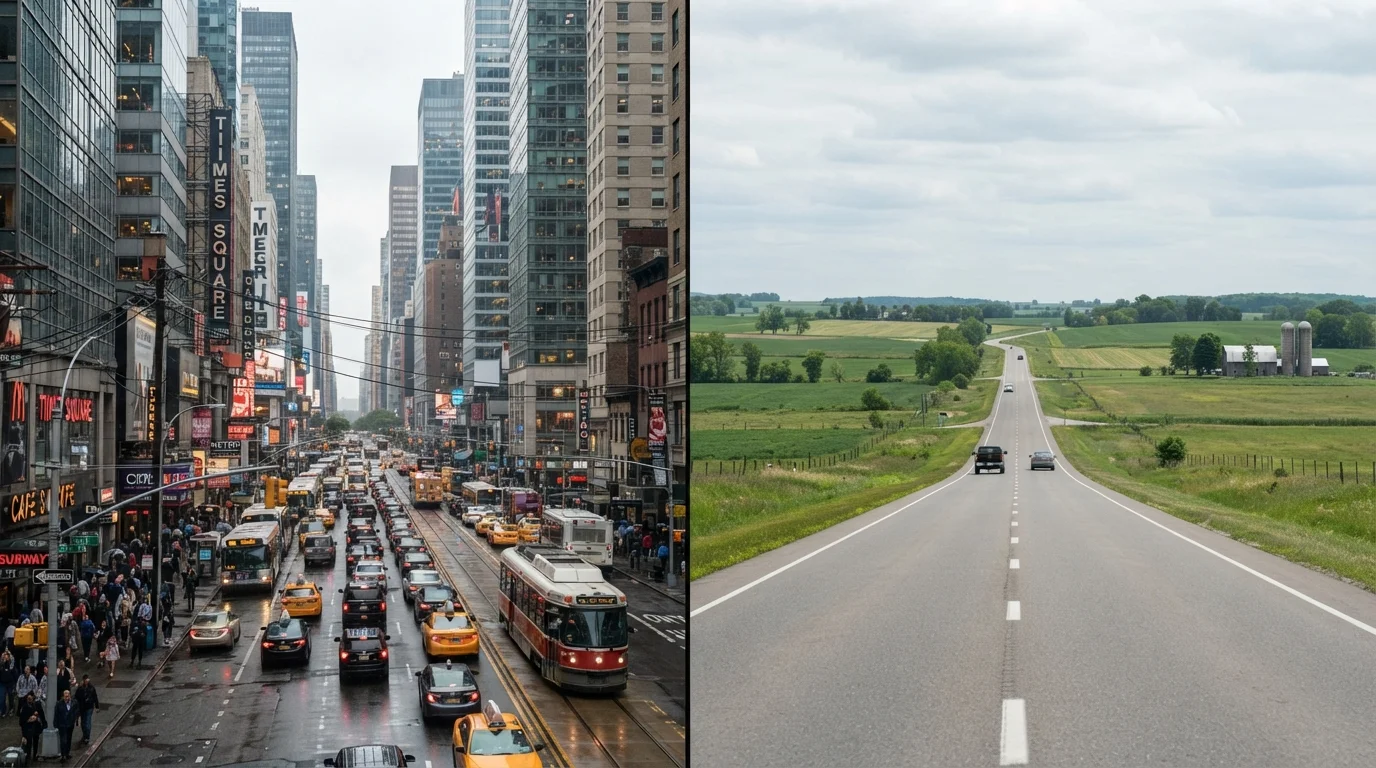
Key Takeaways
- City driving involves more frequent hazards per mile but at lower speeds, reducing the severity of many crashes.
- Rural roads have fewer vehicles but higher posted speed limits and less consistent road maintenance.
- Fatality rates per mile driven are historically higher on rural roads than urban ones in the United States.
- Pedestrians, cyclists, and unexpected turning vehicles are the most common city driving hazards.
- Rural driving introduces risks like deer crossings, no shoulder, limited cell service, and delayed emergency response.
- Adapting your speed, following distance, and attention to the environment you are actually in matters more than any single rule.
Lower speed limits reduce crash severity
Most city streets are posted at 25 to 35 mph, which means collisions that do occur tend to cause less kinetic force than those at highway or rural speeds.
Emergency services reach you faster
Urban areas have shorter average response times for police, fire, and EMS, which can matter significantly after a serious collision or medical event behind the wheel.
Better road surface maintenance in most cities
High-traffic urban roads receive more frequent inspection and repair cycles, meaning potholes and deteriorated pavement are more likely to be addressed promptly.
More route options reduce single-point risk
A blocked lane, flooded street, or crash scene rarely traps you in a city the way it can on a two-lane rural road with no alternate path for miles.
Rural roads offer fewer distractions
Light traffic, no dense signage, and fewer merging vehicles let drivers focus on the road itself rather than constantly monitoring multiple lanes and pedestrian zones.
Rural driving allows more predictable traffic flow
Without traffic signals, cyclists, delivery trucks double-parked, or sudden pedestrian crossings, the path ahead on a rural road is often more stable and readable.
City traffic creates constant high-attention demand
Drivers must track pedestrians, cyclists, buses, and merging vehicles simultaneously. Decision fatigue over a long commute increases the chance of a lapse in attention.
Door zones and cyclists add collision risk
Parked cars on city streets create a persistent hazard when occupants open doors into moving traffic. For more on sharing urban space, see managing road space with pedestrians and cyclists.
Higher fatality rates per mile on rural roads
The National Highway Traffic Safety Administration has consistently reported that rural roads account for a disproportionate share of traffic fatalities relative to the miles driven on them.
Wildlife crossings and unmarked hazards on rural routes
Deer, livestock, and other animals can appear on rural roads with no warning, and the combination of higher speeds and poor lighting makes avoidance much harder than in a city.
Limited cell coverage complicates rural emergencies
A breakdown or crash on a remote rural road may leave a driver with no way to call for help, and the nearest service station or responder may be a significant distance away.
City driving raises the frequency of minor incidents
Fender benders, scraped mirrors, and near-misses are more common in tight urban traffic, which raises insurance claim frequency even when individual incidents are not severe.
Rural roads often lack shoulders and guardrails
A tire blowout or overcorrection at rural speeds, without a shoulder to pull onto or a barrier to limit the vehicle's path, can turn a manageable situation into a serious one.
Our Verdict
Neither environment is inherently safer in every way. City roads concentrate hazards into shorter distances at lower speeds, while rural roads spread risk across longer stretches where speed and isolation amplify consequences. Understanding what each environment demands helps drivers adjust their habits rather than assume open space equals safety.
Drivers who split time between urban and rural roads and want a clear picture of where their habits may need to change.
What makes these two environments so different
City roads and rural roads are not simply fast versus slow or busy versus quiet. The hazards in each environment follow different patterns, and a driver who is well-calibrated for one can develop blind spots in the other.
Urban driving is dense and low-speed. Interactions with pedestrians, cyclists, transit vehicles, and parked cars happen constantly. The margin for error is small in lateral space but relatively forgiving in terms of kinetic energy, since most collisions occur at speeds that cause property damage rather than fatal injuries.
Rural driving is sparse but high-speed. The open road invites faster travel, and the consequences of a mistake scale with that speed. Add limited infrastructure, unpredictable wildlife, and delayed emergency response, and the risk profile shifts considerably.
How intersections are designed also differs between environments. Cities rely heavily on signals and marked crosswalks, while rural intersections are often uncontrolled or rely on stop signs that drivers may treat as low-stakes.
The case for city driving
The most consistent advantage of urban driving is the speed constraint. Lower speed limits reduce the kinetic energy involved in any collision, which is why injury severity in city crashes tends to be lower than in rural crashes at comparable vehicle weights.
Emergency response is faster in cities. If a driver has a medical event, a tire failure causes a collision, or a crash blocks a lane, responders are typically minutes away rather than tens of minutes away.
Road surface quality in high-traffic urban corridors is also generally better maintained than on low-volume rural routes, where repair budgets are spread across more miles with fewer users.
Lower speed limits reduce crash severity
Most city streets are posted at 25 to 35 mph, which means collisions that do occur tend to cause less kinetic force than those at highway or rural speeds.
Emergency services reach you faster
Urban areas have shorter average response times for police, fire, and EMS, which can matter significantly after a serious collision or medical event behind the wheel.
Better road surface maintenance in most cities
High-traffic urban roads receive more frequent inspection and repair cycles, meaning potholes and deteriorated pavement are more likely to be addressed promptly.
More route options reduce single-point risk
A blocked lane, flooded street, or crash scene rarely traps you in a city the way it can on a two-lane rural road with no alternate path for miles.
Rural roads offer fewer distractions
Light traffic, no dense signage, and fewer merging vehicles let drivers focus on the road itself rather than constantly monitoring multiple lanes and pedestrian zones.
Rural driving allows more predictable traffic flow
Without traffic signals, cyclists, delivery trucks double-parked, or sudden pedestrian crossings, the path ahead on a rural road is often more stable and readable.
The risks city driving creates
The density that makes cities manageable in a crash also makes crashes more frequent. A driver navigating a busy urban corridor must process pedestrians stepping off curbs, cyclists filtering through stopped traffic, delivery vehicles blocking lanes, and buses pulling in and out, all within a few city blocks.
Door zones are a persistent hazard on street-parked corridors. A driver who passes too close to parked cars risks a sudden door opening into the travel lane. This is especially relevant for cyclists, but it also forces drivers to position themselves carefully.
City traffic creates constant high-attention demand
Drivers must track pedestrians, cyclists, buses, and merging vehicles simultaneously. Decision fatigue over a long commute increases the chance of a lapse in attention.
Door zones and cyclists add collision risk
Parked cars on city streets create a persistent hazard when occupants open doors into moving traffic. For more on sharing urban space, see managing road space with pedestrians and cyclists.
Higher fatality rates per mile on rural roads
The National Highway Traffic Safety Administration has consistently reported that rural roads account for a disproportionate share of traffic fatalities relative to the miles driven on them.
Wildlife crossings and unmarked hazards on rural routes
Deer, livestock, and other animals can appear on rural roads with no warning, and the combination of higher speeds and poor lighting makes avoidance much harder than in a city.
Limited cell coverage complicates rural emergencies
A breakdown or crash on a remote rural road may leave a driver with no way to call for help, and the nearest service station or responder may be a significant distance away.
City driving raises the frequency of minor incidents
Fender benders, scraped mirrors, and near-misses are more common in tight urban traffic, which raises insurance claim frequency even when individual incidents are not severe.
Rural roads often lack shoulders and guardrails
A tire blowout or overcorrection at rural speeds, without a shoulder to pull onto or a barrier to limit the vehicle's path, can turn a manageable situation into a serious one.
Attention fatigue is real in stop-and-go urban traffic. The cumulative effect of constant small decisions over an hour-long commute creates conditions where a driver is more likely to miss a signal change or fail to notice a pedestrian stepping out.
Where rural roads carry more risk than they appear to
Open roads feel safer because traffic is light. That sense of space can lead drivers to underestimate stopping distances, follow curves at higher speeds than road geometry supports, and react more slowly because the environment seems predictable.
The NHTSA fatality data is clear on this point: rural roads produce a disproportionate share of fatal crashes relative to the miles driven on them. Speed is the primary factor, combined with roadway geometry that often lacks forgiving runoff areas, guardrails, or clear sight lines around curves.
~50%
Share of US traffic fatalities on rural roads
According to the National Highway Traffic Safety Administration, rural roads have consistently accounted for roughly half of all US traffic deaths despite carrying far less than half of total vehicle miles traveled.
25 mph
Typical urban default speed limit
Many US cities have adopted 25 mph as a standard default speed on residential streets, based on research linking speed to pedestrian survivability in a collision.
2x
Rural fatality rate vs. urban per mile driven
NHTSA data indicates the fatality rate per 100 million vehicle miles traveled is roughly twice as high on rural roads as on urban roads.
Wildlife is a real and underappreciated hazard. Deer collisions peak at dawn and dusk, the same low-light periods when rural roads lack the ambient illumination of city streets. A deer entering the road at 60 mph gives a driver less than a second to react.
Weather affects both environments differently
Rain lowers visibility and grip on any road, but the consequences differ by environment. In a city, slow traffic limits how far a vehicle travels before a driver can react. On a rural road at higher speeds, the same conditions leave far less margin. Wet-road driving techniques apply in both settings but matter more when you have more speed to manage.
Breakdowns on remote rural roads also carry risks that city breakdowns do not. No cell coverage, no nearby help, and high-speed passing traffic make a disabled vehicle on a rural shoulder genuinely dangerous. Pulling completely off the road, turning on hazard lights, and staying away from moving traffic lanes matters more when help may be far away.