

Key Takeaways
- Roundabouts eliminate the left-turn conflicts that cause most fatal crashes at traditional intersections.
- Traffic signals give pedestrians more predictable, protected crossing phases than roundabout splitter islands do.
- Roundabouts generally improve average vehicle throughput at low-to-moderate traffic volumes.
- Traditional intersections handle very high pedestrian volumes and complex multi-leg crossings more reliably.
- Right-of-way rules differ between the two designs, and drivers unfamiliar with roundabouts need to adjust their habits.
- Local traffic engineers weigh crash history, pedestrian counts, and traffic volume before choosing a design.
Option A
Roundabout
A circular junction that keeps traffic moving through yield-based entry.
Best for: Moderate-volume intersections where reducing severe crashes and improving flow are the priorities.
Option B
Traditional intersection
A signal- or sign-controlled crossing point familiar to most American drivers.
Best for: High-volume urban corridors where pedestrian crossings are frequent and signal timing can be finely tuned.
If the intersection handles moderate traffic and severe-crash history is a concern
Roundabout
Roundabouts remove the high-speed angle and left-turn conflicts that produce fatal or incapacitating crashes, and they do so without requiring signal timing adjustments.
If the crossing point is in a dense urban area with heavy pedestrian and cyclist traffic
Traditional intersection
Signalized intersections give pedestrians a dedicated, clearly timed phase to cross, which is easier to navigate than the continuous-yield environment of a roundabout.
If traffic volumes are very high and consistent throughout the day
Traditional intersection
At saturated volumes, signal control can manage throughput across multiple legs more precisely than a single-lane roundabout circulatory road.
How the two designs work
A traditional intersection stops or signals each approach separately. Drivers wait for a green light or a clear gap, then cross paths with vehicles from other directions. Left turns across oncoming traffic are common, and they account for a large share of serious crashes at these junctions.
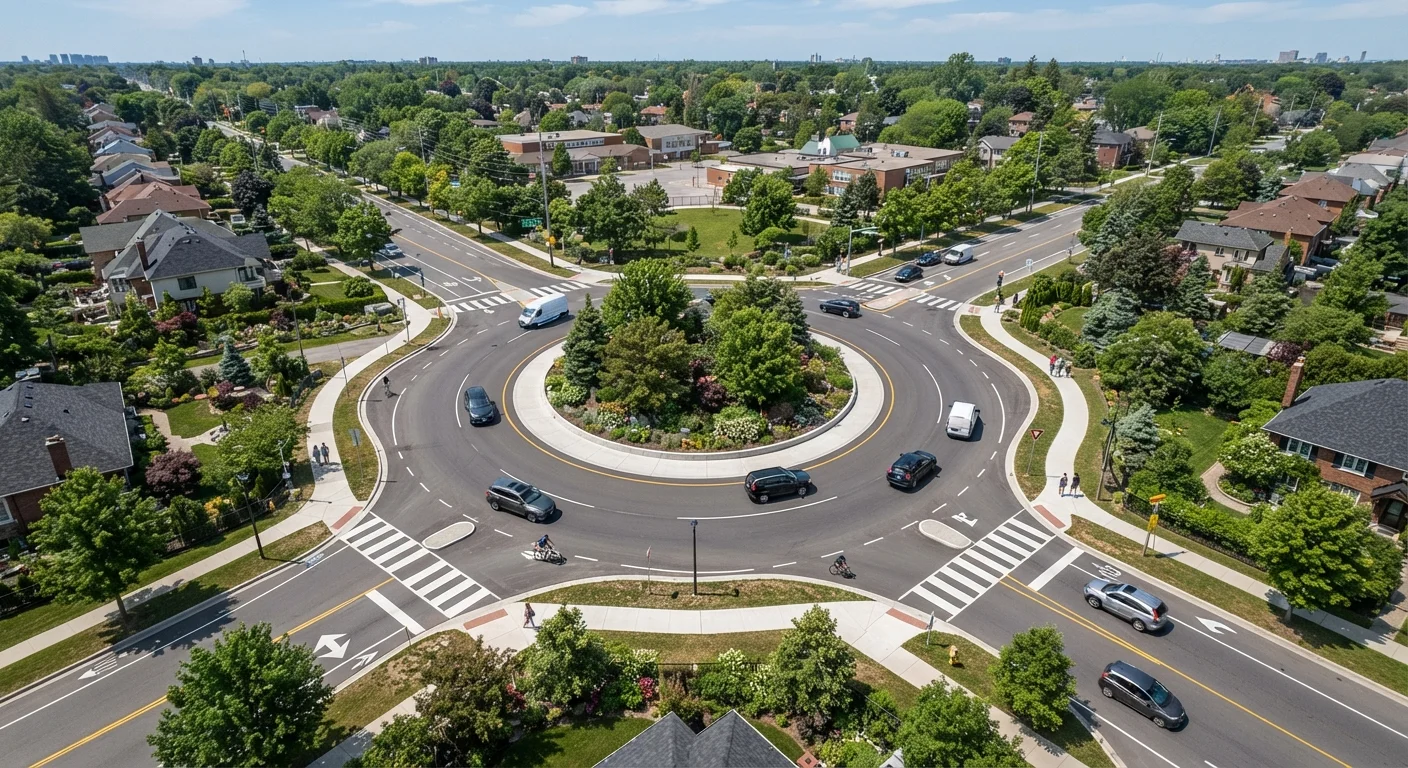
A roundabout replaces that crossing pattern with a one-way loop. Entering drivers yield to vehicles already in the circle, merge in, travel around the central island, and exit at their chosen road. Because all traffic moves in the same direction, the high-speed angle collisions that make traditional intersections dangerous are largely removed.
Right-of-way rules at roundabouts differ from those at stop signs or signals, which is one reason many American drivers feel uncertain when they first encounter one. At a roundabout, circulating traffic always has priority. Entering drivers must wait for a gap, even if no signal tells them to stop.
Roundabouts are not the same as traffic circles
Modern roundabouts are engineered with specific entry geometry, yield-at-entry rules, and lower design speeds. Older traffic circles and rotaries, which some US cities still have, use different rules and can involve higher speeds. The safety data for modern roundabouts does not automatically apply to those older designs.
Safety: where each design has an advantage
The safety record of modern roundabouts is well-documented by the Insurance Institute for Highway Safety. Converting a traditional signalized intersection to a roundabout reduces injury crashes by roughly 40 percent on average, and fatal or incapacitating crashes by approximately 75 percent. The geometry itself drives this outcome: vehicles travel more slowly through the curve, and no one is crossing directly in front of fast-moving traffic.
~40%
Reduction in all injury crashes
The Insurance Institute for Highway Safety has reported that converting traditional intersections to roundabouts reduces injury crashes by roughly 40 percent on average.
~75%
Reduction in fatal and incapacitating crashes
The same IIHS research found fatal and incapacitating crashes drop by approximately 75 percent after roundabout conversion.
3,700+
Modern roundabouts in the US
The Federal Highway Administration has noted that the number of modern roundabouts in the United States has grown substantially from fewer than a dozen in the early 1990s.
Traditional intersections have their own safety strengths. Signalized crosswalks give pedestrians and cyclists a protected phase with clear start and stop cues. At a roundabout, pedestrians cross on a yield basis at splitter islands, which requires more independent judgment. For people with visual impairments or mobility limitations, that environment can be more difficult to read. Accessible pedestrian signals at traditional intersections provide audio and tactile feedback that roundabouts generally do not replicate as well.
Traffic flow and efficiency
At low-to-moderate traffic volumes, roundabouts move more vehicles per hour than signalized intersections. Traffic does not sit through a full red-light cycle when the competing approach is empty. During off-peak hours, the continuous-flow design reduces overall delay.
At very high volumes, particularly when multiple approaches carry heavy loads simultaneously, the roundabout circulatory road can become a bottleneck. Signal-controlled intersections allow engineers to allocate green time precisely across approaches, which makes them more adaptable at saturation. Multi-lane roundabouts can handle higher volumes, but they also introduce more complex weaving behavior and greater difficulty for drivers who are unfamiliar with the layout.
Roundabouts also function without electricity. A power outage turns a signalized intersection into an uncontrolled four-way stop, while a roundabout continues operating under its standard yield rules. Traffic laws vary by state, and some states have specific rules about how drivers should treat a dark signal, so it is worth knowing the local rule wherever you drive.
What drivers should know behind the wheel
At a roundabout, slow down as you approach, watch for pedestrians at the crosswalk before the yield line, and check for a gap in circulating traffic before entering. Signal your exit so drivers behind you and pedestrians ahead of you can anticipate your move. Do not stop inside the circle unless traffic ahead forces you to.
At a traditional intersection, the main errors involve misjudging gaps on left turns and running stale yellow lights. Pedestrian and cyclist safety at signalized crossings still depends on drivers checking for people who may still be crossing as a light changes.
City and rural driving each bring different intersection patterns. Rural areas have seen a faster growth in roundabout adoption partly because lower-speed approaches make the design easier to retrofit and because severe rural crashes motivated a search for alternatives to stop signs on fast two-lane roads.