

Key Takeaways
- Phone use is one source of distraction among many; eating, grooming, and in-vehicle controls all divert attention.
- Distraction has three forms: visual, manual, and cognitive. Many common activities trigger all three at once.
- Cognitive distraction lingers after the physical task ends, so the risk window is longer than most drivers assume.
- Hands-free phone use reduces manual distraction but does not eliminate cognitive distraction.
- Traffic laws on phone use vary by state, and compliance alone does not make a driver fully attentive.
Distracted driving
Distracted driving is any activity that pulls a driver's attention away from the primary task of operating a vehicle safely. Distractions fall into three categories: visual (eyes off the road), manual (hands off the wheel), and cognitive (mind off the drive). Phone use gets most of the attention in public conversation, but eating, adjusting in-vehicle controls, talking to passengers, and even daydreaming produce the same types of impairment.
Cognitive distraction can persist for several seconds after a task ends, a period researchers call 'attention residue,' meaning a driver may still be impaired even after putting down a phone or finishing a conversation.
Why the phone framing is too narrow
Handheld phone use is illegal in most US states and gets the largest share of public awareness campaigns, but it represents one category within a wider problem. The National Highway Traffic Safety Administration (NHTSA) has consistently documented that distraction-affected crashes involve a range of behaviors: eating and drinking, adjusting radio or navigation controls, interacting with passengers, personal grooming, and external objects outside the vehicle.
Each of these activities pulls attention in one or more of three ways. Visual distraction takes a driver's eyes off the road. Manual distraction removes one or both hands from the wheel. Cognitive distraction occupies working memory with something other than driving. A glance at a navigation screen is primarily visual. Reaching for a coffee cup is both manual and visual. A hands-free phone call is almost entirely cognitive. Many everyday habits combine all three.
For a fuller picture of how attention works during driving, see the science behind mind-wandering and focus.
Set up before you drive
Entering a destination, adjusting seat and mirrors, and selecting audio before the vehicle moves eliminates most screen interaction that would otherwise happen at speed. A two-minute pre-trip routine removes a significant share of in-motion distraction.
The distractions drivers most often overlook
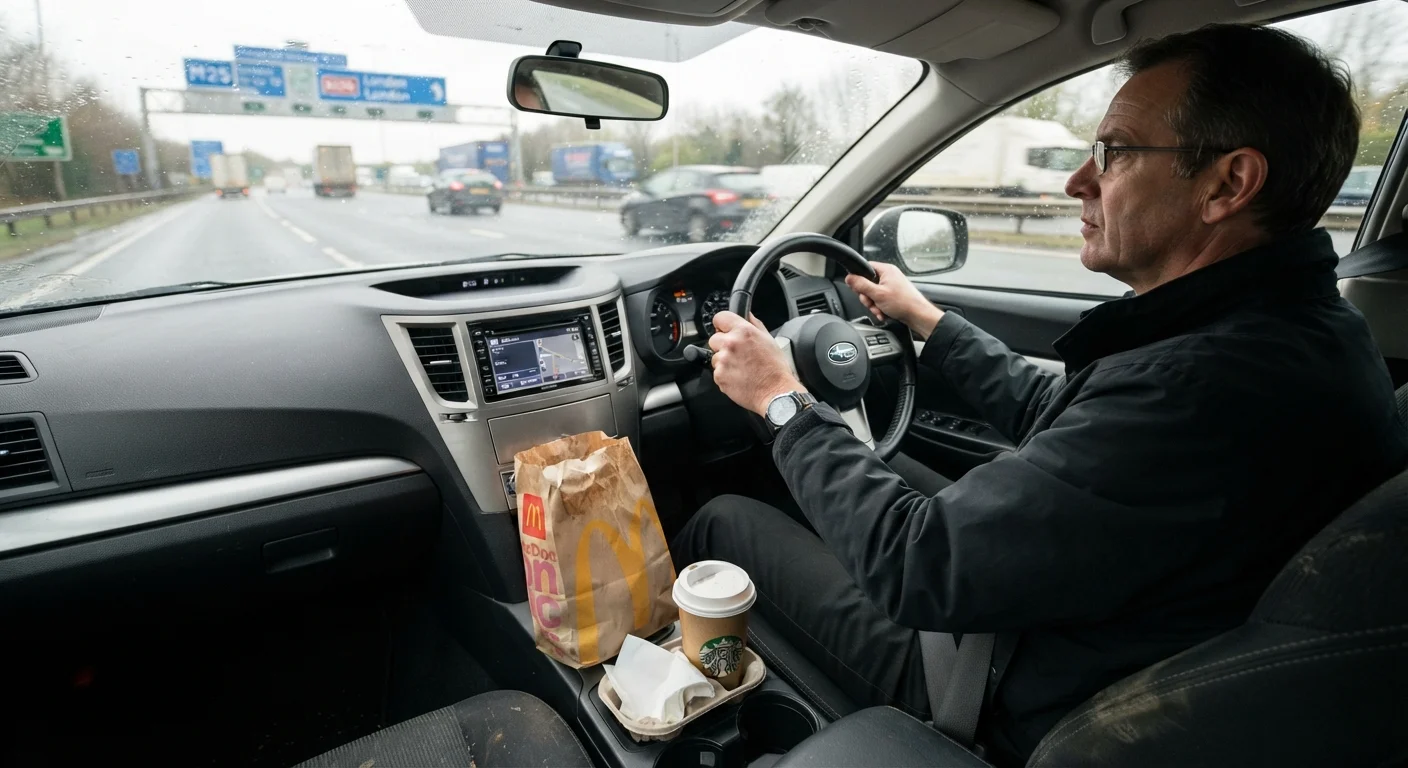
Eating and drinking behind the wheel is one of the most common forms of distraction, and one of the least regulated. Unwrapping food, managing a spill, or retrieving something from a bag in the passenger seat can occupy a driver for several seconds at a time. Because eating feels routine, most drivers do not register it as impairment.
Passenger conversations present a different kind of distraction. Adults talking with another adult in the vehicle tend to adjust naturally when traffic becomes demanding. Teenagers are less consistent at this, and research from several decades of crash data has linked young driver crashes to the presence of peer passengers rather than phone use specifically.
Modern vehicle controls add another layer. Touch-screen infotainment systems, climate controls embedded in digital menus, and voice-command interfaces that require multiple interactions all demand eyes and attention. A driver searching through audio menus while traveling at highway speed covers significant ground without full attention on the road.
Cognitive distraction also comes from within: stress, unresolved personal issues, and fatigue all reduce the cognitive bandwidth available for driving. This overlaps with the impairment seen in drowsy driving. For more on that connection, see why fatigue is treated like impairment.
~3,300
US deaths involving distracted drivers annually
NHTSA has reported approximately this figure across recent reporting years, though annual totals vary.
5 seconds
Average time eyes are off road when reading a text
At 55 mph, that is the equivalent of traveling the full length of a football field without looking, according to NHTSA educational materials.
4x
Crash risk increase with handheld phone use
Research published in epidemiological studies, including work cited by the Insurance Institute for Highway Safety, has estimated this approximate increase in collision risk.
What the risk actually looks like on the road
Distracted drivers do not always cause crashes. Many distracted moments pass without incident, which reinforces the incorrect belief that the behavior is safe. The risk is probabilistic: distraction reduces the time available to react to unexpected events. A child stepping off a curb, a vehicle braking suddenly ahead, or a cyclist in a door zone all require a fraction-of-a-second response. Distraction erodes that margin.
Pedestrians and cyclists are particularly exposed when drivers are inattentive at intersections and crosswalks, where most conflicts occur. The driver's responsibilities around pedestrians and cyclists depend on consistent visual scanning, which any distraction interrupts.
Following too closely makes distraction more dangerous. A driver who is both tailgating and cognitively distracted has less time and less space to respond if the vehicle ahead brakes. The two behaviors compound each other in ways that neither does individually.
Practical steps that reduce distraction
Stowing a phone before starting the vehicle removes the temptation to respond to notifications. Do Not Disturb driving modes, available on most smartphones, suppress incoming alerts automatically. Managing which apps can send notifications in the first place reduces the pull. The guide to smarter notification habits covers how to audit and adjust those settings.
For in-vehicle controls, setting navigation destinations, adjusting climate, and selecting audio before driving eliminates the need to interact with screens while in motion. Pre-trip setup takes a few minutes and removes most of the interaction that would otherwise happen at speed.
Distraction laws vary significantly across states, including what counts as a handheld device and what penalties apply. Traffic laws that vary by state covers where those differences are greatest. Legal compliance sets a floor, not a ceiling, for safe driving behavior.