

Key Takeaways
- Your circadian rhythm governs sleep timing, hunger, hormone release, body temperature, and mood across every 24-hour cycle.
- Light is the strongest external signal that sets and resets your internal clock each day.
- Irregular sleep schedules, shift work, and late-night screen exposure are among the most common disruptors.
- Consistent sleep and wake times, morning light exposure, and timed meals can reinforce a healthy rhythm.
- Chronic circadian disruption is associated with higher risk of metabolic, cardiovascular, and mood disorders.
Circadian rhythm
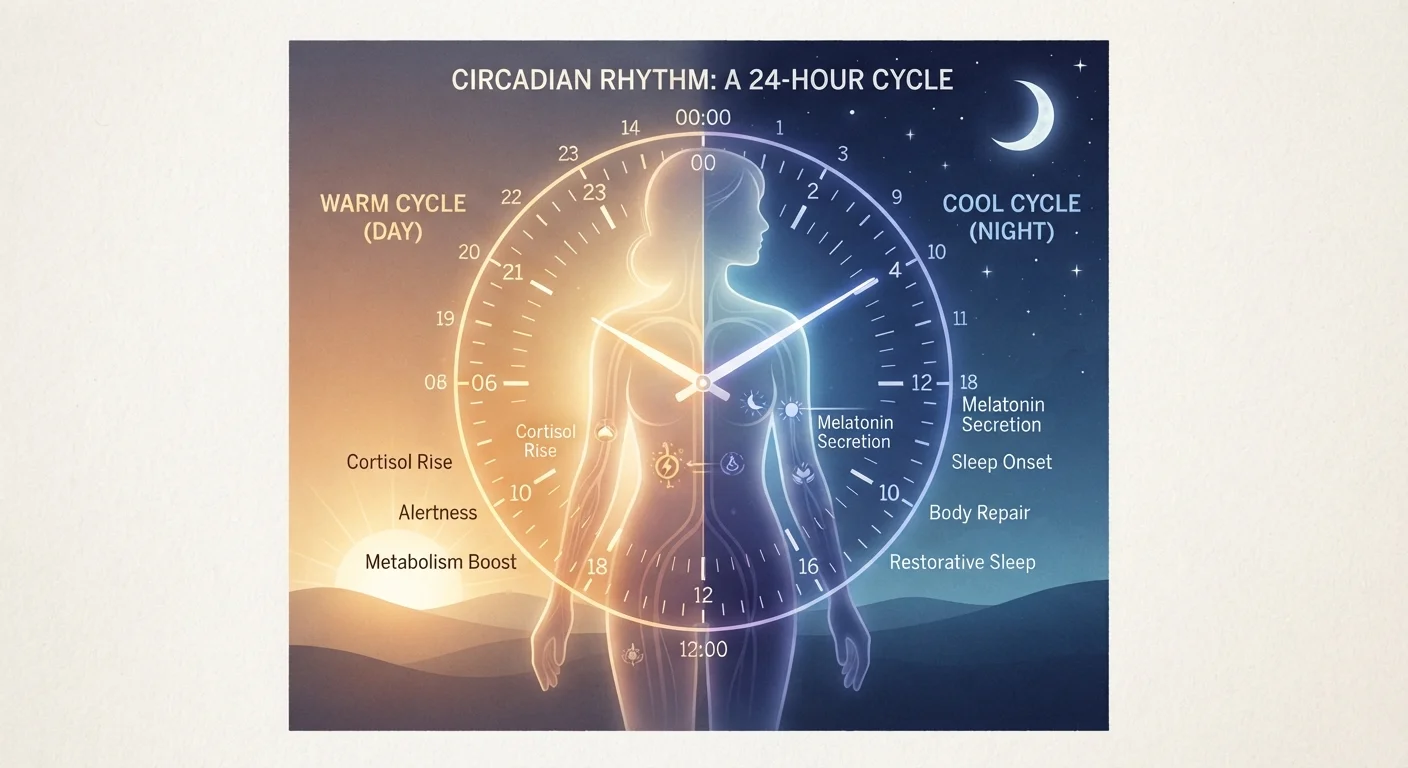
A circadian rhythm is an internal biological cycle that repeats approximately every 24 hours and regulates when your body sleeps, wakes, eats, and releases hormones. Nearly every cell in the human body contains molecular clock machinery that follows this cycle. The master clock, a small region in the brain called the suprachiasmatic nucleus (SCN), coordinates all these individual cellular clocks using light as its primary time cue.
The SCN sits in the hypothalamus and receives direct input from light-sensitive retinal cells containing melanopsin, a photopigment especially sensitive to short-wavelength (blue) light.
How the internal clock actually works
The suprachiasmatic nucleus (SCN) in the hypothalamus is roughly the size of a grain of rice, yet it coordinates biological timing across every organ system. It does this by sending hormonal and neural signals that rise and fall on a near-24-hour schedule. The word 'circadian' comes from the Latin circa diem, meaning 'about a day,' which reflects that the clock runs on approximately 24 hours rather than exactly.
Inside each cell, a set of clock genes (including CLOCK, BMAL1, PER, and CRY) form a feedback loop that takes about 24 hours to complete one cycle. The SCN synchronizes all these cellular clocks using light as the dominant external cue, a process called entrainment. Without regular light exposure, the internal clock drifts slightly each day.
Temperature, physical activity, and meal timing also act as secondary time cues, sometimes called zeitgebers (German for 'time givers'). These signals reinforce the master clock but cannot fully substitute for light. Artificial lighting after dark can blunt the evening rise in melatonin, making it harder for the clock to signal that night has arrived.
What your circadian rhythm controls
Sleep and wakefulness are the most visible outputs, but the clock governs a much wider range of physiology. Core body temperature drops by about 1 to 2 degrees Fahrenheit in the hours before sleep and rises again before waking. Cortisol peaks in the early morning to prepare the body for activity, then declines through the day. Melatonin rises after darkness to signal sleep onset and suppresses again before dawn.
Hunger hormones follow circadian patterns too. Ghrelin (which drives appetite) and leptin (which signals fullness) both fluctuate across the day, partly explaining why late-night eating can feel different from eating the same food at noon. Insulin sensitivity is generally higher in the morning than in the evening, which has implications for blood sugar regulation and metabolic health.
Mood and cognitive performance also track the clock. Reaction time, working memory, and attention tend to peak in the late morning to early afternoon for most people, though individual chronotypes (whether you are naturally an early riser or a night owl) shift these windows. Elevated cortisol from chronic stress can disrupt this hormonal rhythm and fragment sleep even when total sleep time looks adequate.
~24.2 hrs
Average intrinsic human circadian period
Research from Harvard Medical School has measured the average free-running circadian period in humans at approximately 24.2 hours, slightly longer than a solar day, which is why daily light exposure is needed to keep the clock synchronized.
20%
U.S. workers in shift or non-standard schedules
The Bureau of Labor Statistics has estimated that roughly 1 in 5 U.S. workers holds a job with non-standard hours, making circadian misalignment a widespread occupational health concern.
~90 min
Melatonin onset lead time before sleep
In most adults with a typical sleep schedule, melatonin secretion begins roughly 90 minutes before habitual sleep onset, according to circadian physiology research.
What disrupts the clock most
Irregular sleep and wake times are the most common disruptor for everyday adults. When bedtime shifts by two or more hours between weekdays and weekends, the body experiences what researchers call social jetlag, a weekly rhythm mismatch that carries measurable metabolic and mood consequences.
Shift work is a more severe form of the same problem. Working overnight or rotating shifts forces alertness during the body's biological night, and the misalignment between the internal clock and external schedule accumulates over time. Research has associated chronic shift work with higher rates of metabolic syndrome and cardiovascular risk, though individual responses vary widely.
Light exposure after dark, especially from screens emitting short-wavelength light, suppresses melatonin and delays the clock's sleep signal. This is one reason the common belief that winding down with a screen is harmless does not hold up to scrutiny. Alcohol, though it can accelerate sleep onset, fragments the second half of the sleep period and alters the normal circadian pattern of sleep stages.
Eating large meals late at night sends conflicting time signals to peripheral organ clocks, which use meal timing as an independent synchronizing cue separate from the light signal reaching the SCN.
Practical ways to support your rhythm
Consistent sleep and wake times, including on weekends, give the SCN a reliable anchor. Morning light exposure within an hour of waking is the single most direct way to reinforce the clock's daytime signal. Even on overcast days, outdoor light is significantly brighter than typical indoor lighting and more effective at entraining the SCN.
Timing meals to daylight hours aligns peripheral organ clocks with the master clock. This does not require rigid eating windows, but avoiding large, calorie-dense meals in the two to three hours before bed is consistent with circadian biology. Pre-sleep behavioral patterns that dim lighting and reduce stimulation in the evening support the natural melatonin rise.
Morning habits that include light exposure and movement can reinforce the circadian signal without requiring dramatic schedule changes. Regular physical activity, timed to morning or afternoon rather than late evening, also acts as a positive zeitgeber for most people.
Anyone dealing with persistent sleep difficulty, shift work misalignment, or suspected circadian disorders should consult a qualified healthcare provider. Circadian biology is general information about how the body works, not a personal prescription. A clinician can assess individual factors and recommend appropriate interventions.
This article provides general health information and education only. It is not medical advice. Consult a qualified healthcare professional for guidance specific to your health circumstances.