

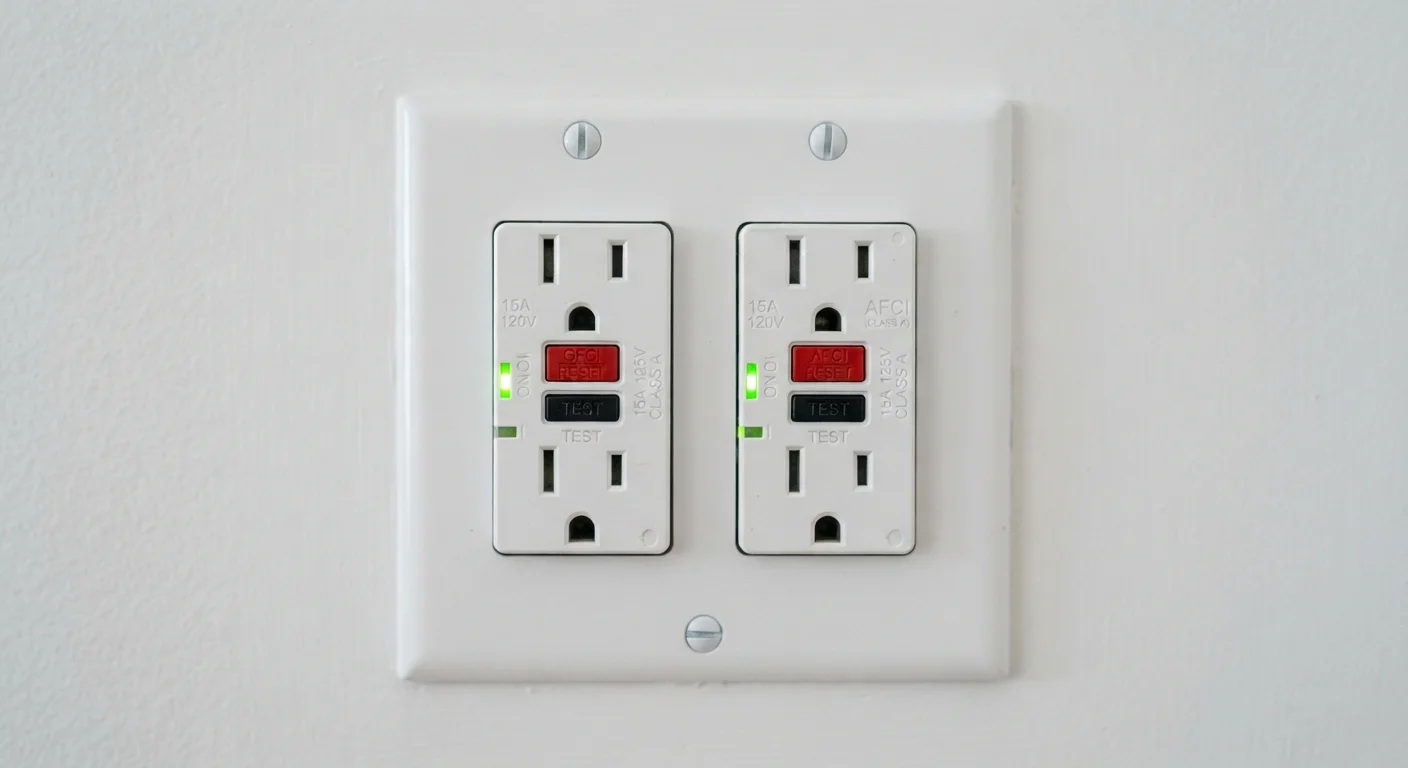
Key Takeaways
- GFCI outlets cut power in milliseconds when current leaks to an unintended path, reducing shock risk near water.
- AFCI outlets detect the irregular electrical arcing that can ignite insulation or framing before a fire starts.
- The National Electrical Code specifies where each type is required; requirements vary by construction date and room type.
- Both types have test and reset buttons, but they are not interchangeable: each addresses a distinct hazard.
- Some locations now require dual-function outlets that combine both GFCI and AFCI protection in one device.
Option A
GFCI outlet
Protection against electric shock from ground faults near water.
Best for: Bathrooms, kitchens, garages, and any area where water and electricity may come into contact.
Option B
AFCI outlet
Protection against electrical fires caused by arc faults in wiring.
Best for: Bedrooms, living rooms, and finished areas where damaged or aging wiring could ignite a fire.
If you are replacing or adding outlets in a bathroom, kitchen, garage, or near any water source
GFCI outlet
Ground faults near water are the primary hazard in wet locations. A GFCI outlet interrupts power fast enough to prevent a lethal shock.
If you are updating outlets in a bedroom, living room, or finished basement
AFCI outlet
These rooms rarely involve water but often have concealed wiring that can arc due to age, damage, or staple punctures. AFCI protection addresses that risk directly.
If your local code or an inspector requires protection in a location that qualifies for both
Dual-function AFCI/GFCI outlet
A single dual-function device satisfies both requirements without needing two separate outlets or a combination circuit breaker.
How each outlet works
A GFCI (ground fault circuit interrupter) outlet constantly compares the current flowing out on the hot wire with the current returning on the neutral wire. Under normal conditions those two values match. If something diverts current along an unintended path, such as through a person who touches a live appliance while standing on a wet floor, the mismatch trips the outlet in roughly 1/40th of a second. That response time is fast enough to prevent a lethal shock in most circumstances.
An AFCI (arc fault circuit interrupter) outlet works differently. It monitors the wiring for the electrical signature of an arc fault: a high-temperature discharge that occurs when current jumps a gap between damaged, frayed, or compressed wires. A loose connection behind a wall plate, a cord pinched under furniture, or a staple driven through a cable can all create arcing conditions that a standard breaker would never detect. The AFCI outlet recognizes those irregular patterns and cuts power before the arc can ignite surrounding material.
Older homes and code compliance
Homes built before AFCI or GFCI requirements existed are not automatically required to be updated unless renovation work triggers a permit. However, voluntarily adding GFCI protection in wet areas and AFCI protection in bedrooms is a practical safety measure regardless of when the home was built. Check with your local building department for specific guidance.
Where each type is required
The National Electrical Code (NEC) sets the baseline for where GFCI and AFCI protection must be installed in new construction and renovations. Local jurisdictions can adopt the NEC with amendments, so the exact requirements in your area may differ. Always verify with your local building department before starting electrical work.
GFCI protection is generally required in bathrooms, kitchens within six feet of a sink, garages, unfinished basements, crawl spaces, outdoor receptacles, and near pools or hot tubs. The logic is consistent: anywhere water and electricity could meet.
AFCI protection has expanded across NEC editions. Bedrooms were the first rooms added, then living rooms, hallways, closets, and most finished spaces followed in later code cycles. If your home was built or rewired recently, a substantial portion of your branch circuits may already require AFCI breakers or outlets.
Some locations, such as kitchen countertop circuits and finished basements, can require both types of protection. A dual-function AFCI/GFCI outlet or a dual-function breaker satisfies that requirement in a single device.
Installation and safety considerations
Both outlet types can protect not just themselves but also additional standard outlets connected downstream on the same circuit, provided the wiring is done correctly. The line terminals connect to the circuit's incoming wires; the load terminals connect to any outlets further along the circuit you want to protect. This is labeled on the device itself.
Testing each outlet monthly using the built-in test button is a straightforward habit. Press the test button, confirm power is off at the outlet, then press reset. If the outlet does not trip or does not reset, it should be replaced.
Electrical work that involves opening a panel, running new circuits, or replacing a breaker carries serious shock and fire risks. That work should be done by a licensed electrician. Replacing an existing outlet with a GFCI or AFCI outlet of the same configuration is a more limited task, but if you are uncertain about the wiring in your home, a professional assessment is the safer path. Just as smoke and carbon monoxide detectors each address a specific threat and belong in specific locations, GFCI and AFCI outlets are designed for distinct hazards and are not substitutes for each other.