

| Smoke detector placement | Ceiling or high on walls, inside and outside every sleeping area, every level (NFPA 72) |
| CO detector placement | Every level and outside sleeping areas, 5 ft or higher on walls (CPSC guidance) |
| Smoke detector lifespan | 10 years from manufacture date (NFPA 72) |
| CO detector lifespan | 5 to 7 years, per manufacturer rating (Manufacturer specifications) |
| Test frequency | Monthly for both detector types (NFPA 72) |
| Minimum distance from cooking appliances (CO) | 15 feet (CPSC) |
Two different threats, two different devices
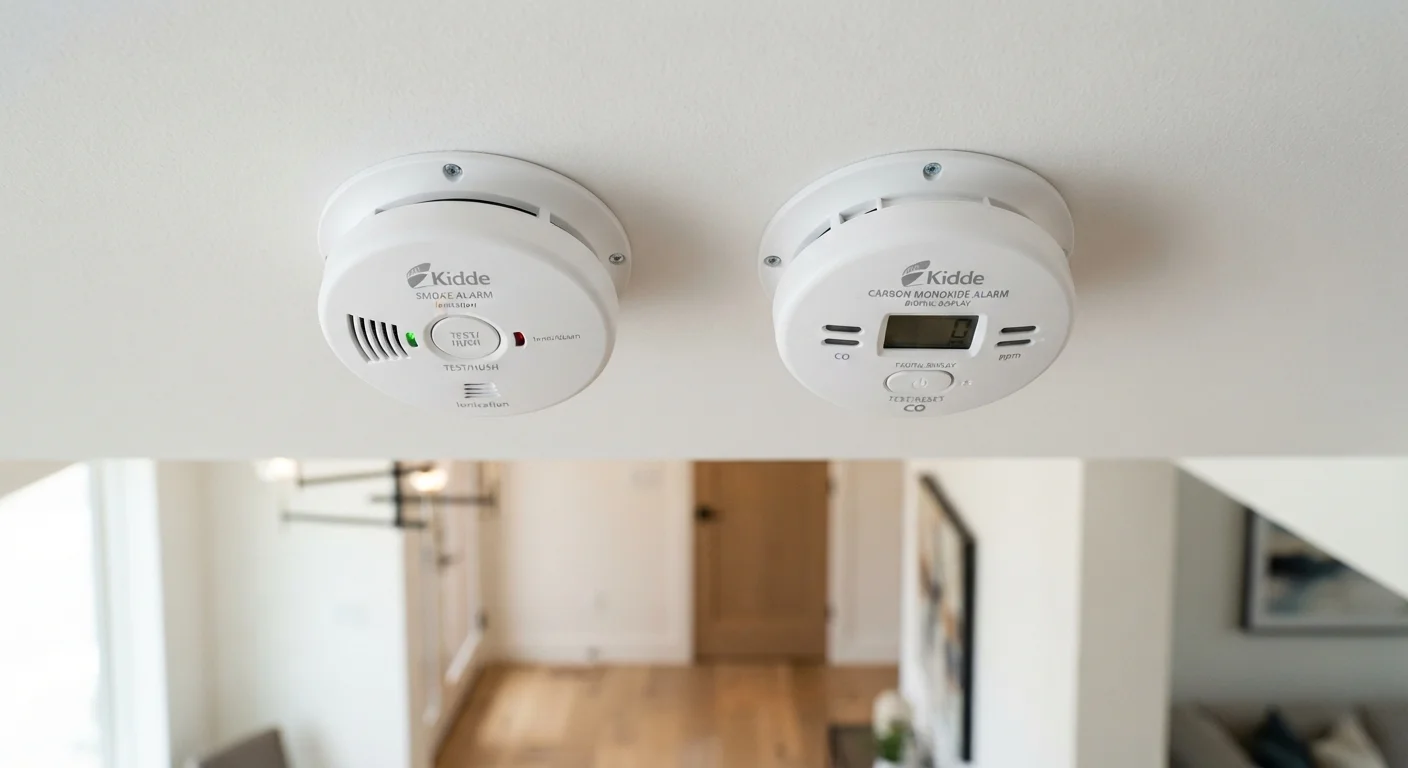
Smoke detectors and carbon monoxide (CO) detectors are not interchangeable. Each senses a specific hazard, and confusing the two leaves real gaps in your home's safety. Combination units exist that do both, but even those require correct placement to work as intended.
Smoke rises, so smoke detectors belong high on walls or on ceilings. Carbon monoxide mixes evenly with room air at roughly the same density as regular air, so CO detectors work at almost any height, though manufacturers typically recommend positioning them at about five feet off the floor or higher, near sleeping areas. Always read the instructions that come with your specific model, because placement guidance can vary.
| Smoke detector placement | Ceiling or high on walls, inside and outside every sleeping area, every level (NFPA 72) |
| CO detector placement | Every level and outside sleeping areas, 5 ft or higher on walls (CPSC guidance) |
| Smoke detector lifespan | 10 years from manufacture date (NFPA 72) |
| CO detector lifespan | 5 to 7 years, per manufacturer rating (Manufacturer specifications) |
| Test frequency | Monthly for both detector types (NFPA 72) |
| Minimum distance from cooking appliances (CO) | 15 feet (CPSC) |
Where to put smoke detectors
The National Fire Protection Association (NFPA) standard 72 sets the baseline most US building codes follow. Under those guidelines, smoke detectors go:
- Inside every bedroom
- Outside each sleeping area (such as a hallway leading to bedrooms)
- On every level of the home, including the basement
Mount ceiling units at least four inches from any wall. Wall-mounted units should sit four to twelve inches below the ceiling. Keep detectors away from kitchens and bathrooms: cooking steam and shower humidity trigger false alarms. A ten-foot buffer from cooking appliances is a common rule of thumb, though local codes may differ. Garages are generally not recommended locations because combustion exhaust from vehicles can cause frequent false triggers.
Homes with high or peaked ceilings need detectors positioned near the peak, since that is where smoke collects first.
Where to put carbon monoxide detectors
CO detectors belong on every level of the home and outside each sleeping area. Unlike smoke, carbon monoxide does not rise or sink significantly, so ceiling or wall placement both work. Many manufacturers suggest five feet or higher as a practical height, which keeps the unit out of reach of small children while still sampling representative room air.
Place CO detectors near fuel-burning appliances such as furnaces, water heaters, fireplaces, and gas dryers, but not directly above or beside them. The Consumer Product Safety Commission (CPSC) recommends at least fifteen feet of separation from cooking appliances to reduce nuisance alarms from brief combustion spikes during normal cooking.
Attached garages are a common source of CO intrusion. A detector just inside the door connecting the garage to the living space adds meaningful coverage.
CO detectors are unrelated to electrical hazards, but if you are also thinking through your home's electrical safety, the GFCI vs. AFCI outlets guide explains how those two protective outlet types work and where each one belongs.
Testing and replacement
Both detector types need monthly testing. Press and hold the test button until the alarm sounds. A weak chirp instead of a full alarm usually signals a low battery.
Battery replacement schedules depend on the unit. Sealed ten-year lithium battery models need no battery changes but must be replaced when they reach end-of-life. Standard 9-volt or AA battery models need fresh batteries at least once a year, though twice a year is a common practical cadence.
Replacement timelines differ between the two devices:
- Smoke detectors: replace every ten years from the manufacture date (printed on the back of the unit).
- CO detectors: replace every five to seven years, depending on the manufacturer's rating. The electrochemical sensor inside degrades over time even if the unit still passes a button test.
A CO detector that has aged past its rated lifespan may appear functional while no longer accurately detecting low-level exposure. Check the manufacture date on each unit and log replacement dates somewhere you will find them, such as a home maintenance binder or a calendar reminder.
Photoelectric detector
A type of smoke detector that uses a light beam and sensor to spot large smoke particles. It responds faster to slow, smoldering fires than to fast, flaming fires.
Ionization detector
A smoke detector type that uses a small radioactive source to detect ionized particles from fast-flaming fires. It is less responsive to slow, smoky fires.
Electrochemical sensor
The sensing element inside most residential CO detectors. It generates a small electrical current when CO molecules are present. The sensor degrades over time, which is why CO detectors carry a fixed replacement date.
End-of-life signal
A pattern of chirps or a voice alert that some detectors emit when they have reached their rated lifespan and need to be replaced, distinct from a low-battery warning.