

Key Takeaways
- Moisture is the most common cause of wood floor warping, whether from above or below the planks.
- Cupping, crowning, and buckling are distinct warp types with different causes and repair paths.
- Subfloor moisture, inadequate acclimation before installation, and insufficient expansion gaps all contribute to warping.
- Mild cupping often reverses on its own once the moisture source is removed.
- Severe warping typically requires professional assessment before sanding or replacement.
Wood floor warping
Wood floor warping is any distortion in which planks bend, bow, or lift away from their intended flat position. It happens because wood is hygroscopic, meaning it absorbs and releases moisture from its surroundings and changes shape as it does. Several distinct warp types exist, and each points to a different underlying cause.
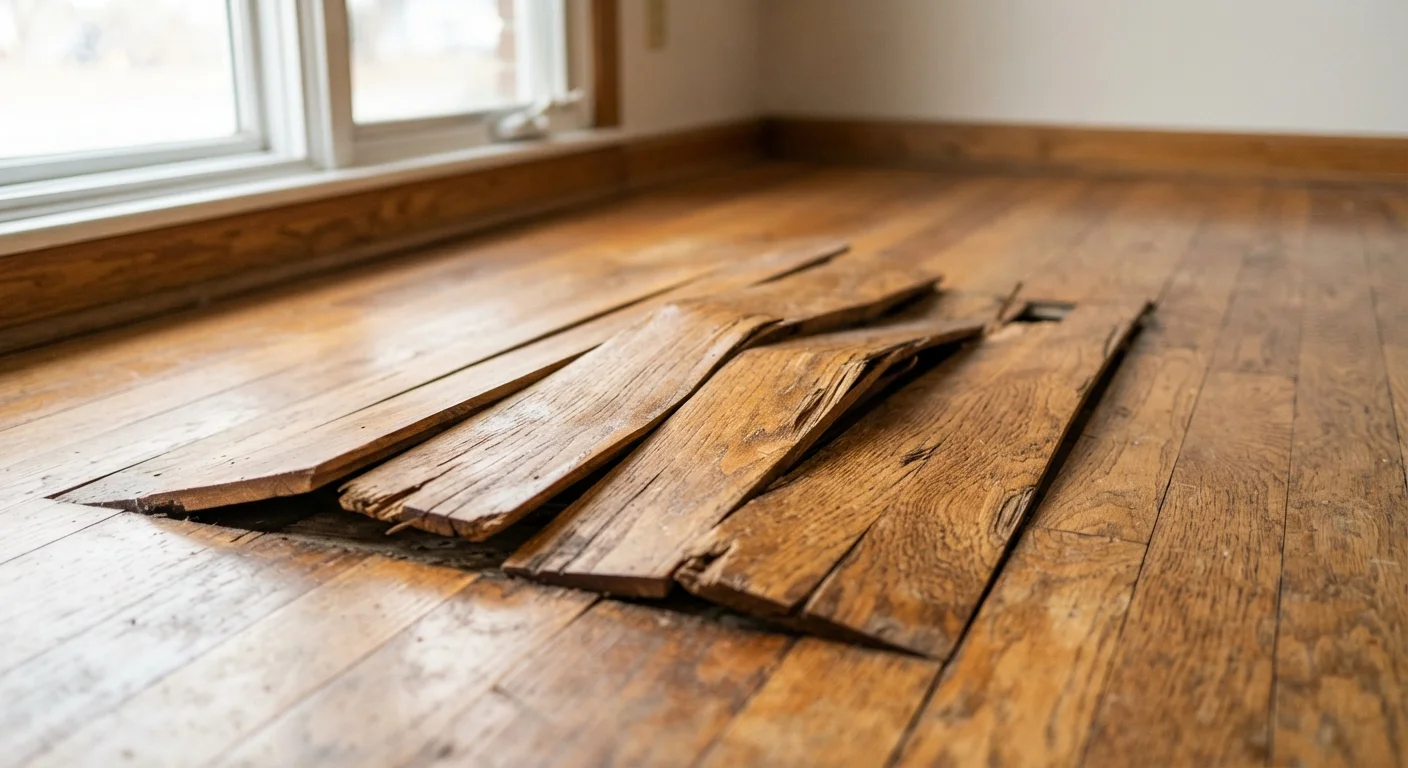
The three main warp forms are cupping (edges rise, center dips), crowning (center rises, edges dip), and buckling (planks lift entirely off the subfloor). Identifying which type is present is the first step toward an accurate diagnosis.
The three types of wood floor warping
Warping is not one problem; it is three distinct deformations, each with its own pattern and cause.
Cupping is the most common. The edges of a plank rise above the center, giving the board a concave, trough-like profile. It typically means more moisture is reaching the underside of the plank than the top, so the bottom expands more than the top.
Crowning is the opposite: the center of the plank sits higher than the edges. This can happen when moisture hits the top surface, but it also follows premature sanding of a cupped floor. When a cupped floor is sanded flat before it has dried, the wood is thinner at the edges. As it finishes drying, the center rises above those thinned edges.
Buckling is the most severe form. Planks pull free from the subfloor and lift, sometimes dramatically. It almost always follows serious flooding or long-term moisture accumulation with no room to expand.
What actually causes each type
Moisture is behind the majority of warping cases, but the source matters.
Subfloor moisture is a frequent culprit for cupping. Concrete subfloors release moisture vapor over time, and if a vapor barrier was not installed correctly, or if a plumbing leak went undetected, that moisture travels up into the planks from below.
Surface spills and high humidity can cause crowning, especially if water sits on the floor for an extended period. Bathrooms, kitchens, and entryways near exterior doors are the most exposed zones. Consistently high indoor humidity, above about 55 percent relative humidity, can also cause gradual expansion across an entire floor.
Installation errors produce a different category of warping. Wood flooring needs time to acclimate to a home's temperature and humidity before installation, generally several days sitting in the room it will occupy. If planks were installed while still carrying moisture levels from a warehouse, they can contract or expand after the fact. Missing or undersized expansion gaps at walls and thresholds can also cause buckling when the wood naturally swells and has nowhere to go.
Address the moisture source first
Any repair attempt made before the underlying moisture problem is resolved is likely to fail. Before sanding, replacing planks, or applying any finish, confirm that the source of moisture has been eliminated and that the floor has returned to a stable moisture content. A moisture meter, available at most hardware stores, can help you track progress.
Subfloor flatness matters too. A subfloor with dips or high spots transfers stress unevenly to planks above it, which can produce localized warping even without any moisture involvement.
What you can realistically do about it
The repair path depends entirely on warp type, severity, and whether the moisture source has been eliminated.
For mild cupping, the first step is finding and fixing the moisture source, whether that means repairing a leak, improving subfloor ventilation, or running a dehumidifier to bring indoor humidity into a stable range. Once the environment stabilizes, many lightly cupped floors flatten on their own over several weeks. Do not sand until the floor has fully dried and stabilized, and do not attempt to weight down cupped planks, as this can crack them.
For crowning, the approach depends on cause. If it followed over-sanding of a previously cupped floor, a qualified flooring professional may be able to re-sand once the wood has fully stabilized. If crowning came from surface moisture, removing the source and allowing the wood to dry is the first move.
For buckling, professional assessment is the appropriate starting point. Buckled planks have often broken their fasteners or adhesive bond, and the subfloor beneath may also be damaged. Attempting to press planks back down without addressing the subfloor can produce an unsafe, uneven surface.
In any warping situation, check for related problems around doors and windows. Gaps in weatherstripping allow humidity and moisture into the home at entry points; common weatherstripping mistakes can quietly worsen the moisture environment that damages floors.
If the affected area is large, if the subfloor shows visible damage or mold, or if a structural leak is suspected, contact a licensed contractor before proceeding with any repair work.