

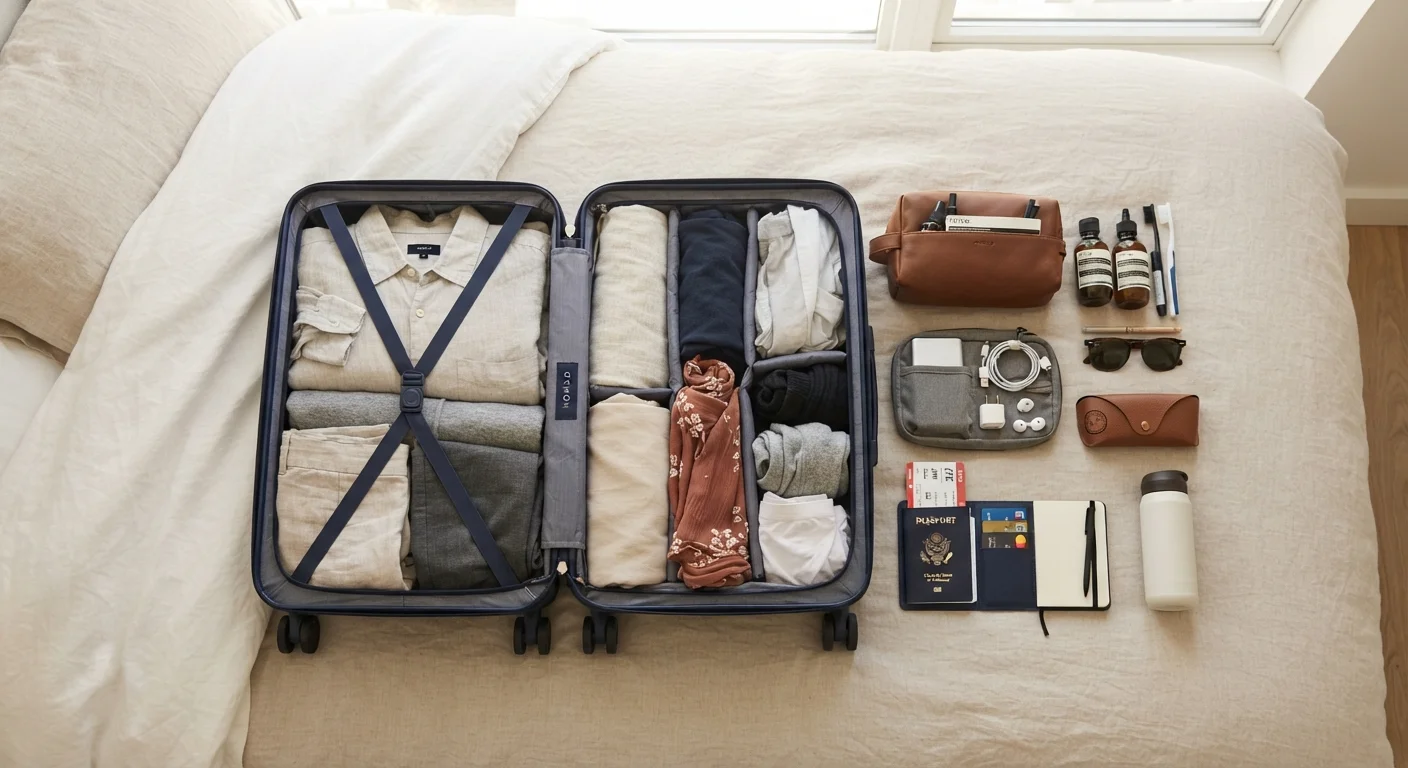
Key Takeaways
- Match your bag type and size to your trip length and transport method before buying anything else.
- A clothing list built around a color palette lets you mix and match without overpacking.
- Scan all travel documents and store copies in a secure cloud folder before you leave home.
- TSA liquid rules apply to carry-on bags; always check airline size and weight limits in advance.
- A pre-departure checklist run the night before departure prevents last-minute scrambles.
- Verify visa, vaccination, and entry requirements through official government sources before every trip.
Choosing the right bag for your trip
The bag you choose shapes every packing decision that follows. A rolling suitcase suits hotel stays and smooth airport floors but becomes a liability on cobblestones or hostel stairs. A backpack gives you mobility on uneven terrain. A hybrid carry-on backpack covers both scenarios for trips under a week.
Size matters as much as style. Most airlines allow a carry-on up to 22 x 14 x 9 inches, though budget carriers often set tighter limits. Measure before you pack, not after. For longer trips where checking a bag is unavoidable, a 25- to 29-inch suitcase with spinner wheels handles most needs without exceeding typical 50-pound weight limits.
If you want to avoid checked baggage entirely, the carry-on only approach requires a deliberate rethink of what you actually need versus what feels comforting to have nearby.
Pack your bag, then remove one-third of the clothing before you zip it. Most travelers use far less than they expect, and a lighter bag reduces fatigue and checked-bag fees.
Travel advisors consistently note that overpacking is the single most common complaint travelers have about their own preparation, and it is entirely preventable before departure.
Use packing cubes organized by category, such as tops, bottoms, and underwear, rather than by day. It is faster to find items and easier to repack at each stop.
Categorical organization means you never unpack everything to find one item, which also makes security screening and hotel check-ins smoother.
Building a practical clothing list
Start with the number of days you will be away, then cut that number roughly in half. Most travelers pack twice what they wear. Choose a base color palette of two neutrals and one accent so every piece works with every other piece.
Plan for activities, not days. Three days of casual sightseeing, one dinner out, and two mornings of hiking each call for different clothing, but many items cross over. A lightweight merino wool shirt, for example, handles both the trail and a casual restaurant. Fabrics that dry overnight reduce the total volume you carry.
For a thorough, adaptable packing list you can print and customize, the pre-trip packing checklist covers clothing, documents, toiletries, and tech in one place.
Documents and financial prep
Gather every document your trip requires at least a week before departure. For international travel that typically means a passport valid for at least six months beyond your return date, any required visas, and proof of onward travel. Visa and entry requirements change; verify current rules through the U.S. Department of State website and the destination country's official immigration authority.
Scan or photograph your passport, travel insurance policy, accommodation confirmations, and any car rental agreements. Store copies in a password-protected cloud folder and email one set to a trusted contact at home.
Notify your bank and credit card issuers of your travel dates and destination. Carry at least two payment methods, kept in separate locations, in case one is lost or blocked.
Toiletries and health essentials
For carry-on travel, the TSA 3-1-1 rule applies: liquids, gels, and aerosols must be in containers of 3.4 ounces (100 ml) or less, all fitting in one quart-sized clear bag per person. Solid alternatives such as shampoo bars and solid moisturizers sidestep the rule entirely and take up less space.
Prescription medications travel in their original labeled containers. Carry a supply sufficient for the full trip plus a few extra days, and keep them in your carry-on rather than checked luggage. For any destination-specific health precautions, consult a travel medicine clinic or your primary care provider well before departure. Requirements for vaccinations or preventive medications vary by destination and individual health history.
Tech gear and power management
Your device list should match your actual use, not your aspirations. A phone, a power bank, a universal adapter, and one set of earbuds cover most travelers completely. A laptop makes sense for work trips or stays longer than two weeks; a tablet rarely justifies the weight if you already carry a phone.
Check the voltage and plug type for every country on your itinerary. A single universal adapter handles most destinations, but some remote areas use non-standard sockets, so confirm beforehand. Download offline maps, tickets, and translation apps before you leave so you are not dependent on a data connection at the airport.
Final pre-departure steps
Run a final check the evening before departure, not the morning of. Confirm that all documents are physically in your bag, your devices are charged, and your liquids bag is accessible for security screening. Set two alarms if your flight is early.
Arrange for someone to hold a spare key, pause mail delivery, and know your rough itinerary in case of emergency. For trips that involve significant driving, the road trip planning guide covers vehicle prep and on-road logistics in detail.
Broader trip logistics such as budgeting and itinerary structure are covered in the trip planning hub, and once you are on the ground, the on the road hub addresses navigation, safety, and destination logistics.