

Key Takeaways
- A few targeted items improve sleep and circulation on flights over eight hours far more than a full bag of extras.
- Compression socks, an eye mask, and noise-reducing headphones address the three biggest comfort problems in economy class.
- Carry-on space is finite: every comfort item you pack should earn its place by solving a specific problem.
- Staying hydrated and moving regularly matters as much as any physical item you bring aboard.
- Verify airline carry-on liquid rules before packing toiletries; regulations vary by country and route.
Why long-haul packing deserves its own strategy
A two-hour domestic hop and a fourteen-hour transoceanic flight ask completely different things of your carry-on. On a short flight, mild discomfort is temporary. On a long-haul route, the same minor annoyance compounds over hours: dry air dehydrates your skin and sinuses, recycled cabin air carries low humidity, seat pressure restricts circulation, and ambient noise from engines makes it hard to sleep at any altitude.
The goal of a long-haul comfort kit is not to replicate your bedroom. It is to neutralize the specific discomforts the aircraft environment creates. That framing cuts through the clutter of "packing lists" that include items solving no real problem. If you are also weighing whether to check a bag or go carry-on only for the broader trip, our practical trade-off guide walks through how those decisions interact.
Pack your sleep kit where you can reach it
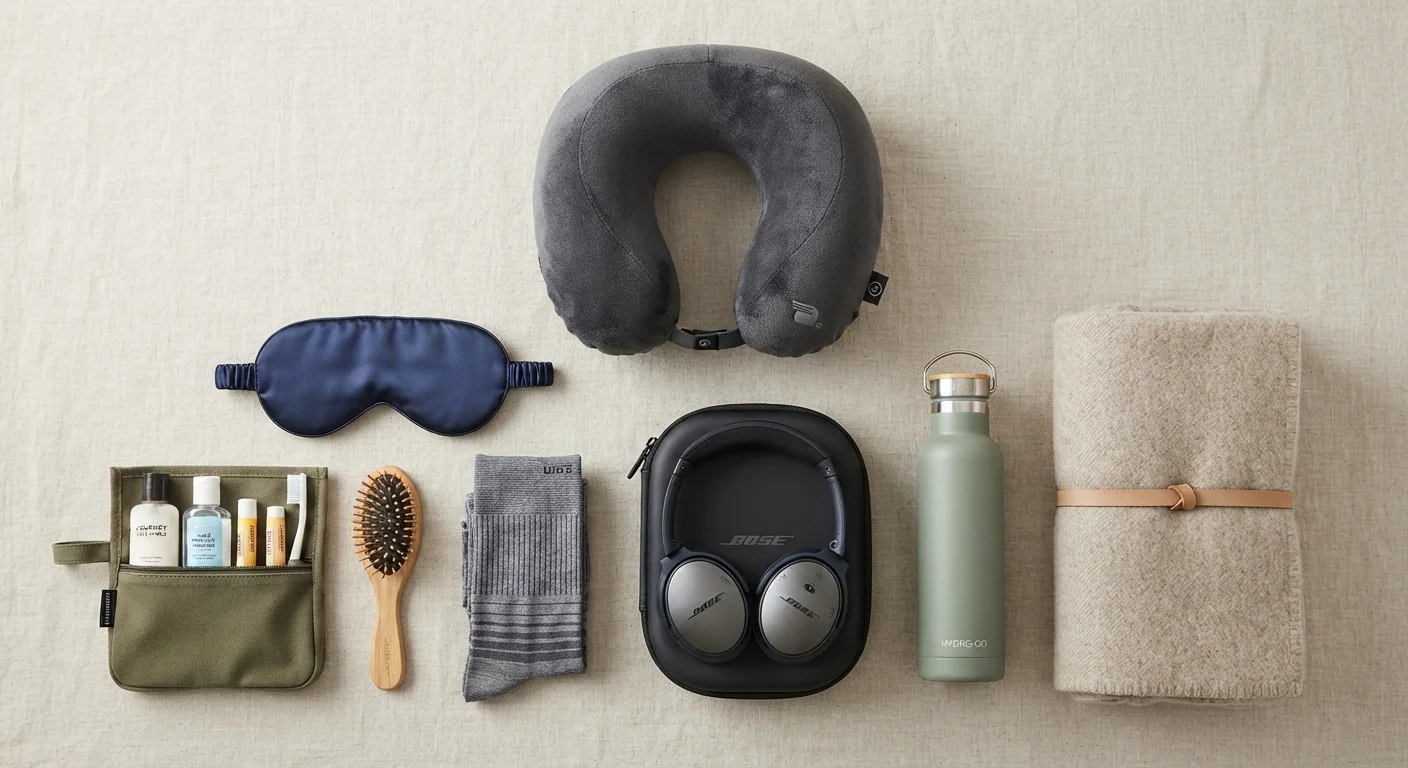
Before stowing your bag, pull out your eye mask, earplugs, neck pillow, and headphones and keep them in the seat pocket. Setting up your sleep environment before takeoff means you are not digging through an overhead bin once the cabin lights dim. It also signals to your brain that sleep is the plan, which can help you settle faster.
Comfort essentials worth the space
Noise-reducing headphones or earplugs
Engine noise on a long-haul aircraft sits around 85 decibels at cruise altitude. That level of sustained noise raises stress hormones and degrades sleep quality. Over-ear headphones with active noise cancellation reduce ambient sound significantly; foam earplugs, while less effective, take up almost no space and cost very little. Either option is worth including because cabin noise is constant, not periodic.
If you use the airline's entertainment system, check whether your headphones connect via a standard 3.5mm jack or require an adapter. Many widebody aircraft still use dual-pin audio jacks, so a small adapter can save the situation.
Sustained engine noise degrades sleep quality; any noise reduction pays off on a flight over eight hours.
Compression socks
Sitting still for extended periods slows blood flow in the lower legs. On flights over six hours, this raises the risk of discomfort and swelling, and for some travelers it carries more serious circulatory concerns. Graduated compression socks apply gentle pressure at the ankle that decreases up the calf, which helps venous blood return toward the heart.
They do not replace movement: standing and walking the aisle periodically, and doing seated ankle rotations, matter alongside whatever you wear. Travelers with circulatory conditions should consult a physician before flying long distances.
Compression socks help circulation during extended sitting and cost almost nothing in bag space.
Eye mask and earplugs as a sleep pairing
Cabin lighting follows the crew's schedule, not yours. On routes crossing multiple time zones, lights may come on hours before your body clock expects morning. A well-fitted eye mask blocks overhead and screen glow from neighboring seats. Paired with earplugs, it creates a consistent sensory environment that makes sleep easier to initiate and maintain.
Fit matters: a mask that presses against your eyelids becomes uncomfortable within an hour. Look for a contoured shape with a nose bridge that allows your eyes to move freely.
A contoured eye mask and earplugs cost almost nothing and create the conditions for real sleep.
A travel pillow that actually supports your neck
Standard U-shaped neck pillows hold your head upright but do little for side-sleepers, which is how most people eventually end up in an aircraft seat. Pillows with an adjustable lobe at the front keep the chin from dropping and the head from tipping sideways. Before packing one, check whether it compresses small enough to attach outside your bag or fit inside without displacing other items.
Some travelers find a small inflatable lumbar pillow more useful than a neck pillow, particularly on seats with minimal lower-back support. You may find through experience that one type works better for your posture than the other.
A pillow that controls chin drop prevents the neck stiffness that follows several hours of seat sleep.
Hydration and skin care for dry cabin air
Aircraft cabin humidity typically runs between 10 and 20 percent, well below the 30 to 50 percent range most people find comfortable at home. That dry air draws moisture from skin, eyes, and nasal passages. A small lip balm, facial moisturizer, and saline nasal mist address the effects directly. All three together fit easily within a 100ml liquid allowance.
Drinking water throughout the flight helps, but relying only on beverage service is not enough on a very long route. A collapsible or reusable water bottle that you fill after security lets you manage your own intake between cart passes.
If you are planning to go carry-on only for the whole trip and need guidance on fitting toiletries within liquid limits, the carry-on only mindset guide covers those strategies in detail.
Cabin humidity below 20 percent dries skin and sinuses fast; a few small toiletries handle the problem directly.
Layers for unpredictable cabin temperature
Cabin temperature varies between the front and rear of the aircraft, between window and aisle seats, and at different points in the flight. Airlines provide blankets on many long-haul routes, but availability is not guaranteed and blanket quality varies. A lightweight layer, a merino wool or synthetic zip-up that compresses into itself, lets you adjust without depending on what the aircraft provides.
This layer also doubles as ground use at your destination if the climate calls for it, which means it earns its space twice.
A compressible mid-layer solves cabin temperature variation without taking up meaningful bag space.
Slip-on shoes or lightweight cabin footwear
Feet swell during long flights due to the same circulatory slowdown that compression socks address. Lace-up shoes that fit fine at boarding can feel uncomfortably tight by hour eight. Slip-on shoes or a pair of compact cabin slippers solve this without requiring you to re-lace anything mid-flight.
Keep footwear on when moving through the aisle or using the lavatory for basic hygiene and safety reasons.
Foot swelling is predictable on long flights; footwear you can loosen or remove matters more than you expect.
Before you zip the bag
Run through each item against the problem it solves. If you cannot name the problem, leave it out. Carry-on space on a long-haul flight matters because your personal item often doubles as in-flight storage: the easier it is to reach your sleep kit and headphones during boarding, the less you disrupt your row when the cabin lights go down.
For a broader look at how these choices fit into full trip preparation, the complete packing and preparation guide covers bag selection, documents, and pre-departure logistics end to end. If the long-haul flight is part of a trip with tight connections, understanding transfer times and minimum connection windows is worth reviewing before you book.