

| Liquid container limit | 3.4 oz (100 ml) per container (TSA.gov) |
| Quart bag limit | 1 bag per traveler (TSA.gov) |
| Prescription medication rule | Exempt from 3-1-1; must be declared if over 3.4 oz (TSA.gov) |
| Baby formula / breast milk | Reasonable quantities allowed; not subject to 3-1-1 (TSA.gov) |
| Electronics over 7 inches | Must be removed from bag and screened separately (TSA.gov) |
| Sharp objects (scissors) | Blades under 4 inches allowed; longer blades prohibited (TSA.gov) |
The 3-1-1 rule: how it works
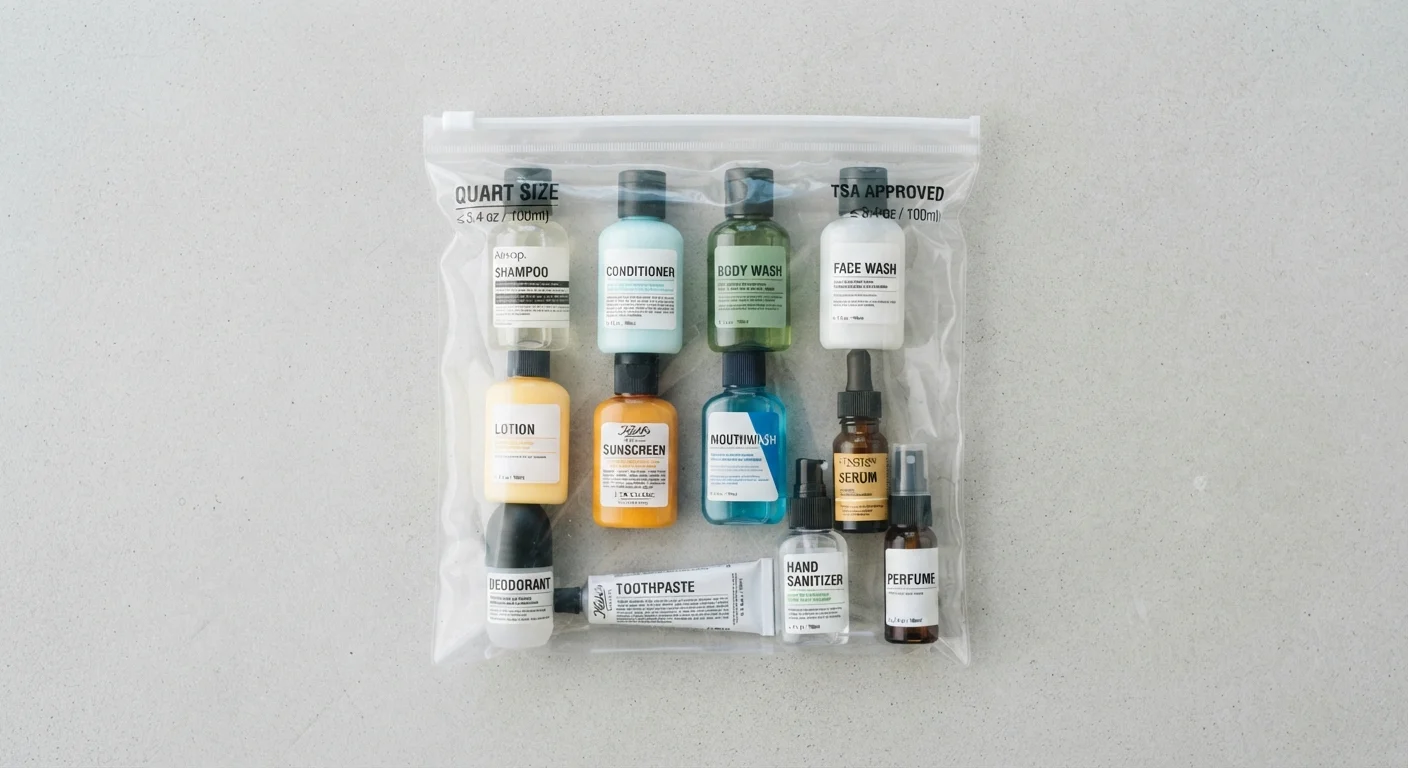
The TSA's carry-on liquid policy is known as the 3-1-1 rule. Each liquid, gel, cream, paste, or aerosol container must hold 3.4 ounces (100 milliliters) or less. All containers must fit inside one clear, quart-sized resealable bag, and each traveler may bring one such bag. That bag goes in the bin by itself during X-ray screening.
The rule applies to a wide range of products: shampoo, conditioner, toothpaste, sunscreen, mouthwash, contact lens solution, and similar items. If a container holds more than 3.4 oz, it cannot go in your carry-on even if it is only partially full. Pack it in checked luggage or transfer the contents into a smaller travel bottle before you leave.
Travelers enrolled in TSA PreCheck typically do not need to remove their quart bag from their carry-on at the checkpoint, though the same size limits still apply.
| Liquid container limit | 3.4 oz (100 ml) per container (TSA.gov) |
| Quart bag limit | 1 bag per traveler (TSA.gov) |
| Prescription medication rule | Exempt from 3-1-1; must be declared if over 3.4 oz (TSA.gov) |
| Baby formula / breast milk | Reasonable quantities allowed; not subject to 3-1-1 (TSA.gov) |
| Electronics over 7 inches | Must be removed from bag and screened separately (TSA.gov) |
| Sharp objects (scissors) | Blades under 4 inches allowed; longer blades prohibited (TSA.gov) |
Medication and medical supplies
Prescription and over-the-counter medications in liquid form are exempt from the 3-1-1 limit. You may carry medically necessary liquids in quantities greater than 3.4 oz, but you must declare them to the officer at the checkpoint before screening. TSA may need to open and test these items.
Solid medications (pills, tablets, capsules) have no volume limit. They can stay in original labeled containers or a pill organizer; neither format is required by TSA, though labeled containers can help if an officer has questions.
Insulin, syringes, and other diabetes-related supplies are permitted. Inform the officer that you are carrying them. Ice packs or gel packs used to keep medication cool are also allowed in any quantity, though they may receive additional screening if they are partially frozen or slushy.
Medical devices such as CPAP machines, nebulizers, and bone stimulators are allowed in the cabin. Remove them from their cases for X-ray screening. TSA's website lists specific guidance for individual devices if you want to confirm in advance.
Always verify before you fly
TSA policies can change, and individual officers have discretion at the checkpoint. Check TSA.gov and your airline's guidelines before your trip. For international travel, the destination country's aviation authority may have different rules.
Food, baby items, and other exempt liquids
Baby formula, breast milk, and toddler juice are allowed in quantities that exceed 3.4 oz and do not need to fit in the quart bag. Inform the officer at the checkpoint, and be prepared for additional screening. The same applies to liquid or puree baby food.
Solid food in carry-on bags is generally permitted, but liquid or gel-based foods (yogurt, hummus, peanut butter, jam, soup) are subject to the 3-1-1 rule because TSA classifies them as gels or liquids. Whole fruit, sandwiches, and dry snacks travel with no restriction. If you are uncertain about a specific food item, the TSA "What Can I Bring?" tool on TSA.gov lets you look it up by name.
Electronics, sharp objects, and other common restrictions
Laptops and tablets larger than a standard paperback book (roughly 7 inches or more) must be removed from your bag and placed flat in a separate bin for X-ray screening unless you have TSA PreCheck. Smaller tablets, e-readers, and phones can stay in your bag.
Lithium-ion batteries (including spare laptop and phone batteries and power banks) must travel in carry-on bags, not checked luggage, because of fire risk in the cargo hold.
Sharp items follow specific rules. Scissors with blades shorter than 4 inches are allowed; longer blades go in checked luggage. Disposable razors and cartridge razors are permitted. Straight razors and safety razor blades (without the handle) are not. Small pocketknives with blades under 2.36 inches (6 cm) are technically on the TSA prohibited list and may not be carried on.
For the full list of prohibited items and edge cases, check our airport reference guide for additional context on navigating security and terminals. If you want to weigh whether certain items make carry-on travel practical for your trip, this packing trade-off guide covers the decision in detail.
3-1-1 rule
TSA's carry-on liquid policy: containers must hold 3.4 oz (100 ml) or less, all containers must fit in 1 clear quart-sized bag, and each traveler may bring 1 such bag.
TSA PreCheck
A U.S. government expedited screening program. Enrolled travelers go through dedicated lanes and generally do not need to remove shoes, laptops, or quart bags during screening.
Prohibited item
Any object TSA bans from carry-on bags entirely. Some prohibited items may still be packed in checked luggage; others are banned from all aircraft.
Medically necessary liquid
A liquid, gel, or aerosol a traveler carries for a health reason (prescription medication, insulin, eye drops). TSA exempts these from the standard 3.4 oz limit, though additional screening may apply.