

| IATA code length | 3 letters (International Air Transport Association standard) |
| ICAO code length | 4 letters (International Civil Aviation Organization standard) |
| U.S. airports with multiple IATA codes | New York (JFK, LGA, EWR), Chicago (ORD, MDW), Los Angeles (LAX, BUR, LGB, ONT, SNA) |
| Baggage report filing | File before exiting the terminal for best outcome (Standard airline baggage service guidance) |
| Black airport signs indicate | Gates, baggage claim, ground transportation (secure zone) (FAA and TSA airport signage standards) |
| Green airport signs indicate | Exits, ground transport, rental cars (outside secure zone) (FAA and TSA airport signage standards) |
IATA airport codes: what those three letters mean
Every commercial airport in the world has a three-letter code assigned by the International Air Transport Association (IATA). These codes appear on your boarding pass, baggage tag, and flight confirmation. They are the universal shorthand airlines, baggage handlers, and ticketing systems use to identify origin and destination.
Most codes are intuitive. LAX is Los Angeles International. ORD is Chicago O'Hare (named after the former Orchard Field site). DFW is Dallas/Fort Worth. A few are less obvious: EWR is Newark Liberty, and MSY is Louis Armstrong New Orleans International. When a city has multiple airports, each gets its own code. New York City travelers choose between JFK, LGA (LaGuardia), and EWR depending on airline and location.
A separate four-letter code system called ICAO (International Civil Aviation Organization) is used by pilots and air traffic control, not passengers. You will rarely see ICAO codes on consumer-facing documents, but knowing they exist explains why you may occasionally see something like KLAX in aviation contexts alongside the familiar LAX.
IATA code
A three-letter identifier assigned to commercial airports worldwide by the International Air Transport Association. It appears on boarding passes and baggage tags.
ICAO code
A four-letter airport identifier used by pilots and air traffic control. Passengers rarely encounter it on consumer documents.
Concourse
A corridor or wing within an airport terminal that connects multiple gates. Some airports use 'concourse' and 'terminal' interchangeably.
Airside
The area of an airport past the security checkpoint, accessible only to ticketed passengers and credentialed staff.
Landside
The public portion of an airport before security screening, accessible to anyone including meeters and greeters.
Gate close time
The time printed on a boarding pass when the jetway door closes. Arriving after this time generally means the flight is no longer accessible.
If you're building general airport literacy, the same logic that applies to decoding transit maps applies here. Reading an unfamiliar public transit system covers how to orient yourself quickly in any new transportation environment.
Terminal and gate categories
Large airports are divided into terminals, which are separate buildings or connected structures. Each terminal may serve one or several airlines. Gates are numbered or lettered boarding areas within a terminal. A gate designation like B22 means Terminal B, Gate 22.
Concourses are the corridors that connect gates within a terminal. Some airports use the terms interchangeably with terminal; others treat them as distinct. Atlanta's Hartsfield-Jackson, for example, has a main terminal and separate concourses (A through F) linked by an underground train.
Domestic and international terminals are sometimes separate buildings with different security and customs infrastructure. If your itinerary includes a connection between a domestic and an international flight, confirm whether you need to change terminals and factor in extra time. Your boarding pass will show both the terminal and gate, but verifying at the airport's departure board is always worth a glance since gates can change.
| IATA code length | 3 letters (International Air Transport Association standard) |
| ICAO code length | 4 letters (International Civil Aviation Organization standard) |
| U.S. airports with multiple IATA codes | New York (JFK, LGA, EWR), Chicago (ORD, MDW), Los Angeles (LAX, BUR, LGB, ONT, SNA) |
| Baggage report filing | File before exiting the terminal for best outcome (Standard airline baggage service guidance) |
| Black airport signs indicate | Gates, baggage claim, ground transportation (secure zone) (FAA and TSA airport signage standards) |
| Green airport signs indicate | Exits, ground transport, rental cars (outside secure zone) (FAA and TSA airport signage standards) |
Boarding pass terms and zone language
A boarding pass contains more information than most travelers read. Here are the fields that matter most:
- Flight number: the airline's two-letter code followed by up to four digits (for example, AA 237).
- Seat: row number and letter (A through F on most wide-body jets, A through C on regional aircraft).
- Boarding group or zone: the order in which passengers board. Zone 1 boards before Zone 2, and so on. Airlines set their own zone structures.
- Gate close time: when the jetway door closes, not when the plane pushes back. Missing this time means missing the flight.
- Sequence number: on open-seating carriers, this determines your place in the boarding line.
TSA PreCheck and CLEAR are expedited screening programs. If you are enrolled, your boarding pass will show a TSA Pre checkmark or a CLEAR indicator, directing you to a dedicated lane. For a full breakdown of what you can and cannot bring through security, see TSA liquid rules and carry-on regulations explained.
Common airport signage decoded
Airports use a color-coded and symbol-based signage system that is largely standardized across U.S. facilities.
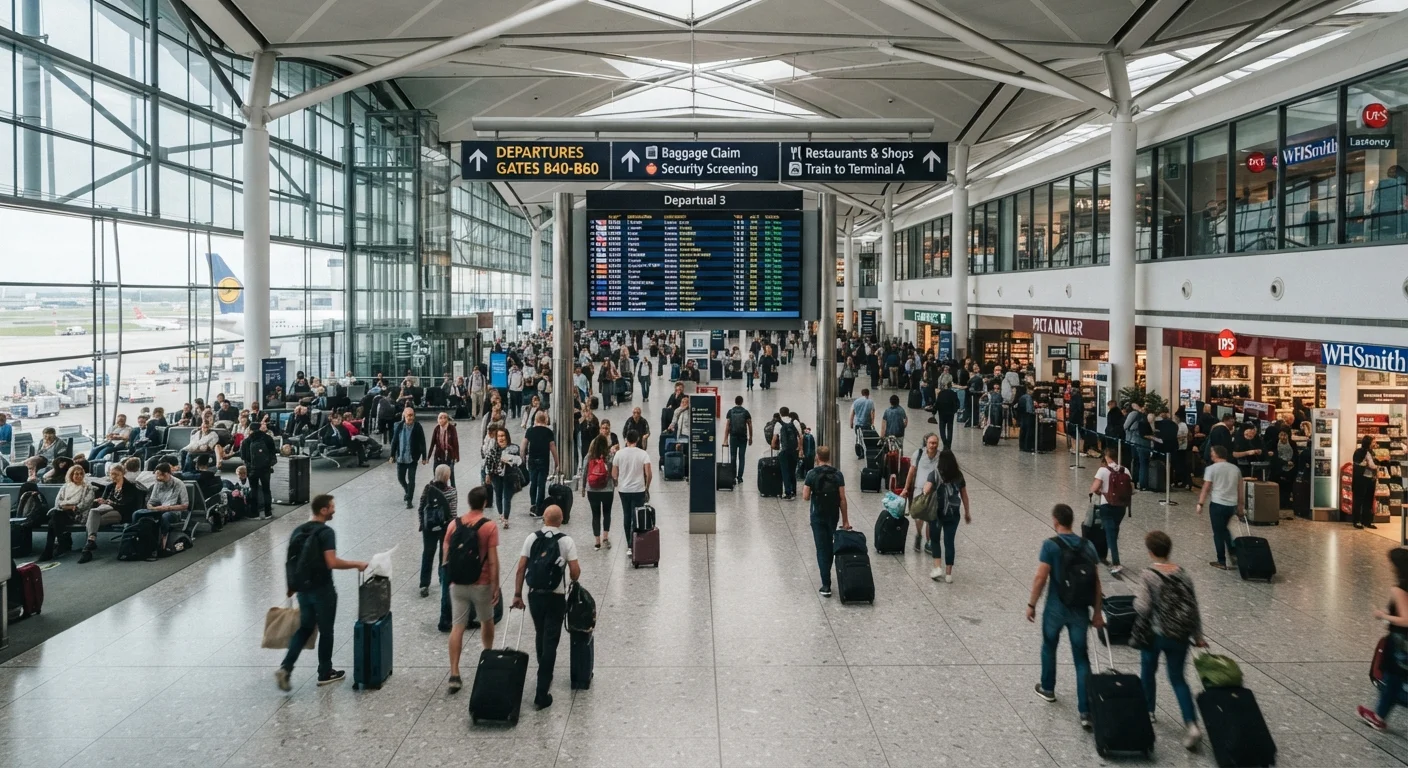
Black signs with white text point to gates, baggage claim, and ground transportation within the secure or ticketed area. Yellow signs warn of construction or temporary detours. Green signs direct to exits, ground transportation, and rental car facilities outside the secure zone. Blue signs indicate services: restrooms, ATMs, information desks, and accessibility routes.
The term landside refers to the public area of an airport before security screening. Airside is everything past the security checkpoint. This distinction matters when meeting an arriving passenger: you can only go airside if you have a boarding pass.
Baggage claim areas are always landside. Carousels are numbered, and the arrivals board maps each incoming flight to a carousel number. If your bag does not appear within a reasonable time after your flight lands, locate the airline's baggage service desk (also landside) before leaving the terminal. Filing a delayed baggage report before you exit gives the airline a documented point of contact.
Connecting travelers should look for Connections or Gates signs immediately after deplaning, not exit signs. Following exit signage will take you out of the secure zone and require re-screening to reach your next gate.