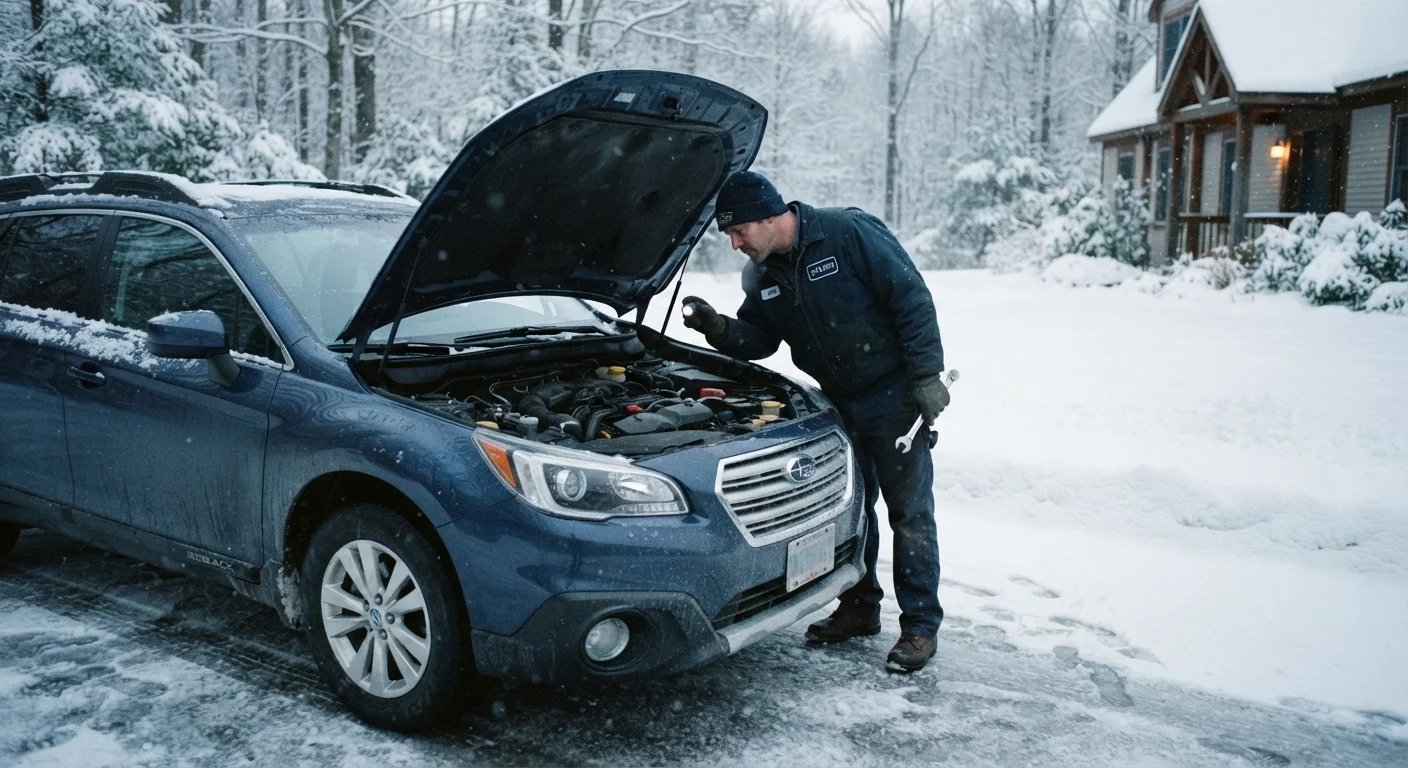
Cold temperatures can cut a car battery's cranking power by roughly half, making battery condition the most urgent check.
Winter tires outperform all-season tires on ice and packed snow because of their softer rubber compound and tread design.
Coolant concentration should be tested, not assumed, before freezing temperatures arrive.
Wiper blades, washer fluid, and lights matter more in winter because visibility drops faster and daylight hours are shorter.
An emergency kit in the trunk can make a cold-weather breakdown safer to manage.
45–90 min
Summary
18 items · 45 to 90 minutes
Why winter preparation is different
Summer driving puts stress on cooling systems and tires. Winter shifts that stress to batteries, fluids, and traction in ways that can leave a driver stranded in genuinely dangerous conditions. Cold weather thickens engine oil, reduces battery voltage, and causes tire pressure to drop roughly 1 PSI for every 10-degree Fahrenheit fall in temperature. None of those changes announce themselves before a problem happens.
This checklist covers the systems most affected by cold. Work through it before the first hard freeze, ideally when temperatures are still above freezing so you can move around the vehicle comfortably. For a broader pre-drive habit, see the pre-trip vehicle inspection walkthrough.
Battery
Have your battery load-tested at an auto parts store or garage if it is more than three years old. A voltage reading alone does not reveal how much cranking power remains. See battery health and load testing for what the numbers mean.Must
Inspect battery terminals for white or blue-gray corrosion buildup and clean them with a wire brush if present. Corroded terminals increase resistance and can prevent a cold start.Must
Check that the battery hold-down bracket is secure. Vibration from winter road conditions can accelerate battery wear.Should
Tires
Check tire pressure on all four tires and the spare using a gauge, not a visual inspection. Inflate to the vehicle manufacturer's specification (found on the door jamb sticker), not the maximum listed on the tire sidewall.Must
Measure tread depth with a tread depth gauge or the quarter test: insert a quarter into the groove with Washington's head pointing down; if you can see the top of his head, the tread is worn to the point where winter traction is seriously reduced.Must
Consider switching to dedicated winter tires if you regularly drive in temperatures below 45 degrees Fahrenheit or on packed snow and ice. Winter tires use a softer rubber compound that stays pliable in the cold, which all-season tires do not match.Should
Inspect sidewalls for cracking or bulging, both of which are more likely to cause a failure in cold temperatures when rubber is less flexible.Should
Fluids
Test coolant concentration with a test strip or refractometer. Most vehicles need a 50/50 mix of antifreeze and water, which protects to around -34 degrees Fahrenheit. A mix that is too diluted can freeze in the engine block or radiator.Must
Check the engine oil level and confirm the viscosity grade matches the manufacturer's winter recommendation for your climate. Thicker oils flow more slowly when cold, which increases wear during the first seconds of a cold start. See what happens during a cold start for context.Must
Replace windshield washer fluid with a winter-rated formula rated for at least -20 degrees Fahrenheit. Summer washer fluid will freeze in the reservoir and lines.Must
Check brake fluid level. If it has not been replaced in two or more years, moisture absorption may have lowered its boiling point and freezing resistance.Should
Visibility and lights
Replace wiper blades if they streak or skip. Winter-specific blades have a rubber boot that prevents ice and snow from packing into the frame, which standard blades lack.Must
Test all exterior lights including headlights, brake lights, turn signals, and reverse lights. Days are shorter in winter and visibility drops faster in precipitation; a burned-out bulb is harder to notice until another driver points it out.Must
Clean headlight lenses if they have yellowed or hazed. Oxidized plastic can reduce light output significantly even when the bulb is new.Should
Belts, hoses, and heating
Inspect serpentine belt for cracking, fraying, or glazing. Cold temperatures make existing cracks propagate faster, and a broken serpentine belt disables charging, power steering, and cooling simultaneously.Must
Check heater and defroster output. A heater core that works adequately in mild weather may not keep the cabin warm enough at 10 degrees Fahrenheit, and a rear defroster that is only partially functional will leave blind spots in the glass.Must
Squeeze radiator hoses when cold to check for soft spots, hardness, or swelling at the clamps. A failing hose is more likely to burst during a cold start when pressure spikes.Should
Four-wheel and all-wheel drive systems
If your vehicle has a selectable 4WD system, test the engagement before you need it. Actuators and transfer case linkages that have not been used since last winter can seize or fail to engage properly.Must
Check the transfer case and front differential fluid if the manufacturer recommends it at your mileage interval. These fluids thicken in cold and degrade with age.Should
If your vehicle has all-wheel drive, confirm that all four tires are the same brand, model, and tread depth. Significant tread variation between axles can cause drivetrain stress on AWD systems.Should
What to keep on hand
A few basic tools make this process faster and more accurate. A tire pressure gauge is the minimum. A battery load tester (available at most auto parts stores) gives a more reliable picture of battery health than a simple voltage reading. A coolant test strip or refractometer tells you the actual freeze point of your antifreeze rather than requiring you to guess based on the last service date.
Required
Tire pressure gauge
Measures actual tire inflation so you can correct pressure after temperature-driven drops.
Required
Battery load tester
Tests how much cranking amperage the battery can actually deliver, not just its resting voltage.
Required
Coolant test strip or refractometer
Determines the freeze point of the existing coolant mixture so you know if it needs adjustment.
Required
Tread depth gauge
Gives a precise measurement of remaining tread depth across the tire surface.
Optional
Wire brush (small)
Removes corrosion from battery terminals without damaging the posts.
Do not skip the battery load test
A battery can show 12.6 volts at rest and still fail under the load of a cold start. Resting voltage alone is not a reliable indicator of winter readiness. If your battery is more than four years old, a load test is the only way to know whether it will reliably start the car at low temperatures.
Coolant top-offs can dilute your mix
Topping off a low coolant reservoir with plain water lowers the antifreeze concentration and raises the freeze point. If the level is low, identify and fix the cause before adding fluid, then test the concentration before winter arrives.
Winter emergency kit for your trunk
Preparation does not end with the mechanical checks. A breakdown in sub-freezing temperatures is a different situation than one on a summer afternoon. A roadside emergency kit should already live in your car, but winter adds a few specific items: a wool blanket or emergency mylar blanket, a small bag of sand or kitty litter for traction under a spinning tire, an ice scraper with a long handle, and jumper cables or a portable jump starter. If you drive regularly in rural or mountainous areas, a small folding shovel is worth including.
Once your car is ready mechanically, the next step is adjusting how you drive. Winter driving habits on ice and snow covers braking, steering, and speed management for slick conditions.
This article provides general vehicle maintenance information for educational purposes. For diagnosis of specific mechanical issues, consult a qualified mechanic.
Cars Editorial Team is the collective byline for our editorial team and contributor network. Articles published under this byline or an editorial pen name are researched, written, and reviewed according to our editorial standards for clarity, consistency, and independence before publication.
Disclaimer: The content on this site is for informational purposes only and is not a substitute for professional advice. Always consult a qualified professional for guidance specific to your situation.