

Our Verdict
Neither type is universally better for your credit profile. Revolving credit gives you ongoing flexibility and has a direct, immediate effect on your utilization ratio, so managing balances carefully matters every month. Installment loans build a history of consistent, scheduled payments and diversify your credit mix over time.
| Best for | Recommended |
|---|---|
| Readers focused on lowering their credit utilization quickly | Revolving credit (by paying down balances) |
| Readers building long-term payment history with predictable costs | Installment loans |
| Readers with only one credit type on file | Adding the missing type to improve credit mix |
What makes these two credit types different
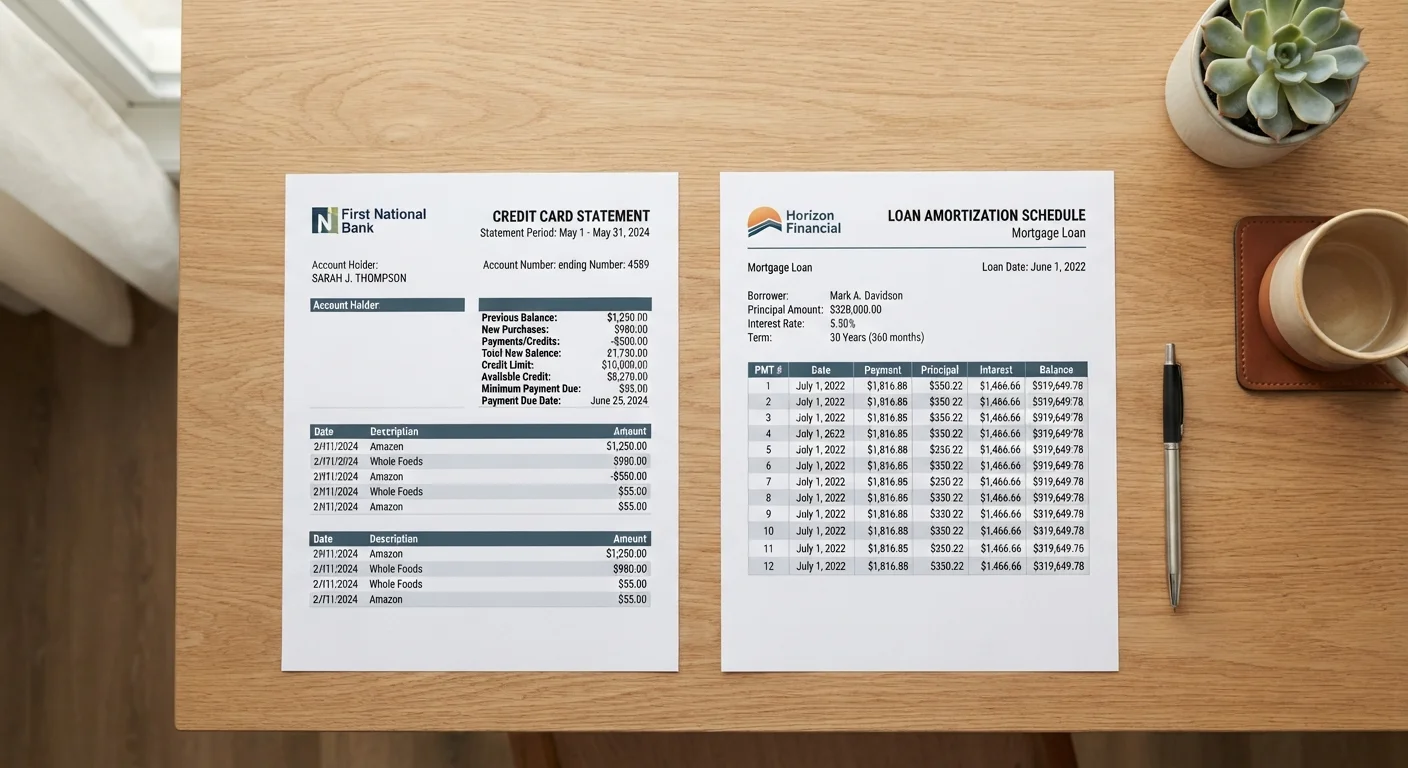
Credit accounts fall into two broad categories. Revolving credit, such as credit cards or home equity lines of credit, gives you a set limit you can borrow against repeatedly. You pay down the balance, and that capacity becomes available again. Installment credit, such as auto loans, mortgages, student loans, or personal loans, gives you a fixed lump sum that you repay in equal scheduled payments over a set term. Once the loan is paid off, the account closes.
That structural difference is what drives most of the variation in how each type is handled by credit scoring models. If you want a fuller picture of how scoring works overall, see how each scoring factor is weighted.
How revolving credit affects your score
The most important credit-specific factor tied to revolving accounts is utilization, which is the percentage of your available revolving credit you are currently using. FICO scoring models treat utilization as a significant variable, typically the second-largest factor after payment history. If your combined credit card limits total $10,000 and your balances total $4,000, your utilization is 40%. Many credit professionals suggest keeping that figure below 30%, though lower is generally better.
Utilization is recalculated each time your card issuers report balances to the credit bureaus, usually once per billing cycle. That means a high balance one month can drop your score, and paying it down the following month can bring the score back up relatively quickly. This responsiveness cuts both ways: it rewards discipline and penalizes carrying large balances even temporarily.
| Feature | Revolving credit | Installment loans | |
|---|---|---|---|
| Balance flexibility | Borrow, repay, and reuse up to limit | Fixed amount, repaid on schedule | |
| Utilization ratio | Yes, scored monthly | Not scored the same way | |
| Primary score driver | Utilization and payment history | Payment history over loan term | |
| Score response speed | Can change within one billing cycle | Builds gradually over months or years | |
| Account status after payoff | Stays open with available credit | Closes; contributes to history length | |
| Contributes to credit mix | Yes | Yes |
Revolving accounts also affect the length of your credit history. Closing an old card removes that account's credit limit from your utilization calculation and, over time, may shorten your average account age. Closing accounts is one of several habits that gradually pull a score down.
How installment loans affect your score
Installment loans do not carry a utilization ratio. What they do contribute is a record of on-time, scheduled payments over months or years. Payment history is the largest factor in most scoring models, and a long installment loan with no missed payments adds a reliable stream of positive data to your report.
When you first take out an installment loan, your score may dip slightly. The new account lowers your average account age, and the hard inquiry from the application has a small, short-term effect. Hard inquiries work differently from soft checks, and their impact fades within a year.
As you pay down the loan, the balance decreases relative to the original amount. Scoring models do consider the ratio of remaining balance to original loan amount on installment accounts, but this has a far smaller effect than revolving utilization. The primary benefit of an installment loan is the payment history it builds month after month.
Set up autopay for installment loans
Because installment loans build value primarily through on-time payments, a single missed payment can undercut months of positive history. Setting up autopay for at least the minimum amount due removes the risk of an accidental late payment. Confirm the payment date and your account balance each month to avoid overdraft issues.
Credit mix and why having both types matters
Credit mix, meaning the variety of account types on your report, accounts for roughly 10% of a FICO score. Lenders view a borrower who has managed both revolving and installment credit as a lower risk than one who has only ever used one type. If your file contains only credit cards, adding an installment loan (and maintaining payments) can improve your mix. The reverse is also true.
You do not need to open accounts purely to improve credit mix. The benefit is modest, and taking on debt you do not need carries its own financial cost. The point is that having both types naturally, as a result of real borrowing needs, gives your profile more dimension than a single type alone. If you are new to borrowing, the fundamentals of how credit works are worth reviewing before adding any new account.
Practical considerations when managing both
If you carry revolving balances, paying them down has a faster, more visible effect on your score than almost any other action. Installment loans reward patience: the benefit accumulates over the life of the loan through consistent payments.
Missing a payment on either type damages your score, but the damage is identical in mechanism: a late payment reported to the bureaus. The account type does not change how payment history is scored. What differs is recovery. A paid-down revolving balance can lift your score in the next billing cycle. A late payment stays on your report for seven years regardless of account type. A collections account shows how long negative marks can linger.
This article is for general informational purposes only and does not constitute financial or credit advice. For guidance specific to your situation, consult a qualified financial professional.