

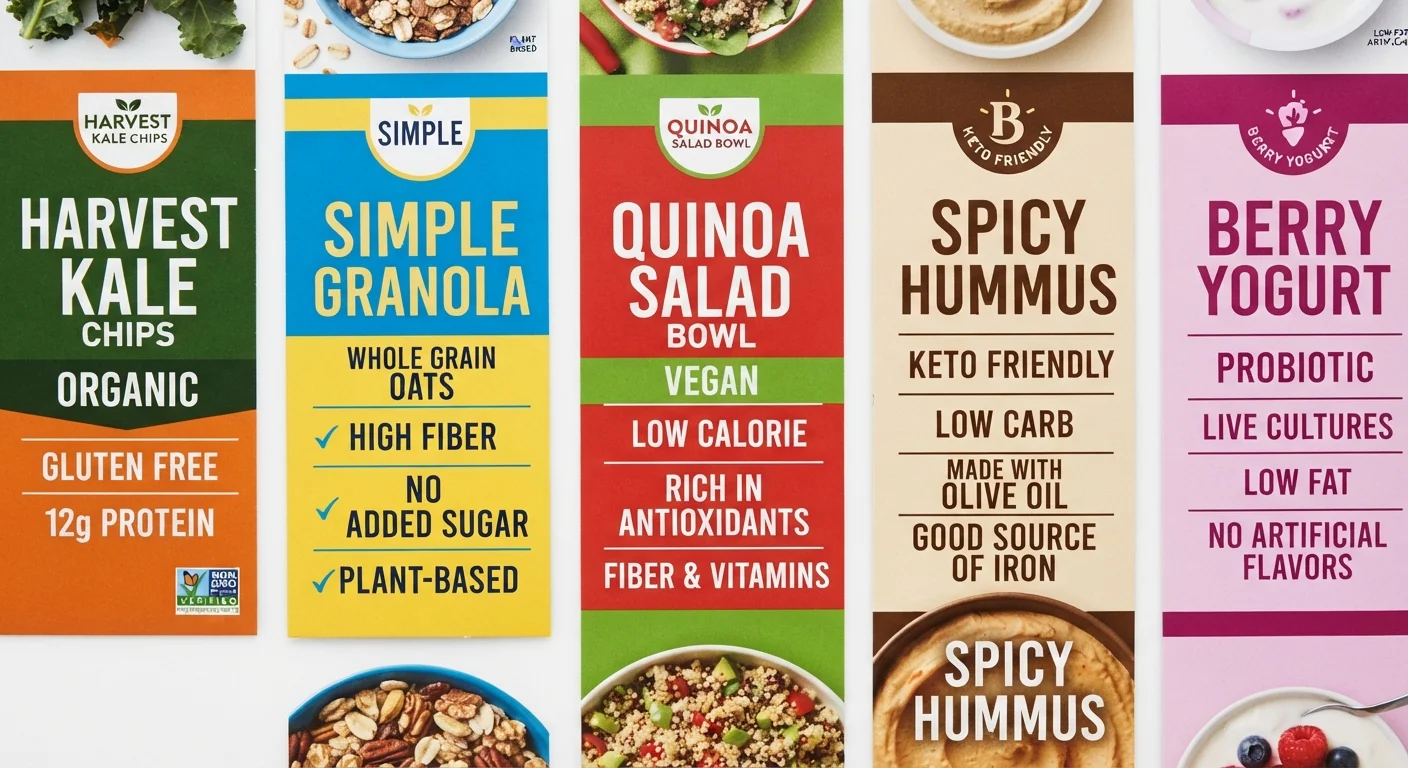
| Fat-free threshold | Less than 0.5 g fat per serving (FDA food labeling regulations) |
| Low-fat threshold | 3 g or less fat per serving (FDA food labeling regulations) |
| Low-sodium threshold | 140 mg or less sodium per serving (FDA food labeling regulations) |
| Very low sodium threshold | 35 mg or less sodium per serving (FDA food labeling regulations) |
| Low-calorie threshold | 40 calories or fewer per serving (FDA food labeling regulations) |
| High-protein / high-fiber threshold | 20% or more of Daily Value per serving (FDA food labeling regulations) |
| "Natural" regulatory status | Informal FDA policy only, not a formal regulation (FDA informal policy statement) |
| "Reduced" minimum difference | At least 25% less than the reference food (FDA food labeling regulations) |
Why label claims have legal definitions
Front-of-package nutrition claims in the United States are not marketing suggestions. The Food and Drug Administration (FDA) sets specific, enforceable thresholds for most of them. A manufacturer cannot call a food "low sodium" unless it meets the FDA's numeric cutoff. That regulatory structure gives these terms real meaning, but only if you know what the thresholds actually are.
This article covers the most common claims you will see on packaged food, what each one legally requires, and where the definitions leave room for misinterpretation. For a broader grounding in how to read a full nutrition facts panel, see the end-to-end nutrition fundamentals guide.
Daily Value (DV)
A reference amount set by the FDA representing the recommended daily intake of a nutrient for a typical adult eating 2,000 calories per day. Percent DV on a label shows how much one serving contributes toward that reference amount.
Reference food
The standard or original version of a product used as a comparison point when calculating "reduced" or "light" claims. The reference food is typically a similar product from the same category.
PDCAAS
Protein Digestibility Corrected Amino Acid Score. A measure of protein quality that accounts for both the amino acid profile of a protein and how well the body can digest and absorb it.
Process claim
A label statement describing how a food was made or handled, such as "no salt added" or "minimally processed," rather than stating the food's actual nutrient content.
Fat and calorie claims
Fat-free means fewer than 0.5 grams of total fat per serving. Low-fat means 3 grams or fewer per serving. Reduced-fat means at least 25% less fat than the standard version of that food, but the reduced product can still be high in absolute fat if the original was very high.
Calorie claims follow the same pattern. Low-calorie requires 40 calories or fewer per serving. Reduced-calorie requires at least 25% fewer calories than the reference food. Light (or "lite") can mean the product has one-third fewer calories or half the fat of the reference food, but "light" can also refer to color or texture if the label says so explicitly.
One consistent issue with low-fat products: removing fat often requires adding sugar or sodium to maintain flavor. Checking the full nutrition facts panel rather than the front-of-package claim gives you the complete picture. The added sugar article covers how manufacturers list sugar under multiple ingredient names.
Sodium claims
Sodium-free means fewer than 5 mg per serving. Very low sodium allows up to 35 mg per serving. Low sodium allows up to 140 mg per serving. Reduced sodium requires at least 25% less than the reference food.
No salt added or unsalted means no salt was added during processing, but the food may still contain naturally occurring sodium. This is a process claim, not a sodium-content claim.
| Fat-free threshold | Less than 0.5 g fat per serving (FDA food labeling regulations) |
| Low-fat threshold | 3 g or less fat per serving (FDA food labeling regulations) |
| Low-sodium threshold | 140 mg or less sodium per serving (FDA food labeling regulations) |
| Very low sodium threshold | 35 mg or less sodium per serving (FDA food labeling regulations) |
| Low-calorie threshold | 40 calories or fewer per serving (FDA food labeling regulations) |
| High-protein / high-fiber threshold | 20% or more of Daily Value per serving (FDA food labeling regulations) |
| "Natural" regulatory status | Informal FDA policy only, not a formal regulation (FDA informal policy statement) |
| "Reduced" minimum difference | At least 25% less than the reference food (FDA food labeling regulations) |
Protein and fiber claims
High-protein is one of the more nuanced claims. The FDA ties it to percent Daily Value (DV): "high" requires 20% or more of the DV for protein per serving. "Good source" of protein means 10 to 19% DV. However, the DV calculation depends on protein quality, measured by the Protein Digestibility Corrected Amino Acid Score (PDCAAS). A food with lower-quality protein must have more grams per serving to qualify. For a detailed look at how protein quantity and quality interact, see how much protein you actually need.
High-fiber follows the same DV structure: 20% or more of the DV (28 grams) per serving qualifies as high. "Good source" of fiber means 10 to 19% DV. These thresholds do not distinguish between soluble and insoluble fiber, which have different physiological effects.
The tricky claims: natural, whole grain, and made with
"Natural" is the most loosely defined term in common use. The FDA has a longstanding informal policy that "natural" means nothing artificial or synthetic was added, but this is not a formal regulation. It says nothing about pesticide use, processing methods, or nutritional quality. The food processing spectrum article explains how processing level and ingredient sourcing relate to each other.
"Whole grain" on the front of a package does not mean the product is entirely whole grain. It may contain a small amount. The only way to confirm whole grain content is to check whether a whole grain (such as whole wheat or oats) is the first ingredient listed.
"Made with" claims ("made with real fruit," "made with whole wheat") indicate that ingredient is present, not that it is present in meaningful amounts. An ingredient can be listed last and technically satisfy the claim.
This article provides general nutrition information for educational purposes and is not a substitute for advice from a registered dietitian or qualified healthcare professional. Individual dietary needs vary; consult a professional before making significant changes to your diet.