

Key Takeaways
- A usage spike of 50 gallons or more per day compared to your baseline often signals a hidden leak.
- Your water meter can confirm an active leak in under 10 minutes, without any tools.
- Toilets, irrigation systems, and water heaters are the most common sources of silent leaks.
- Catching a leak early limits both water waste and potential structural damage to your home.
- Most utilities will issue a one-time leak adjustment credit if you document and repair a confirmed leak.
What you will need
What your water bill actually tells you
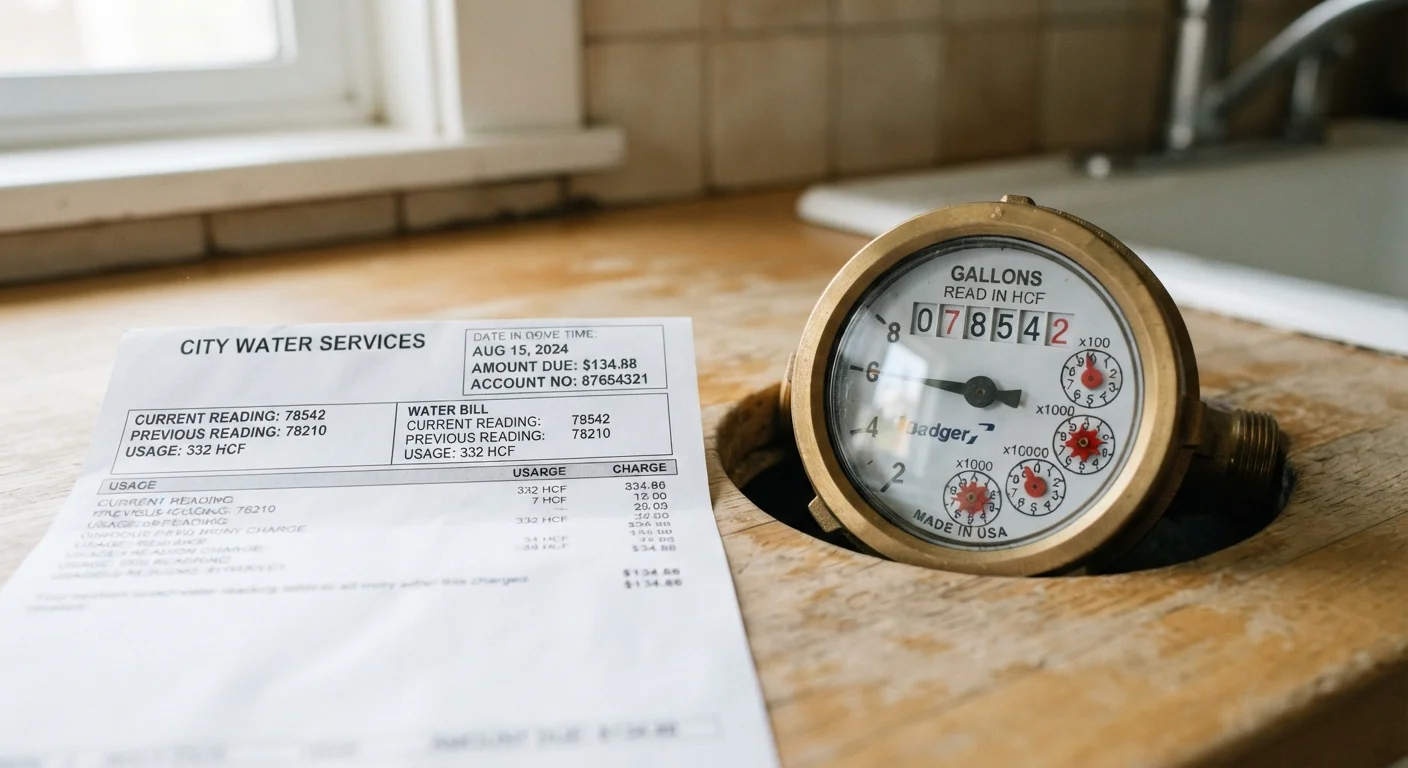
Most water bills show two numbers worth examining: the total volume used in the billing period (typically in gallons or hundred cubic feet, abbreviated CCF) and your daily average usage. Some utilities also display a usage graph comparing the current period to prior months. If yours does, that graph is your first diagnostic tool.
A typical single-family household in the US uses roughly 80 to 100 gallons per person per day. Multiply that by the number of people in your home and by the number of days in the billing period, and you get an expected range. If the bill shows meaningfully more than that, and nothing obvious changed (no house guests, no pool filling, no new irrigation zone), a leak is a likely explanation.
Pull out your last two or three bills and note the usage column for each. If one period is substantially higher than the others, identify which months bracket it. That narrows the window when the leak likely started, which can matter both for the repair and for requesting a billing adjustment from your utility. For a broader picture of how routine plumbing habits affect your home, see our overview of residential plumbing maintenance.
Set a usage alert with your utility
Many water utilities now offer a free high-usage alert by email or text when your consumption exceeds a threshold you set. Enabling this means you do not have to wait until the bill arrives to catch a sudden spike. Check your utility's online account portal to see if this feature is available.
How to use your meter to confirm a leak
The meter is the most reliable short-term test because it measures flow in real time. Before you start, make sure every water-using fixture and appliance in the home is off: faucets, ice makers, washing machines, dishwashers, irrigation timers, and any outdoor bibs. Then follow the steps below.
Record the current meter reading
Open the meter box (usually a small concrete or plastic cover flush with the ground near the street) and write down the full reading shown on the dial or digital display. Include all digits, and note the time.
Wait two hours without using any water
Leave the home undisturbed for at least two hours. Do not flush toilets, run faucets, or operate any appliance. If you have an automatic ice maker, turn it off at the wall or refrigerator control before you start.
Read the meter again and compare
Return to the meter and record the new reading at the same level of precision. Subtract the first reading from the second. Any positive difference means water moved through the supply line while all fixtures were off. Even a small difference, say two to three gallons over two hours, points to a real leak that will add up over weeks.
If the leak indicator moves during the two-hour wait but you cannot find an obvious source indoors, the leak may be in the supply line between the meter and the house, or in an underground irrigation zone. Those repairs generally require a licensed plumber. Do not attempt to excavate or splice a pressurized supply line yourself.
Know when to call a professional
Any leak suspected to be inside a wall, under a concrete slab, or in the underground supply line between the meter and the house requires a licensed plumber. These repairs involve pressurized systems and may require a permit depending on your local building code. Attempting them without proper training risks injury, flooding, and code violations.
Where to look first
Once you have confirmed water is moving, start with the most common offenders before calling a professional.
Toilets account for a large share of hidden household leaks. A worn flapper valve lets water trickle continuously from the tank into the bowl without making noise you would notice. Drop a few drops of food coloring into the tank and wait 10 to 15 minutes without flushing. If color appears in the bowl, the flapper is not sealing and needs replacement. This is a straightforward repair most homeowners can do with a replacement flapper (available at any hardware store) and no special tools.
Irrigation systems are the second most common source. A broken emitter, cracked lateral line, or failed zone valve can release hundreds of gallons overnight without wetting any visible surface if the ground is dry. Run each zone manually and walk the perimeter while it runs.
Water heaters sometimes develop slow drips at the pressure relief valve or supply connections. Check the area around the base and the drain pan. A puddle there is not always from condensation.
Hidden leaks inside walls or under slabs can cause structural damage over time, similar to the slow deterioration described in our article on how a small roof leak becomes a structural problem. If you suspect a pipe inside a wall or under the slab, stop the investigation and contact a licensed plumber. Cutting into drywall without knowing pipe locations can cause additional damage and poses a risk with older homes that may have lead or galvanized steel pipe.
Requesting a leak adjustment from your utility
Many water utilities offer a one-time courtesy adjustment, sometimes called a leak credit or high-usage adjustment, that reduces or eliminates the overage charge from a billing period affected by a confirmed leak. Policies vary by provider, so check your utility's website or call their customer service line.
To request an adjustment, you typically need: the bill in question, documentation of the repair (a receipt from a plumber or a photo of the replaced parts with a date), and a follow-up bill showing usage has returned to your normal baseline. Some utilities require the adjustment request within a set number of days after the repair, so act promptly once the fix is done.
Your water bill is not just a payment notice. Read across billing periods the same way a spending audit tracks patterns over time, as the approach in this three-month spending audit guide illustrates. Consistent review each month gives you a baseline that makes any future anomaly easy to spot and act on quickly.