

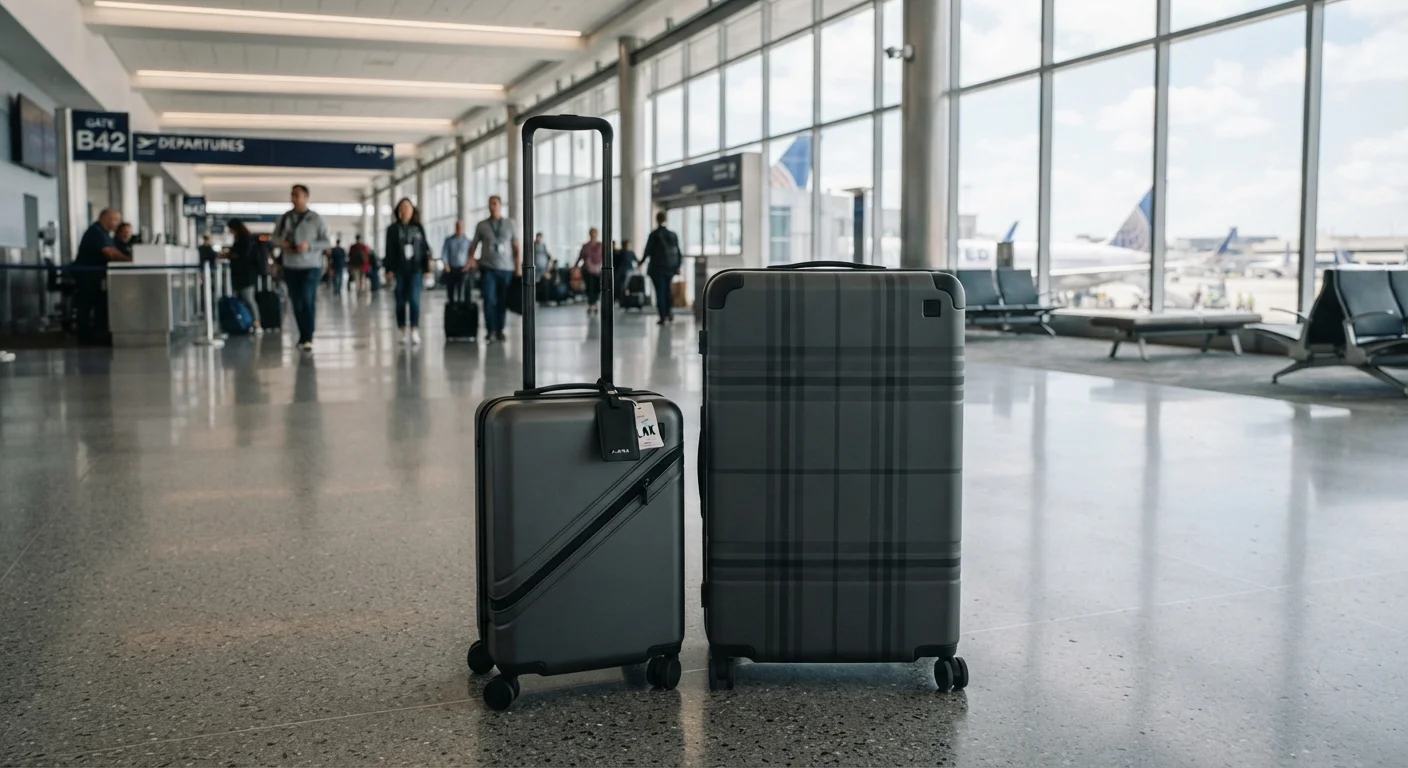
Key Takeaways
- Carry-on bags skip baggage fees and eliminate wait time at baggage claim.
- Checked bags give you more packing volume and fewer restrictions on liquids and gear.
- Airline size and weight limits vary, so confirm them before you fly.
- Trip length alone does not determine the right choice; the contents of your bag do.
- Lost or delayed baggage is a real risk with checked luggage; keep valuables and medications with you.
Option A
Carry-on bag
The fast, fee-free option for travelers who want full control of their luggage.
Best for: Short trips, frequent flyers, and anyone who wants to move quickly through the airport.
Option B
Checked bag
The flexible choice when volume, liquids, or gear make a small bag impractical.
Best for: Longer trips, families, travelers with specialized equipment, or anyone bringing restricted items.
If you are taking a short domestic trip with flexible packing needs
Carry-on bag
You avoid fees, skip baggage claim, and stay mobile. A well-organized carry-on handles most weekend and week-long trips comfortably.
If you are traveling for two or more weeks or need specialized gear
Checked bag
Extended trips often require more clothing, shoes, or equipment than a carry-on can hold, and the added volume justifies the fee.
If your itinerary includes multiple connecting flights with tight layovers
Carry-on bag
Checked bags can miss connections. Keeping luggage with you removes that risk entirely.
If you are traveling with young children or need full-size toiletries
Checked bag
Children's supplies and liquids over 3.4 oz cannot realistically fit within carry-on liquid rules, making checked bags the practical choice.
What actually separates the two options
The core difference is custody. With a carry-on, your bag stays with you from check-in to arrival. With a checked bag, you hand it over to the airline and collect it at the destination carousel. That handoff has real consequences for time, cost, and risk.
Checked baggage fees on U.S. domestic routes commonly run between $30 and $40 per bag, per direction, though fee structures vary by airline and fare class. Carry-on bags are generally included in base fares on full-service carriers, though some budget carriers charge for overhead bin access. Confirm the policy for your specific fare before you book.
Time is the other variable. Checking a bag adds steps at departure (check-in counter or bag drop) and at arrival (waiting at baggage claim, which can range from 15 minutes to over an hour). Carry-on travel eliminates both.
| Criterion | Carry-on bag | Checked bag |
|---|---|---|
| Typical fee (domestic U.S.) | Usually free on full-service carriers | $30-$40 per bag, per direction |
| Liquid restrictions | 3.4 oz limit per container | No liquid restrictions |
| Baggage claim wait | None | 15 minutes to over an hour |
| Risk of loss or delay | Very low (stays with you) | Low but present |
| Packing volume | Limited to overhead bin size | Up to 50 lbs standard |
| Gate check risk | Possible on full flights | Not applicable |
Packing limits and restrictions
The TSA limits carry-on liquids to containers of 3.4 oz (100 ml) or less, all fitting in one quart-sized clear bag. That rule affects toiletries significantly. Checked bags face no such liquid restriction, which matters for anyone bringing full-size products or specialty items. For a detailed look at what the rules cover, see TSA liquid rules and carry-on regulations.
Carry-on size limits are set by each airline, not a single universal standard. A bag that fits in one carrier's overhead bin may be gate-checked on another. Typical U.S. domestic limits run around 22 x 14 x 9 inches, but always check the specific airline's policy. Weight limits for carry-ons are less common on domestic U.S. routes but do apply on many international carriers.
Checked bags have their own weight limits, usually 50 lbs for standard economy. Overweight fees apply above that threshold and can exceed the cost of the original baggage fee.
When a carry-on is the better fit
Carry-on travel works well for trips up to about a week when you pack with some intention. Shifting to a carry-on-only approach often means choosing versatile clothing, using travel-size toiletries, and being selective about shoes. The payoff is speed, savings, and the certainty that your bag arrives when you do.
Frequent flyers on short business trips are the clearest fit. One bag, no checked fee, straight to the gate. But leisure travelers on longer trips can also manage with a carry-on, particularly if the destination has laundry access or the traveler is comfortable wearing items more than once.
The risk to account for: overhead bin space can fill on busy flights, and airlines may gate-check carry-ons involuntarily on full planes. If that happens, the bag goes below and you collect it at the jet bridge, not baggage claim, but the timing is still out of your hands.
When a checked bag makes more sense
Some trips are simply hard to pack for without more space. Multi-week travel, cold-weather destinations, beach vacations with gear, or trips that involve formal events alongside casual outings can push the volume beyond what a carry-on reasonably holds. The honest trade-offs of packing light are worth reading before you decide.
Checked bags also accommodate items that cannot go in the cabin: most sporting equipment, certain tools, full-size liquids, and some medical devices. If your trip requires any of those, a checked bag is not optional.
The main risk is loss or delay. The U.S. Department of Transportation tracks mishandled baggage rates for domestic carriers; the rate is low but not zero. Keep medications, electronics, travel documents, and any irreplaceable items in your carry-on regardless of whether you also check a bag.
Verify limits before every trip
Airline baggage policies change, and rules differ between carriers, fare classes, and international routes. Check the specific airline's baggage page when you book and again before you travel. Official government travel advisories and airline websites are the authoritative sources for current rules.