

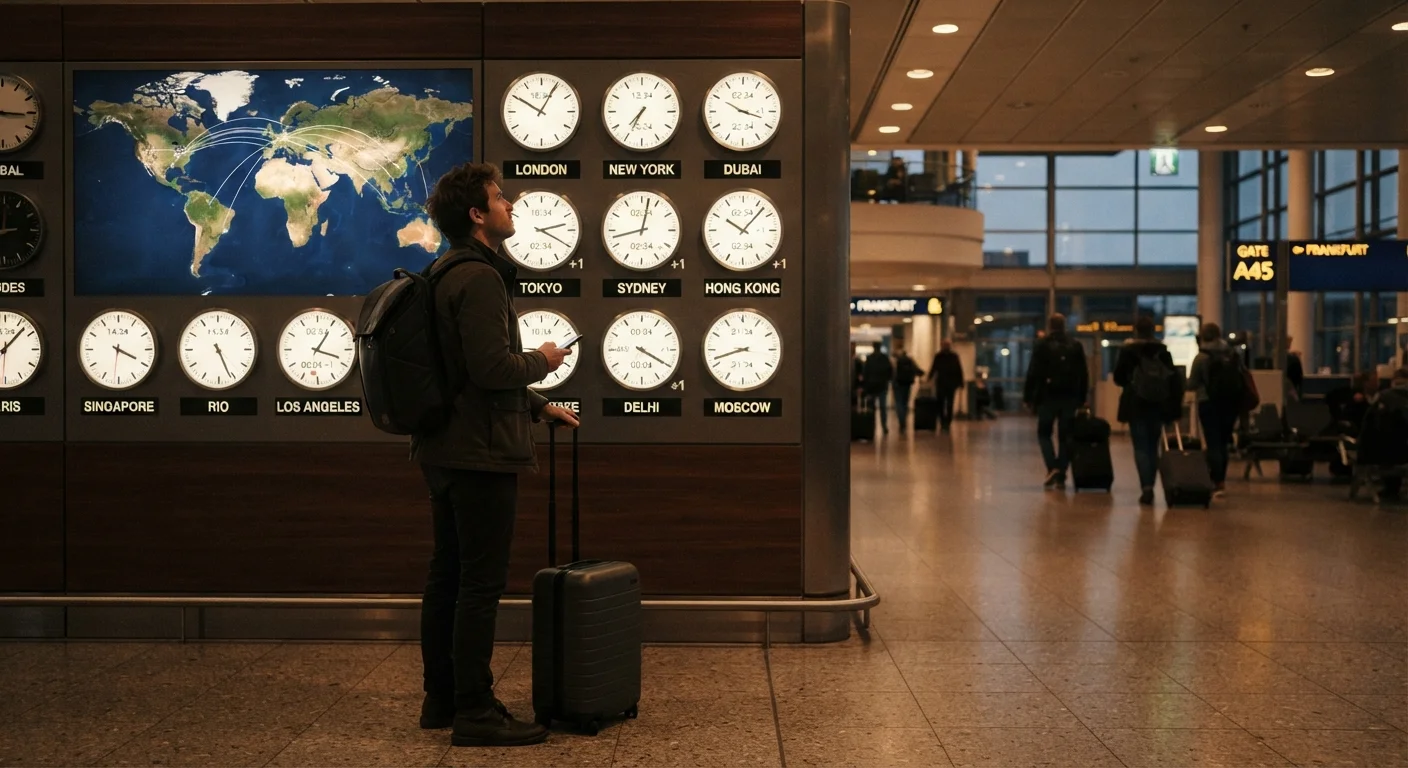
Key Takeaways
- UTC is the universal reference point; every local time is expressed as UTC plus or minus an offset.
- Daylight saving time (DST) shifts clocks by one hour in participating regions, and transition dates differ by country.
- Some countries and territories use non-standard half-hour or 45-minute offsets, not just whole-hour steps.
- Scheduling tools that auto-detect time zones can still fail if DST transitions fall mid-trip.
- Confirming local time through your destination's official sources protects against DST and offset errors.
Time zone offset
A time zone offset is the difference, in hours (and sometimes half-hours), between a location's local time and Coordinated Universal Time (UTC). When you cross from one time zone into another, clocks shift by that offset. Most of the world uses whole-hour offsets, but some countries use 30- or 45-minute increments.
UTC replaced Greenwich Mean Time (GMT) as the international time standard, though the two differ by less than one second and are used interchangeably in everyday travel contexts.
Why time zones cause more problems than jet lag
Jet lag gets most of the attention, but the scheduling errors that time zones produce can be more immediately damaging. A missed business call, a hotel checkout misread by 12 hours, or a flight departure confused with the departure city's time instead of the destination's time can derail a trip in ways that no amount of rest fixes.
The confusion traces back to one core misunderstanding: travelers often think of time zones as simple hour-by-hour steps around the globe. In practice, political borders, historical decisions, and daylight saving rules make the system irregular. China spans a geographic range that would normally cover five time zones, yet the entire country operates on a single offset (UTC+8). Parts of western China experience sunrise after 10 AM in winter as a result.
Understanding the actual structure of time zones, not just the idea of them, gives travelers a practical tool for avoiding these errors. For broader planning context, see how time zones and local closures interact before you finalize an itinerary.
How UTC offsets actually work
Every time zone is defined by its offset from UTC. UTC+3 means local clocks are three hours ahead of UTC; UTC-5 means five hours behind. When you know the UTC offset for your home location and your destination, the math is direct: subtract one offset from the other to find the gap between the two places.
The wrinkle comes with non-standard offsets. India (UTC+5:30), Iran (UTC+3:30), Nepal (UTC+5:45), and several Australian states use half-hour or 45-minute increments. A traveler assuming all offsets are whole hours will be off by 30 or 45 minutes in these places, which is enough to miss a call or a scheduled pickup.
The most reliable habit is to convert every time-sensitive appointment to UTC before you travel, then reconvert it to local time at your destination. This two-step process eliminates the mental arithmetic errors that come from trying to add and subtract offset hours in your head while fatigued.
Convert to UTC before you travel
Write down your three most time-sensitive appointments (flight departure, hotel checkout, any scheduled calls) as UTC times before you leave home. Post them somewhere accessible, such as a note on your phone. When you arrive, convert from those UTC anchors to local time rather than trying to mentally adjust from your home time zone.
Daylight saving time: the hidden offset shift
Daylight saving time (DST) adjusts clocks forward by one hour in spring and back in fall in participating regions. The goal is to shift daylight into evening hours during the longer days of summer. About 70 countries observe some form of DST, but the transition dates are not synchronized globally.
The US moves clocks on the second Sunday of March and the first Sunday of November. The European Union shifts on the last Sunday of March and the last Sunday of October. Between those dates, the standard offset between, say, New York and London is temporarily one hour different from what it is the rest of the year. A meeting scheduled weeks in advance using a static hour difference can arrive an hour early or late during that window.
Several countries have permanently abandoned DST in recent years, and legislation to do so has been debated in others. Before confirming meeting times with international contacts, verify whether both locations are currently in or out of DST. Government or official municipal websites for each country are the reliable source for this.
Practical steps for scheduling across time zones
The following approach works whether you are coordinating a remote work call from abroad or confirming tour booking times with a local operator.
- Identify the UTC offset for every location involved, including DST status on the specific date in question.
- Convert all appointment times to UTC as a common reference.
- Reconvert from UTC to each participant's local time and confirm those times explicitly in your calendar invite or message.
- Set a phone reminder using local destination time, not your home time zone, so the alert fires at the correct local moment.
Calendar applications handle much of this automatically, but they depend on your device's location settings being accurate. If you are using a borrowed device or a SIM from a different region, the auto-detection can produce the wrong offset. Manual verification takes less than two minutes and eliminates that risk.
If your trip involves a layover that spans a significant time zone boundary, the connection window in local time may look different from what you calculated at home. Transfer time planning requires accounting for local clock differences, not just elapsed flight hours.
For travelers building detailed daily schedules, a structured itinerary approach can help anchor each activity to the correct local time from the start.