

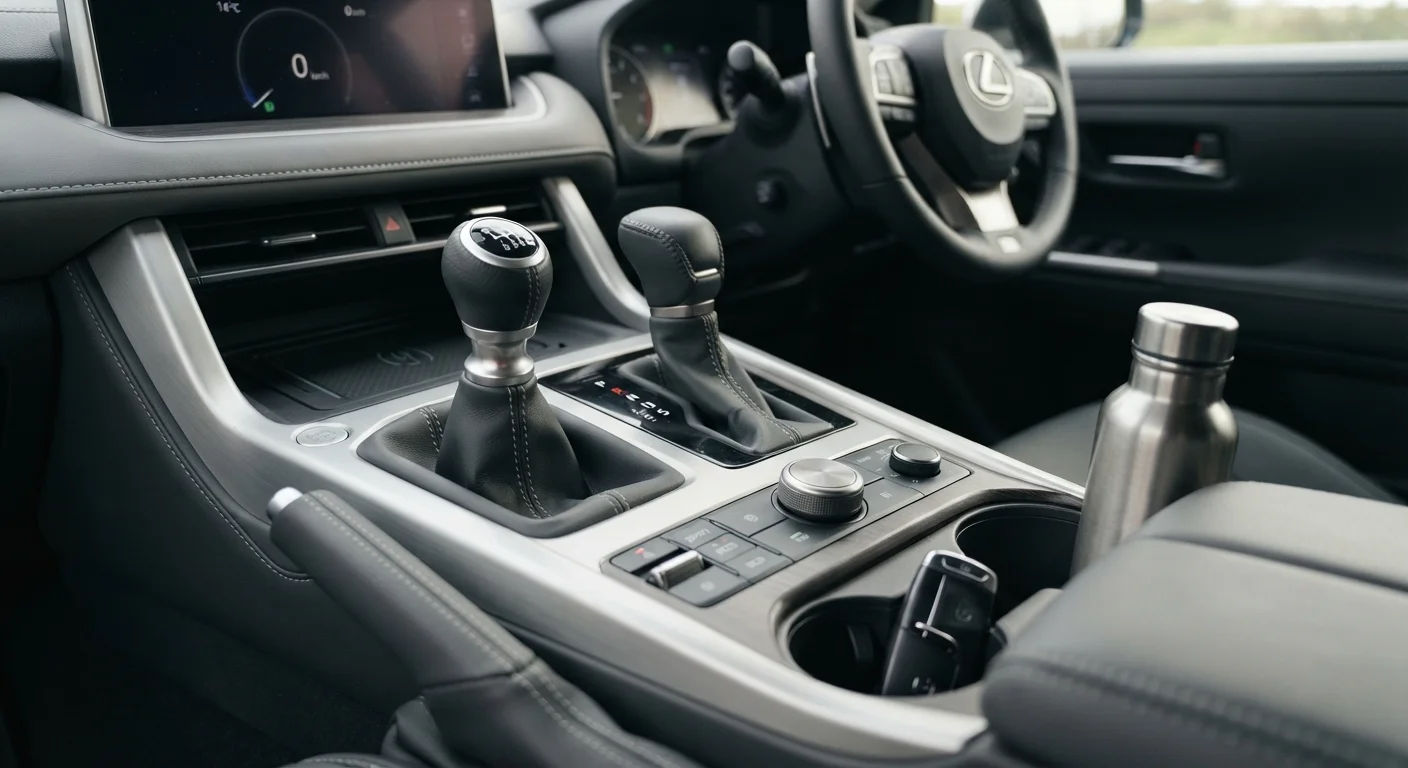
Key Takeaways
- Manual transmissions require the driver to operate a clutch pedal and select gears, which demands more physical coordination.
- Automatic transmissions shift gears on their own, letting the driver focus entirely on steering and road conditions.
- Hill starts, traffic, and towing each present different challenges depending on which transmission type you drive.
- Stalling is unique to manual driving and most common during low-speed maneuvers.
- Many modern driver assistance features are available on both transmission types, though integration varies by vehicle.
- Maintenance needs differ: clutch wear is a manual-specific cost, while automatic fluid condition matters more for automatics.
Option A
Manual transmission
The driver-controlled option that puts gear selection in your hands.
Best for: Drivers who want direct control over engine power and are willing to develop the clutch and shifting technique it requires.
Option B
Automatic transmission
The self-shifting option that handles gear changes for you.
Best for: Drivers who prioritize ease of use, especially in stop-and-go traffic or unfamiliar road conditions.
If you drive primarily in dense urban traffic
Automatic transmission
Repeated clutch engagement in stop-and-go conditions is physically tiring and increases clutch wear over time. An automatic removes that demand entirely.
If you want maximum control on winding or hilly roads
Manual transmission
Selecting your own gear lets you anticipate engine braking and power delivery rather than waiting for the transmission to decide.
If you are a new or returning driver
Automatic transmission
Removing clutch coordination from the learning process lets new drivers focus on road awareness, signaling, and positioning.
If you frequently tow or carry heavy loads
Manual transmission
Experienced drivers can manually hold lower gears on grades, avoiding the hunting behavior some automatics show under load.
What each transmission actually requires from you
With a manual transmission, the driver manages three inputs simultaneously: the clutch pedal, the gear shifter, and either the accelerator or brake. Releasing the clutch too quickly causes the engine to stall; releasing it too slowly causes excessive clutch wear. Getting the balance right takes practice, and most drivers take weeks to build consistent muscle memory for it.
An automatic transmission monitors vehicle speed and engine load, then selects gears without driver input. The driver uses only two pedals. That simplicity is real, but it comes with a tradeoff: you surrender direct control over which gear the vehicle is in at any moment. In most driving situations that is not a problem, but on long descents or when overtaking, some drivers find themselves working around the transmission's choices rather than directing them.
Manual mode on automatics
Many modern automatic transmissions include a manual shift mode, accessible via the gear selector or steering-wheel-mounted paddle shifters. This lets the driver hold a specific gear when needed, such as on a long descent or before an overtaking maneuver. The transmission will typically override the driver's selection if the engine approaches a harmful rev range.
Both transmission types require the driver to understand how engine braking works. In a manual, selecting a lower gear actively slows the vehicle through compression. In an automatic, you can typically select a lower range manually using the gear selector or paddle shifters if the vehicle has them. Consult your owner's manual for the correct procedure on your specific vehicle.
Hill starts and low-speed control
Hill starts are where manual driving becomes genuinely difficult for new drivers. Holding a vehicle stationary on a slope while simultaneously releasing the clutch, applying throttle, and releasing the brake requires precise timing. Roll-back is common until the technique is practiced. Hill-start assist, now fitted to many manual vehicles, holds brake pressure briefly after you release the brake pedal, giving you a moment to engage the clutch without rolling backward.
Automatic transmissions handle hill starts with no special technique required. Brake, shift to drive, apply throttle. In bumper-to-bumper traffic on an incline, this difference becomes significant over the course of a commute.
At parking lot speeds and in tight maneuvering, manual drivers use clutch slip (partially engaging the clutch to move slowly without stalling) to control crawling speed. Automatic drivers use light brake pressure against idle engine power. Neither is inherently safer; both require attentiveness.
How each transmission affects longer drives
On highway driving, the gap between the two narrows. A manual driver selects top gear and largely stays there. Fatigue from shifting is minimal at steady speed. Where it returns is in construction zones with variable speed limits, or when traffic waves force repeated deceleration and acceleration.
Automatic transmissions in highway driving are generally undemanding. Modern units with six or more gear ratios keep the engine close to its most efficient operating range across a wide range of speeds. Some drivers use manual mode or paddle shifters to downshift before long grades, which gives more predictable engine braking without relying on the transmission to detect the slope.
For long-distance driving, the maintenance needs of a high-mileage vehicle differ by transmission type. Clutch assemblies on manuals wear gradually and require periodic inspection and eventual replacement. Automatic transmissions depend heavily on fluid condition; degraded fluid accelerates internal wear. See how to check and interpret transmission fluid for guidance on monitoring fluid condition between service intervals.
Safety and driver attention
Driving a manual requires more conscious attention to vehicle operation, particularly in unfamiliar situations. That additional cognitive load can compete with awareness of pedestrians, cyclists, or sudden hazards. For drivers new to manual operation, this is worth taking seriously rather than dismissing.
Automatic transmissions free up attention for road scanning, which is an advantage in complex environments. Many advanced driver assistance systems are designed around the assumption of an automatic transmission, though most function on manuals as well. Adaptive cruise control, for example, works on a manual vehicle but requires the driver to downshift manually when the system reduces speed significantly.
Neither transmission type makes a vehicle inherently safer. Driver behavior, vehicle condition, and road awareness matter far more than which type of gearbox is fitted. For more on staying aware around other road users, the guidance on sharing the road with large trucks applies regardless of what transmission your vehicle has.