

Key Takeaways
- The envelope method limits overspending by making budget boundaries physical and immediate.
- It works best for variable spending categories like groceries, dining, and entertainment.
- Digital versions of the system exist but require consistent discipline to replicate the friction of spending real cash.
- Combining envelope budgeting with a monthly review helps you adjust category amounts over time.
- This article provides general financial education and is not personalized financial advice.
The envelope method
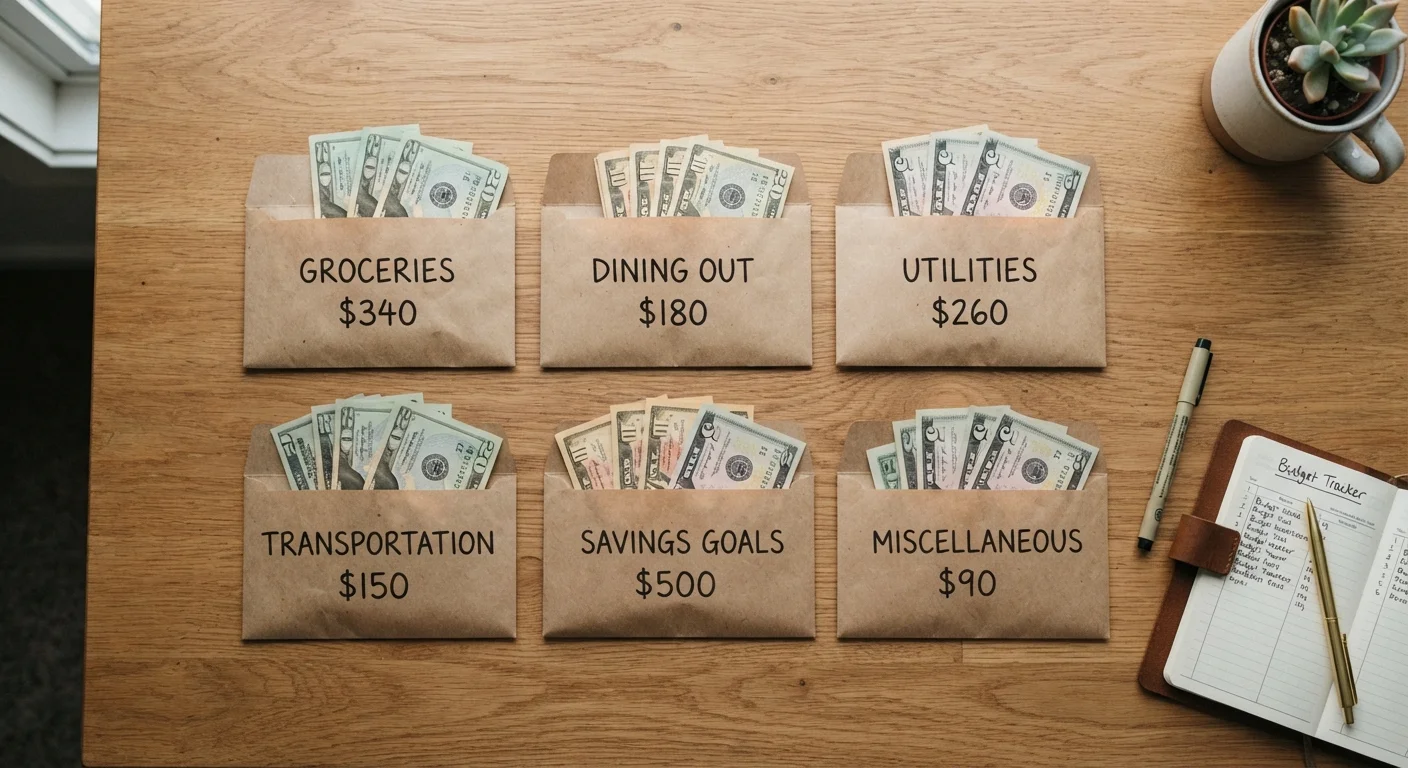
The envelope method is a cash-based budgeting system where you divide your income into physical envelopes, each labeled for a specific spending category such as groceries, gas, or dining out. When an envelope is empty, spending in that category stops until the next budget period. The system works by making spending limits tangible and visible rather than abstract numbers on a screen.
In personal finance, this approach is sometimes called 'zero-based cash budgeting' because every dollar of income is assigned to an envelope or savings goal before the month begins, leaving a zero unallocated balance.
How the envelope method works
At the start of each pay period, you withdraw cash for every variable spending category in your budget. Each category gets its own labeled envelope: one for groceries, one for gas, one for dining out, and so on. The cash inside each envelope is the only money available for that purpose until the next pay period.
When you spend, you pull from the relevant envelope. When the envelope empties, that category is closed. There is no moving money from a debit card or tapping a credit card to extend the limit. The physical constraint is the point.
Fixed expenses such as rent, utilities, and insurance stay outside the envelope system entirely. Those amounts are predictable and paid by transfer or check from your main account. The envelope method focuses its discipline on the discretionary categories where most spending drift actually happens.
Aligning your bill due dates with your pay cycle matters here too. If your envelopes are funded on payday but a large bill hits a week before, you may draw down cash needed elsewhere. Mapping out timing before you set envelope amounts prevents that problem.
Why cash works differently than a card
Behavioral research has found that people tend to spend more freely when using cards compared to cash. One explanation is that handing over physical bills registers a loss in a way that a card swipe does not. The envelope method deliberately uses that friction.
Seeing a thin stack of bills left in a grocery envelope mid-month sends a concrete signal that is harder to rationalize than a checking account balance buried in a banking app. The information is immediate and proportional: half the cash gone means half the month's allowance spent.
18%
Average reduction in discretionary spending with cash-only budgeting
A study published in the Journal of Consumer Research found participants spent roughly 18% less on discretionary items when using cash compared to credit cards.
33%
US adults who follow a written budget
Gallup polling has consistently found that roughly one in three American adults maintains a detailed monthly budget, leaving a large share managing spending without a formal framework.
This tactile feedback is also why digital envelope apps require more self-discipline to maintain. The information is the same, but the friction is reduced. That is not a fatal flaw; it just means the system depends more on the habit of checking the app before each purchase than on the automatic resistance of reaching into an envelope.
Setting realistic category amounts
The envelope method fails when category amounts are set by aspiration rather than actual spending patterns. Assigning $300 to groceries when your household consistently spends $480 does not reduce spending; it produces empty envelopes by the third week and a decision to abandon the system.
Before setting amounts, pull three months of bank and card statements and calculate what you actually spend in each variable category. Use those averages as your starting point. From there, you can choose to reduce a category intentionally, but the reduction should be a specific decision, not a wish.
Running a monthly budget review alongside the envelope system lets you spot which envelopes consistently run out early and which still have cash left over. Adjusting amounts based on that pattern is more reliable than guessing at the outset.
Adapting the method for digital spending
Physical cash is impractical for online purchases, subscription services, and contactless payments. A workable adaptation is to run the envelope system only for in-person, discretionary spending and to track digital purchases separately using dedicated budget categories in a spreadsheet or app.
Some people use a prepaid debit card as a digital envelope, loading a fixed amount at the start of the month. When the card balance hits zero, the category is closed. This approach preserves the hard limit while accommodating card-based purchases.
Pay-yourself-first budgeting pairs naturally with the envelope method. Transferring savings automatically on payday, before funding envelopes, means savings are not what is left after spending but a fixed amount treated as non-negotiable. The two approaches address different parts of the budget: one protects savings, the other controls spending. For goals-based saving, organizing money into named savings buckets extends the same categorical thinking into longer-term priorities.
For households managing combined income and shared expenses, the system needs clear rules about which envelopes are joint and which are individual. A shared groceries envelope with two people spending from it requires communication that a solo budget does not. Structuring a household budget with defined shared and personal spending categories can resolve that friction before it becomes a point of conflict.
This article is for general informational and educational purposes only and does not constitute personalized financial advice. Consult a qualified financial professional for guidance specific to your situation.