

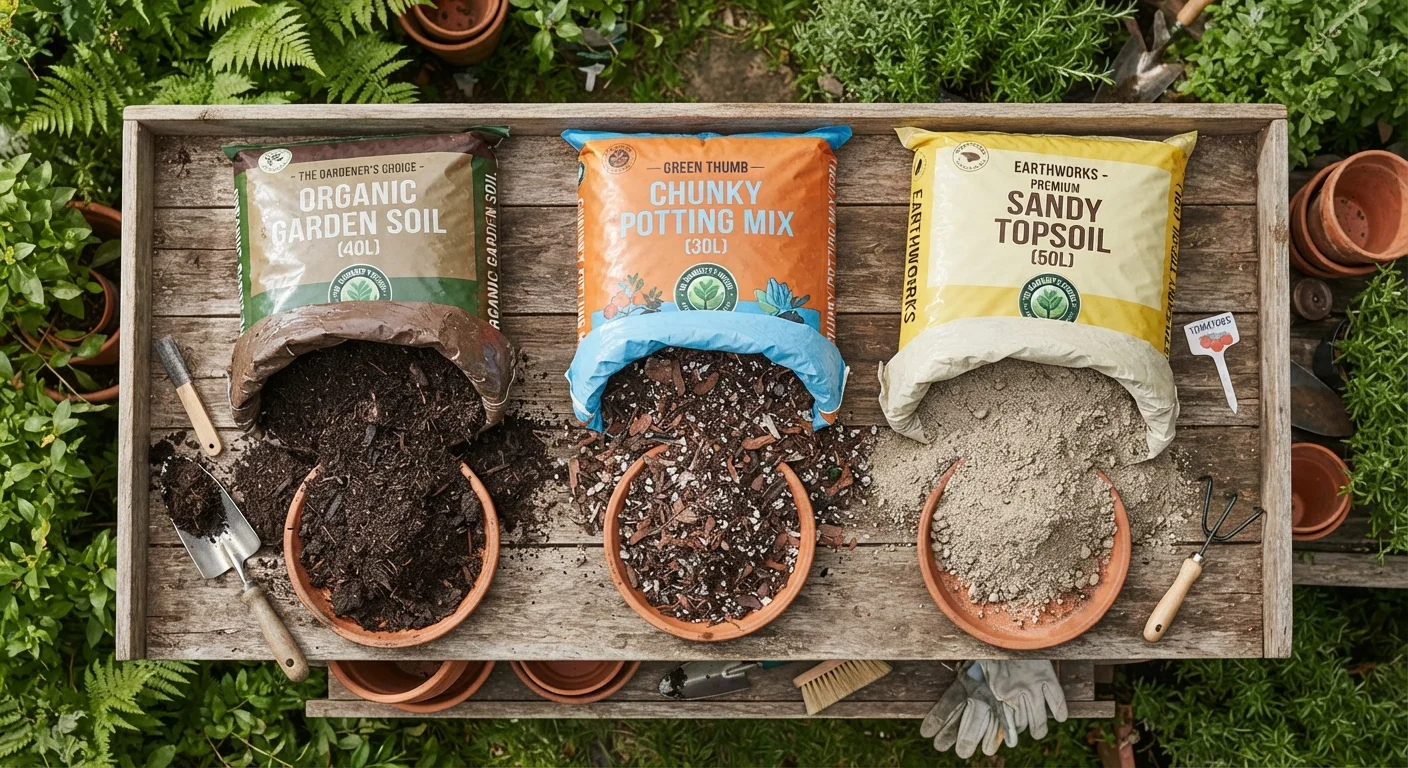
The three products and what sets them apart
Garden soil, potting mix, and topsoil share shelf space at garden centers, but they are not interchangeable. Each has a distinct composition designed for a specific job.
Garden soil is a blend of natural soil combined with organic matter such as compost or aged bark. It is formulated to improve existing in-ground beds by adding nutrients and loosening compacted earth. Most bags are labeled for in-ground use only, because the blend is meant to work alongside the microbial life already present in your yard.
Potting mix (sometimes called potting soil, though it often contains no actual soil) is made from lightweight materials: peat moss or coco coir, perlite, vermiculite, and sometimes compost. The mix drains freely, resists compaction inside a container, and holds just enough moisture for roots to reach. Container plants need that air-to-water balance; potting mix is engineered to maintain it.
Topsoil is the uppermost layer of earth, sold in bulk or bags with minimal processing. Quality varies widely depending on source. Bagged topsoil works well for filling low spots in a lawn, grading a yard, or providing base fill in a raised bed. It is not a finished growing medium on its own.
Perlite
A volcanic glass processed into lightweight white granules. Added to potting mixes and soil blends to improve drainage and prevent compaction.
Peat moss
Partially decomposed sphagnum moss harvested from bogs. Used in potting mixes to retain moisture and add a slightly acidic structure. Coco coir is a common alternative made from coconut husks.
Vermiculite
A mineral that expands when heated, creating lightweight flakes. Mixed into potting media to retain moisture and improve aeration, particularly useful for seed starting.
Organic matter
Decomposed plant or animal material, such as compost or aged bark, added to soil to improve structure, water retention, and nutrient availability.
Soil aeration
The presence of air pockets within a growing medium. Roots need oxygen to function; compacted or waterlogged soil reduces aeration and can damage or kill plants.
Coco coir
Fiber derived from coconut husks, used as a sustainable replacement for peat moss in potting mixes. It retains moisture well and breaks down more slowly than peat.
When to use each one
The right choice depends on where you are planting, not just what you are planting.
Use garden soil when planting directly in the ground. Work it into your existing bed at the depth and ratio listed on the bag, typically a few inches mixed with native soil. For improving your beds season by season, repeated additions of garden soil and compost steadily build structure without requiring a full overhaul each year.
Use potting mix for any container: pots, window boxes, hanging baskets, or grow bags. Garden soil compacts in a confined space and blocks drainage; topsoil does the same. Potting mix keeps roots aerated and prevents the waterlogging that kills most container plants. Some mixes include starter fertilizer, so check the label to know whether you need to feed separately from the start.
Use topsoil for bulk fill and grading. If you are leveling a lawn depression or building a raised bed from scratch, topsoil provides inexpensive volume. For a raised bed intended for food production, combine topsoil with compost and a coarse material such as perlite to create a workable growing medium. Straight topsoil alone is often dense and low in available nutrients.
Reading labels and avoiding common mix-ups
Labels on bagged soil products vary by manufacturer. Terms like "garden soil," "raised bed mix," and "in-ground mix" can describe very different formulations depending on the producer. Read the listed ingredients and the intended use statement on the back of the bag rather than relying on the front-panel name alone.
pH also matters regardless of which product you choose. A soil pH test tells you whether you need to adjust acidity or alkalinity before planting. Most vegetables and common ornamentals prefer a slightly acidic to neutral range, but no bagged product guarantees that range out of the bag.
One frequent mistake is adding potting mix to an in-ground bed to "lighten" the soil. Because potting mix is designed to dry out between waterings, it can dry out faster than surrounding soil and create uneven moisture zones around roots. A better approach is to work compost or aged organic matter directly into the ground instead. For more on what actually improves in-ground soil over time, see building better garden soil over time.
For fertilizer choices that work alongside these soil products, knowing the nutrient release timing of your fertilizer helps you avoid overfeeding or underfeeding alongside a mix that already contains amendments.