

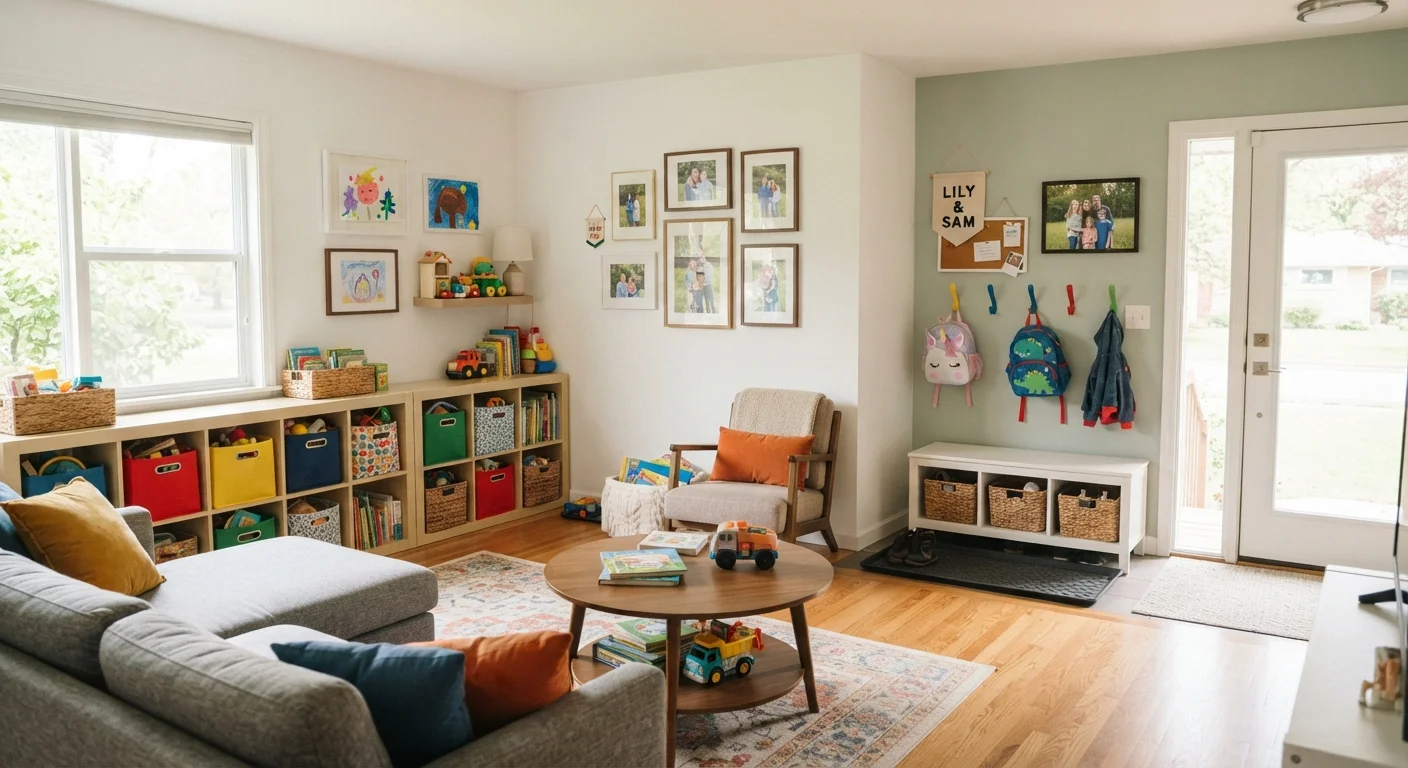
Key Takeaways
- Systems designed for kids must be simple enough for kids to use independently.
- Reducing the total volume of toys and supplies is more effective than buying more storage.
- Assigning a fixed home to each category of item prevents scatter across multiple rooms.
- Short daily resets are more sustainable than occasional deep-clean sessions.
- Involving children in setup makes them more likely to follow through consistently.
Why standard organization advice falls short for families
Most home organization guidance assumes a stable, adult-controlled environment where items stay where you put them. Families with children have a different reality: toys migrate, craft supplies multiply, and a tidy room at 9 a.m. can look entirely different by noon. The solution is not more discipline or more containers. It is building systems that account for how kids actually behave, not how you wish they would.
If you are new to thinking about organization as a whole-home project, this introduction to home organization covers the core concepts worth understanding before you redesign any space.
Start with the most-used room
Pick the room where clutter causes the most daily friction, usually the main living area or the entryway. Getting one space working well gives you a model to repeat elsewhere and a concrete example to show children what the goal looks like.
Core practices for organizing with kids in the house
The practices below address the specific friction points families encounter. They work across different home sizes and ages of children.
Cut volume before adding storage
More bins and shelves do not solve a volume problem; they just give clutter more places to hide. When you reduce the number of items to what the family genuinely uses, any storage system becomes easier to maintain. Excess toys also make it harder for children to focus and choose.
Give every item a fixed, specific home
Vague categories like 'miscellaneous' or 'kids' stuff' create ambiguity about where things belong, which means they end up wherever they land. A named, physical spot for each category removes that decision from the daily reset.
Design storage for the child's height and motor skills
If a child cannot physically access or use a storage system independently, you become the system. Low shelves, open bins, and lightweight lids mean children can put things away without adult help.
Create an outbound staging area near the door
Backpacks, permission slips, library books, and sports gear create daily bottlenecks at the exit. A dedicated drop zone near the main entrance keeps these items out of the rest of the house and reduces morning scrambles.
Involve children in the setup process
Children follow systems they helped design more reliably than those imposed on them. Even young children can choose bin colors or decide which shelf a toy type belongs on. That ownership translates to more consistent follow-through.
Do a small rotation instead of keeping everything accessible
When all toys are always available, rooms feel cluttered and children often engage less deeply with any single item. Storing a portion of toys out of circulation and swapping them periodically reduces visual chaos without reducing what kids actually have.
Making resets quick and repeatable
A 10-minute tidy at the end of the day beats a three-hour Saturday overhaul. When every item has a fixed, labeled spot, the reset requires no decisions, only physical action. Children as young as three can participate when bins are low, open-top, and clearly marked with pictures alongside words.
Staying organized over time depends far more on daily habits than on any single setup session. The goal of every system you build should be to make the reset as frictionless as possible for everyone in the household, including the smallest members.
Household zones help here: when each area has a clear purpose, items that drift into the wrong zone are easy to spot and easy to return.
Tackling the whole house without burning out
Trying to overhaul every room at once is the fastest path to giving up halfway through. A room-by-room approach lets you finish one space completely before moving on, which gives you both a working system and a visible win. This room-by-room decluttering guide breaks the process into steps that fit into real schedules.
Kitchens often become secondary storage for school papers, art projects, and sports gear. Common kitchen organization pitfalls are worth reading before you redesign that space, since family kitchens have failure patterns that adult-only kitchens do not.