

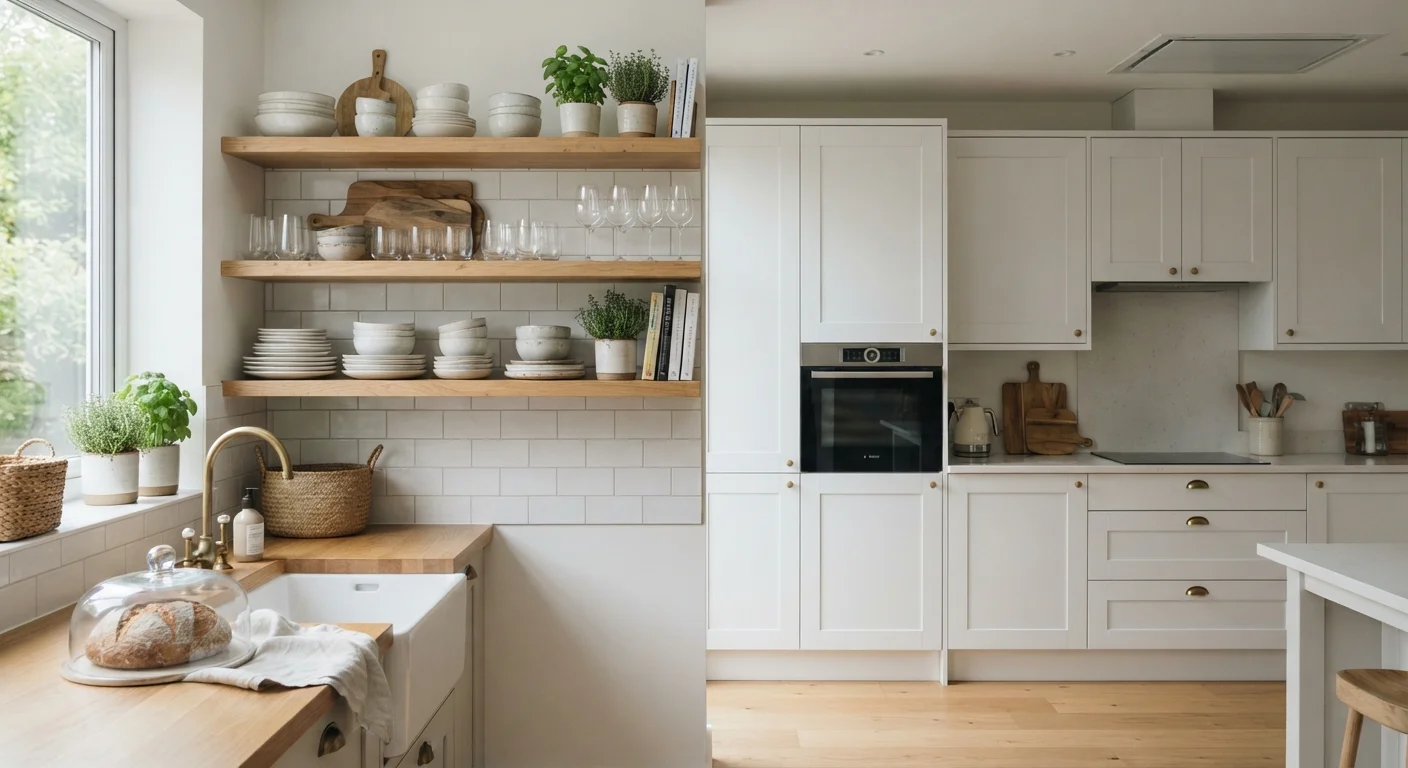
Key Takeaways
- Open shelving requires consistent tidiness because every item is visible at all times.
- Cabinets protect contents from dust, grease, and moisture more effectively than open shelves.
- Open shelves can make a small room feel more spacious, while cabinets add visual weight.
- Cabinet hardware, hinges, and doors add installation complexity and long-term maintenance needs.
- Mixing both approaches is common and lets you match storage type to what you actually keep.
Option A
Open shelving
Visible, accessible storage that doubles as display space.
Best for: Homeowners who maintain tidy habits and want everyday items within easy reach.
Option B
Cabinet storage
Enclosed storage that keeps clutter out of sight.
Best for: Households that prioritize low maintenance and want flexibility in what they store.
If your household generates a lot of visual clutter
Cabinet storage
Doors hide mismatched items and reduce the mental effort of keeping surfaces presentable.
If you want frequently used items grabbed without opening anything
Open shelving
Open shelves eliminate the step of opening and closing doors, which matters for high-traffic areas.
If you cook often and have a range or fryer nearby
Cabinet storage
Grease and steam settle on open shelves quickly, coating dishes and requiring frequent cleaning.
If you're working with a narrow or low-ceilinged room
Open shelving
Floating shelves without overhead cabinet boxes keep walls from feeling heavy and closed in.
What each approach actually means
Open shelving means wall-mounted or freestanding shelves with no doors: contents are visible from anywhere in the room. Cabinet storage uses enclosed boxes, typically with hinged or sliding doors, that conceal what's inside.
Both store the same types of items. The difference is in access, appearance, and upkeep, and those differences compound over time depending on how a space gets used.
Neither approach is inherently superior. The right choice depends on the room, the household, and how honestly you assess your own cleaning habits.
The case for open shelving
Open shelves work well when the items stored are attractive or uniform, such as matching dinnerware, glass jars, or a curated set of cookbooks. In those situations, the storage itself becomes part of the room's visual character rather than something to hide.
Accessibility is a real advantage. There are no doors to open, which speeds up grabbing frequently used items. In kitchens, this matters for spices, oils, and prep tools that move on and off the counter throughout a meal.
Open shelves also cost less to install than full cabinet runs. The materials are simpler, the hardware is minimal, and the installation typically requires only brackets and wall anchors rather than face frames, hinges, and adjustable shelving systems.
In small rooms, open shelving can reduce visual weight. A wall of cabinet doors reads as a solid surface; a wall of open shelves reads as lighter, which can help a cramped kitchen or bathroom feel less boxed in. For more ways to gain capacity in tight spaces, see organization strategies for small spaces.
When open shelves create more work
Open shelving works best with a consistent editing habit. Without it, shelves accumulate items that don't belong, and the visual effect reverses quickly. Before committing to open shelves in a high-traffic room, consider whether the items you'd store there are ones you'd be comfortable having visible at any moment. If the honest answer is no, closed storage will serve the space better.
The case for cabinet storage
Cabinets hide disorder. That single fact drives most purchase decisions. When storage is enclosed, mismatched containers, half-used boxes, and utilitarian items like cleaning supplies stay out of sight without requiring you to organize them to a display standard.
Dust and grease are serious considerations in kitchens. Open shelves collect airborne grease particles from cooking, and items stored near a range need wiping down regularly. Cabinets slow that accumulation considerably, particularly for items used infrequently.
Closed storage also gives you more flexibility in what you keep. Open shelves invite editing: you either display things intentionally or they look cluttered. Cabinets accept practical reality, including the odd-shaped appliance, the bulk purchase, and the items that are useful but not photogenic.
For a broader look at how storage choices interact with kitchen workflow, the article on common kitchen organization pitfalls covers several related decisions worth thinking through together.
| Criterion | Open shelving | Cabinet storage |
|---|---|---|
| Visibility of contents | Always visible | Hidden behind doors |
| Dust and grease accumulation | Accumulates faster | Slower, mostly on exterior |
| Installation complexity | Lower, fewer components | Higher, requires hardware |
| Flexibility in what you store | Limited, items must look presentable | High, anything goes inside |
| Effect in small rooms | Feels lighter, more open | Can feel heavier if overused |
| Maintenance type | Frequent surface wiping | Periodic hardware adjustment |
Maintenance and long-term upkeep
Open shelves require more frequent surface cleaning because dust settles on both the shelf and the items on it. In a kitchen, that interval shortens near the stove. In a bathroom, humidity accelerates the problem.
Cabinets shift maintenance to the hardware. Hinges loosen over time, doors go out of alignment, and drawer slides wear down with heavy use. These are fixable problems, but they do come up, especially in high-traffic rooms.
The honest maintenance comparison: open shelving demands consistent daily tidiness, while cabinets demand occasional hardware attention. Neither is maintenance-free.
If you find yourself mixing both approaches, matching the right storage container to each space can help you make better use of what goes inside each type.