

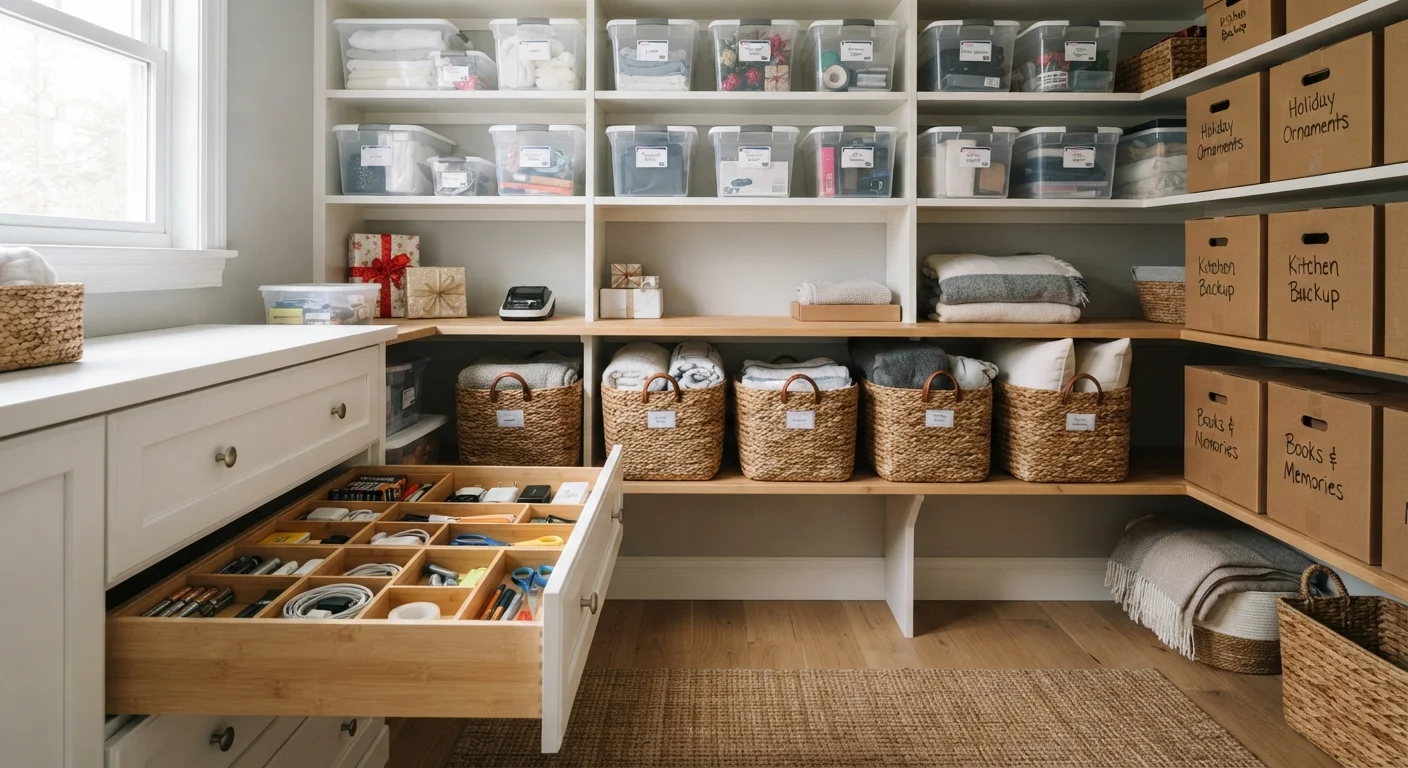
Key Takeaways
- Clear bins work well where quick visual access matters, such as pantries and linen closets.
- Woven baskets suit living spaces where aesthetics and soft goods storage overlap.
- Drawer organizers prevent small items from shifting and mixing in kitchen and bathroom drawers.
- Rigid lidded boxes protect infrequently used items in attics, garages, and under-bed storage.
- Container size should match both the items stored and the shelf or drawer dimensions.
Our Verdict
No single container type works everywhere. The right choice depends on how often you access items, whether the space is visible, and the physical dimensions available. Matching container to context is what keeps a system usable long-term.
| Best for | Recommended |
|---|---|
| High-traffic kitchens and pantries | Clear stackable bins |
| Living rooms and bedroom surfaces | Woven baskets |
| Bathroom and kitchen drawers | Drawer organizers |
| Attic, garage, and seasonal storage | Rigid lidded boxes |
Why container type matters more than quantity
Buying more containers does not automatically produce more order. A bin that is too large for a shelf, or a basket placed in a damp garage, creates new problems. The container type has to match the space's conditions, the frequency of access, and the category of items inside.
Four container types cover most household storage needs: clear bins, woven baskets, rigid lidded boxes, and drawer organizers. Each has a distinct set of strengths, and placing the wrong one in a space tends to undo any system within weeks. The comparison below covers where each type performs well and where it falls short.
| Clear bins | Woven baskets | Drawer organizers | Rigid lidded boxes | |
|---|---|---|---|---|
| Best location | Pantry, linen closet, fridge | Living room, bedroom | Kitchen, bathroom drawers | Attic, garage, closet shelves |
| Visibility of contents | High | None | High (open top) | None without labeling |
| Moisture resistance | Good | Poor | Moderate | Good (plastic only) |
| Aesthetic fit | Functional, utilitarian | Warm, decorative | Hidden inside drawers | Utility or storage areas |
| Best for item type | Food, linens, supplies | Soft goods, bulky items | Small loose items | Seasonal, archived items |
| Stackability | Good with flat lids | Poor | Not applicable | Good with uniform sizes |
Clear bins: visibility as the organizing principle
Clear bins let you see contents without opening anything. That property makes them well-suited to pantries, linen closets, and refrigerator shelves, anywhere you need to scan quickly and grab accurately. Stackable versions make use of vertical space on deep shelves.
The limitation is aesthetic. Clear plastic looks out of place in a living room or on an open shelf in a bedroom. Clear bins also show every crumb or dust buildup, so they require more frequent cleaning to stay presentable. For open shelving vs. cabinet storage, the visibility benefit of clear bins matters more inside a closed cabinet than on a display shelf.
Woven baskets: for visible and soft-goods storage
Woven baskets, whether made from seagrass, rattan, or fabric, handle two jobs at once: containing items and looking presentable in shared living spaces. They work well for throw blankets, magazines, children's toys, and other bulky soft goods that do not need precise organization.
They are a poor fit for heavy items, wet environments, or anywhere you need to see contents at a glance. A basket in a bathroom that collects moisture will deteriorate and may develop mold. In living spaces where multiple adults contribute to the system, baskets with consistent placement help maintain order. See organizing a home with multiple adults for more on building systems that hold across different habits.
Label containers that hide contents
Any container that does not show what is inside needs a label on the front or top. This applies to woven baskets, lidded boxes, and opaque bins. A simple label prevents the habit of opening every container to find one item, which is what causes systems to break down over time.
Drawer organizers: keeping small items fixed
The core problem in most kitchen and bathroom drawers is that small items slide together with every open-and-close cycle. Drawer organizers solve this by creating fixed compartments sized to specific item categories: utensils, toiletries, office supplies, batteries.
Fit matters here more than with any other container type. An organizer that does not span the drawer's width will shift around, defeating its purpose. Measure the interior drawer dimensions before selecting any organizer. Modular systems with interlocking pieces allow customization for irregular drawer sizes. For drawers that have become catch-all zones, understanding what your catch-all spots reveal is a useful starting point before adding any organizer.
Rigid lidded boxes: long-term and protected storage
Rigid lidded boxes, typically made from heavy-duty plastic or reinforced cardboard, are designed for items stored infrequently: seasonal decorations, archived documents, off-season clothing, sports equipment. The lid protects against dust, pests, and in the case of plastic, moisture.
Cardboard boxes degrade in humid environments like garages and crawl spaces, so plastic is the more durable option for those areas. For attic and closet storage, uniform box sizes stack more securely and use vertical space more efficiently than a mix of shapes. Small closet organization strategies covers how labeled uniform boxes can reclaim overhead shelf space. When sorting through stored items, sorting discarded items properly reduces what needs to be boxed in the first place.