

Key Takeaways
- Catch-all zones form because homes lack a designated place for certain categories of items.
- A single, intentional junk drawer is a practical household tool; multiple unmanaged piles are a sign of a deeper sorting gap.
- The contents of a catch-all zone reveal which item categories still need permanent homes in your space.
- Containing overflow is more effective than trying to eliminate it entirely.
- Reviewing a catch-all zone every few months prevents gradual buildup from becoming unmanageable.
Catch-all zone
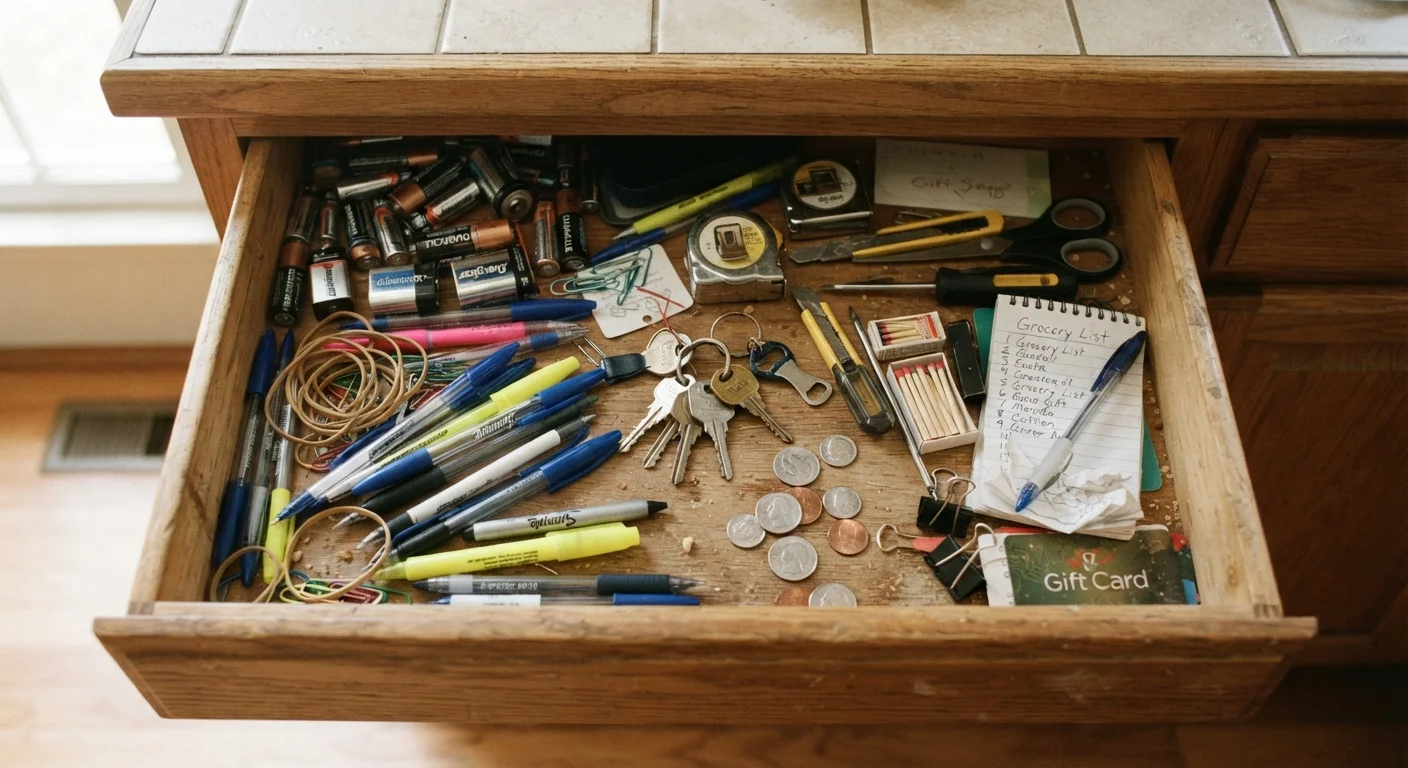
A catch-all zone is any spot in a home that collects miscellaneous items without a clear organizational system. Common examples include junk drawers, countertop piles, the top of the refrigerator, and entry-hall baskets. These spots form naturally because households generate small, hard-to-categorize objects faster than they assign permanent homes for them.
In home organization, catch-all zones are sometimes called 'transitional storage' because they often hold items mid-journey between arrival and final placement.
Why catch-all zones exist in the first place
Every household generates a steady stream of objects that resist easy categorization: the battery that might still have charge, the coupon for a store you visit twice a year, the cable whose device you no longer own. These items land on counters, in drawers, and in baskets because they have nowhere else to go.
Catch-all zones are not a sign of laziness. They are a sign that the home's organizational system has gaps. When a space lacks a clear, accessible home for a category of items, those items migrate to the nearest flat surface or open container. The junk drawer fills up. The entry-table basket overflows. A pile forms on top of the dryer.
Understanding this makes the solution clearer. The goal is not to willpower your way into a perfectly clear counter. The goal is to close the gap by giving problem categories a permanent place. Zoning your home by purpose is one structured way to do this, because it forces you to assign a function to every area before clutter can fill it.
What your overflow spots are telling you
Before clearing a catch-all zone, spend a few minutes looking at what is actually in it. The contents are useful information.
If a spot holds mostly tools, your home probably lacks a dedicated tool storage area close to where repairs happen. If it holds paper (manuals, receipts, notes), the household has no filing or paper-management system. If it holds items from multiple family members, the space may be serving as a shared inbox without any rules about what comes back out.
Sort the contents into rough categories without discarding anything yet. The categories that appear most often point to the organizational gaps worth addressing first. For items you are ready to let go of, sorting them responsibly before they leave the house saves time later.
Use a 'to place' box instead of a surface pile
When an item arrives and has no clear home yet, put it in a single designated box rather than on any available surface. Review the box weekly and assign each item a permanent location or discard it. This keeps the overflow contained to one spot while you work out the longer-term system.
The difference between one junk drawer and a clutter problem
One intentional junk drawer is a reasonable household tool. It holds the genuinely miscellaneous: a spare key, a birthday candle, a small roll of tape. The drawer has physical limits, which naturally caps how much can accumulate.
A clutter problem looks different. It is when the overflow has spread across multiple areas, when surfaces that serve other purposes (the dining table, the bathroom counter, a bedroom chair) have become permanent storage, and when locating a specific item requires searching several spots. At that point, the issue is not the items themselves. The home's organizational structure is not matching the household's actual habits.
A room-by-room decluttering approach works well here because it prevents the common mistake of shuffling clutter from one space to another without resolving where things permanently belong. Shared homes with multiple adults add another layer, since catch-all zones often grow fastest when different people have different thresholds for where things land.
How to make a catch-all zone actually work
The most practical approach is to contain the overflow rather than eliminate it. A contained catch-all zone is a drawer, basket, or bin with clear physical boundaries. When it is full, that is the signal to sort, not to start a second pile nearby.
A few principles help keep the system functional over time. First, only truly miscellaneous items belong in the zone. Anything with a natural category (medications, office supplies, cleaning products) should live with others of its kind. Second, set a review frequency that matches your household's pace. For most homes, a quick sort every two to three months is enough to prevent significant buildup. Third, match the container to the volume. Choosing the right container type for a space affects whether the system holds up over time.
For homes with limited storage to begin with, underutilized spaces like door backs or under-bed areas can absorb specific categories that are crowding a catch-all zone, freeing it to do its actual job.