

Key Takeaways
- Clutter builds through repeated small decisions to delay dealing with an object, not through a single lapse.
- Emotional attachment and loss aversion make discarding items feel disproportionately costly.
- Visual clutter can increase background stress, making it harder to focus and harder to tackle the clutter itself.
- Understanding the pattern behind your clutter is more useful than willpower alone.
- Structural changes to how a home is arranged reduce the daily decision load that leads to buildup.
Clutter accumulation
Clutter accumulation is the gradual buildup of objects in a living space beyond what is regularly used or intentionally kept. It happens through a combination of behavioral habits, emotional attachments, and decision avoidance rather than simple disorganization. Understanding why it builds is the first step toward addressing it effectively.
Behavioral researchers describe clutter-related avoidance as a form of 'deferred decision-making,' where the act of postponing a sorting choice is itself a choice to keep the object in place.
Clutter is a decision problem, not a tidiness problem
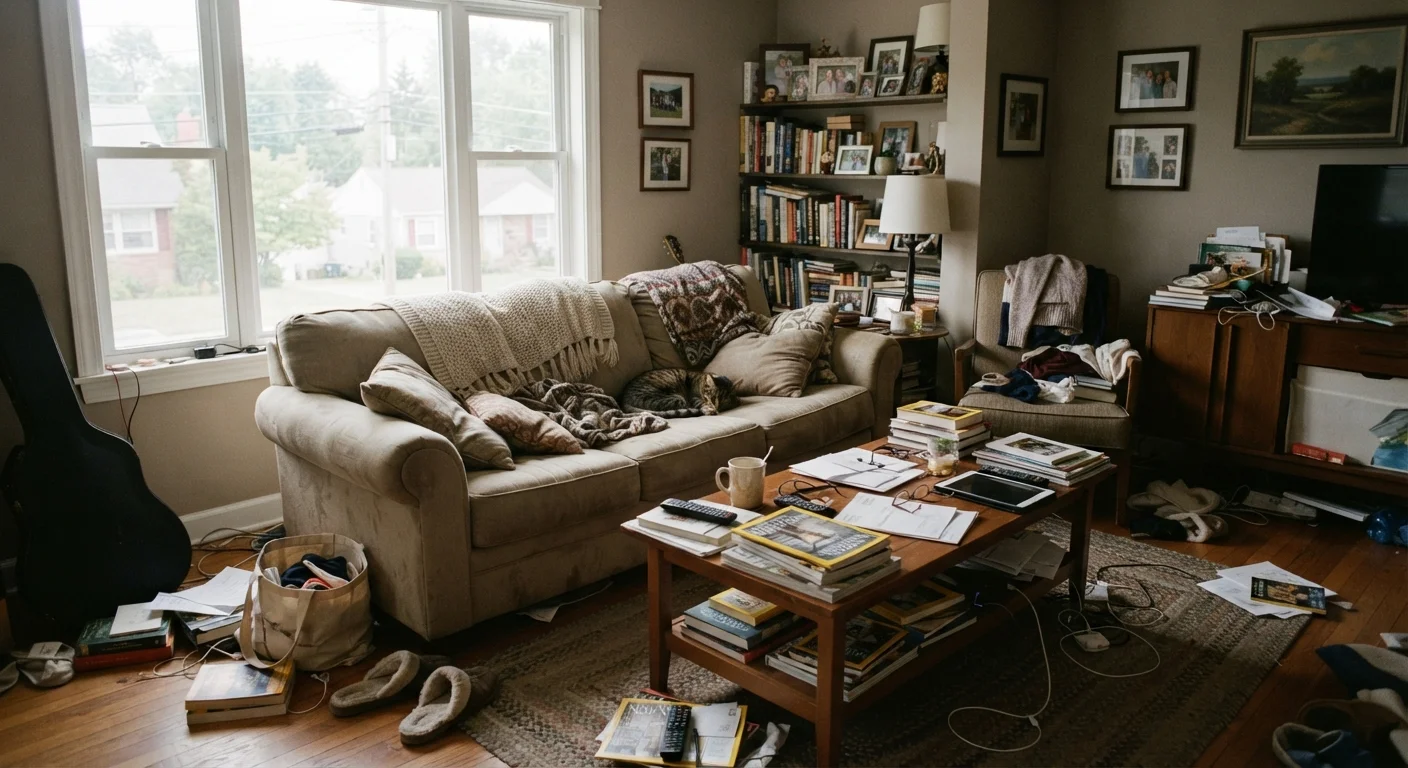
Every object in a cluttered space represents a deferred decision. A piece of mail left on the counter, a shopping bag dropped by the door, a jacket draped over a chair: none of these feel like choices in the moment, but each one is. The decision to deal with an item later is still a decision, and it deposits the object somewhere it was never meant to stay.
This process compounds quickly. Once a surface holds a few items, adding more to it requires less mental resistance than finding a proper place. Behavioral researchers call this 'broken windows' in everyday environments: disorder invites more disorder because the cost of adding to an already-messy area feels low.
The pattern is worth understanding because willpower alone rarely fixes it. A person who clears a surface through sheer effort but hasn't changed the underlying flow of objects through their home will typically see it refill within weeks. Organizing before decluttering can make this cycle worse by creating storage for things that shouldn't be kept at all.
Make the path of least resistance the tidy one
Place a basket or tray near the door for items that need a temporary home when you walk in. A designated landing zone doesn't eliminate decisions, but it concentrates them in one spot rather than scattering them across every surface. Emptying one container once a day is simpler than scanning an entire room.
Why letting go feels harder than it should
Loss aversion is one of the most replicated findings in behavioral psychology. People tend to feel losses more acutely than equivalent gains. Applied to household objects, this means discarding something triggers a sense of loss that feels larger than the practical benefit of having it gone.
Two specific patterns make this worse. The first is the endowment effect: once you own something, you value it more than you would if you were deciding whether to acquire it. The second is sunk cost thinking, where the money or effort spent acquiring an object makes it feel wasteful to release, even if the object hasn't been touched in years.
Sentimental items add another layer. Objects connected to people, places, or periods of life carry emotional weight that has nothing to do with the object itself. Discarding them can feel like discarding the memory, even though the memory doesn't live in the thing.
25%
US homeowners who can't use their garage for a car
According to the US Department of Energy, roughly one quarter of homeowners with a two-car garage have so much stored there that they cannot park in it.
~$18B
Annual US self-storage industry revenue
The Self Storage Association has reported the US self-storage industry generates roughly $18 billion per year, reflecting how much households pay to house possessions that don't fit in their homes.
How the home environment feeds back into the problem
A 2010 study in Personality and Social Psychology Bulletin found that women who described their homes using clutter-related language had higher cortisol levels throughout the day than those who described their homes as restful. The direction of that relationship matters: a cluttered environment doesn't just reflect stress, it appears to sustain it.
Higher background stress reduces executive function, the set of mental capacities involved in planning, decision-making, and task initiation. This creates a feedback loop. Clutter raises stress, stress reduces the capacity to make the decisions that would reduce clutter, and the clutter remains or grows.
Visual complexity also competes for attention. A desk covered in unrelated objects requires the brain to filter out irrelevant information continuously, which takes effort. That effort isn't dramatic, but it accumulates across a day spent in a cluttered space.
Understanding this loop helps explain why tackling clutter often feels harder on the days it matters most. It's not a motivation failure; it's a physiological effect of the environment itself.
What actually interrupts the cycle
Changing the physical structure of how a home handles incoming objects does more durable work than repeated cleanups. Household zones assign a purpose to each area, which reduces the number of micro-decisions needed each day. When there is a designated place for mail, for bags, for items waiting to leave the house, those objects stop accumulating on surfaces because the path for each one is already decided.
Reducing the volume of what enters the home addresses the source. Objects that arrive without a clear purpose or destination are the most likely candidates for clutter. The same psychology that makes discarding difficult also makes acquiring feel low-cost in the moment, which is why the two problems tend to appear together.
For people who find decision fatigue a consistent obstacle, working in short time blocks on one defined area tends to be more effective than attempting a full sweep. The room-by-room method applies this principle at a practical scale, and long-term maintenance habits keep the structure from eroding once it's in place.