

Key Takeaways
- Match bag size to trip length before deciding what to pack, not after.
- A written packing list reduces both overpacking and forgotten items.
- Clothing takes the most space; planning outfits in advance cuts volume significantly.
- Documents and medications belong in your carry-on, never in checked luggage.
- A quick physical checklist the night before departure catches last-minute gaps.
Start here
Choosing the right bag for your trip
Next
Building a packing list that works
Then
Clothing: how much is actually enough
After that
Organizing your bag before you zip
Final step
Documents and non-clothing essentials
Choosing the right bag for your trip
The bag you choose shapes every packing decision that follows. A bag that is too large invites overpacking; one that is too small forces hard cuts at the worst moment.
For trips of one to four days, a 20- to 30-liter backpack or a compact carry-on fits most needs. For five to seven days, a 40-liter bag or a standard carry-on (typically 22 x 14 x 9 inches to meet most U.S. airline limits) is a practical range. Trips longer than a week often call for a checked bag, though plenty of travelers manage two weeks in a carry-on with deliberate clothing choices.
Before buying or borrowing a bag, check your airline's size and weight limits. These vary by carrier and by fare class. Our guide to carry-on vs. checked bags covers the trade-offs in detail if you are still deciding which route to take.
Building a packing list that works
Write your packing list at least three days before departure. A written list does two things: it stops you from packing by impulse, and it gives you a checklist to run through the night before you leave.
Organize the list by category: clothing, toiletries, documents, tech, and any trip-specific items like hiking gear or medication. Work through each category by asking what you actually need each day, not what you might theoretically want. Our pre-trip packing checklist is a good starting template to adapt to your specific trip.
Start with last trip's leftovers
If you have traveled before, check what came home unused from your last trip. Items that stayed in your bag unworn or unopened are strong candidates to leave behind this time. This habit shortens your list faster than starting from scratch every time.
Clothing: how much is actually enough
Clothing fills more bag space than anything else, and most first-time travelers pack too much of it. A practical starting point: plan specific outfits for each day rather than packing individual pieces and hoping they combine.
For a five-day trip, five bottoms and five tops is almost always more than needed. Three to four bottoms and five to six tops, chosen to mix and match, cover the same ground in less space. The capsule wardrobe approach formalizes this method if you want a structured system.
Factor in the weather at your destination, access to laundry, and whether the trip has a formal occasion. Pack for the actual itinerary, not a hypothetical one.
Organizing your bag before you zip
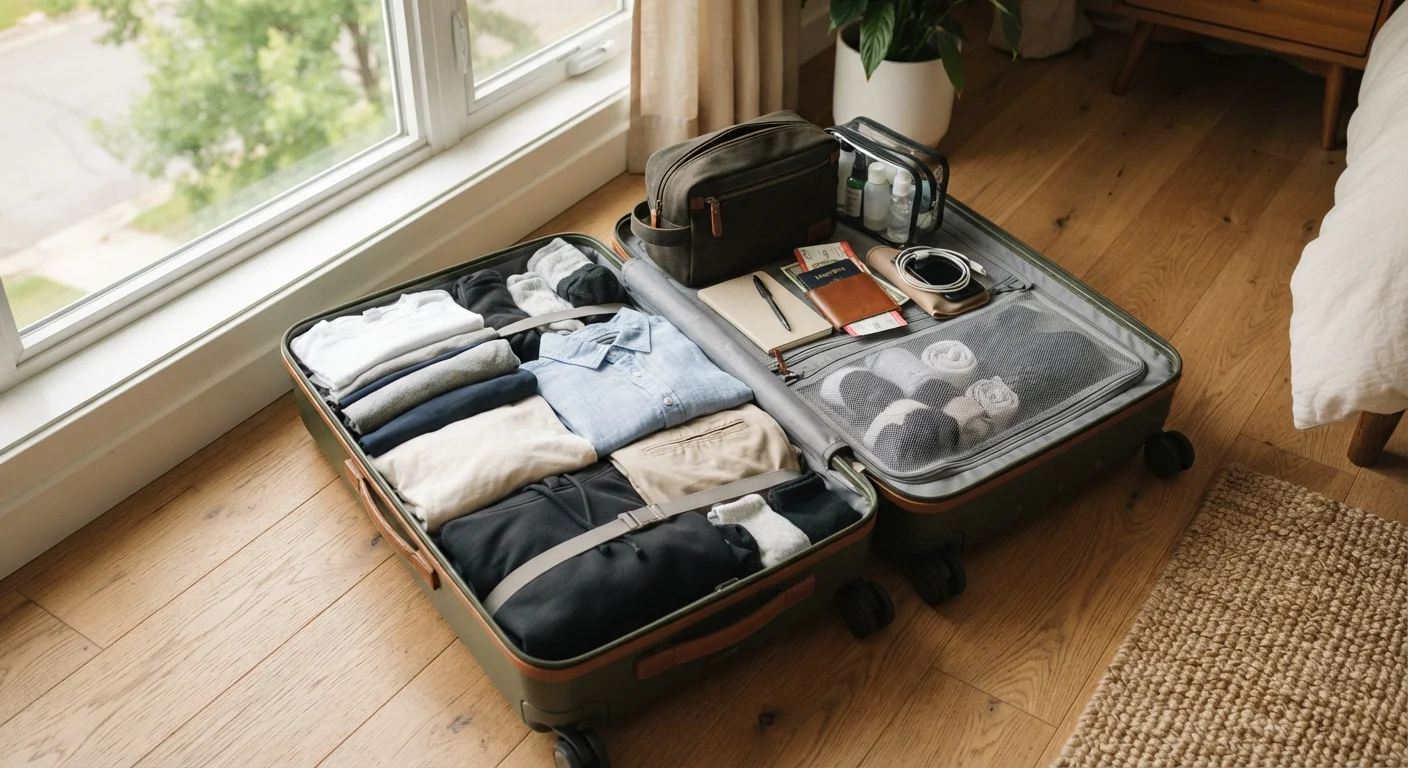
How you arrange items inside your bag affects both space and how easy it is to find things at security or in a hotel room. Heavier items go closest to your back (in a backpack) or at the bottom of a rolling bag, near the wheels. Lighter items fill gaps.
Packing cubes separate categories so you can pull out your toiletry cube without disturbing your clothing. Rolled clothes compress better in tight spaces than flat-folded stacks. For a thorough comparison of organization methods, see packing cubes, compression bags, and roll vs. fold.
Once everything is in, lift the bag. If you cannot carry it comfortably for five minutes, remove items until you can.
Documents and non-clothing essentials
Documents and medications belong in your carry-on bag at all times, not in checked luggage. If a checked bag is delayed or lost, you need these items immediately.
At minimum, carry your passport or ID, any required visas, boarding passes, travel insurance information, and a copy of your accommodation details. For medications, bring enough for the full trip plus a few extra days in their original labeled containers. Always verify entry requirements, visa rules, and any health documentation directly with official government sources and your airline before you travel, as these change without notice.
Keep a phone charger, one day of clothing, and any valuables in your carry-on as well. The complete packing and preparation guide expands on pre-departure logistics if you want a broader framework for your trip.